The wind at the top of the world never stops moving.
It scours the last few hundred feet of rock and ice bare of snow.
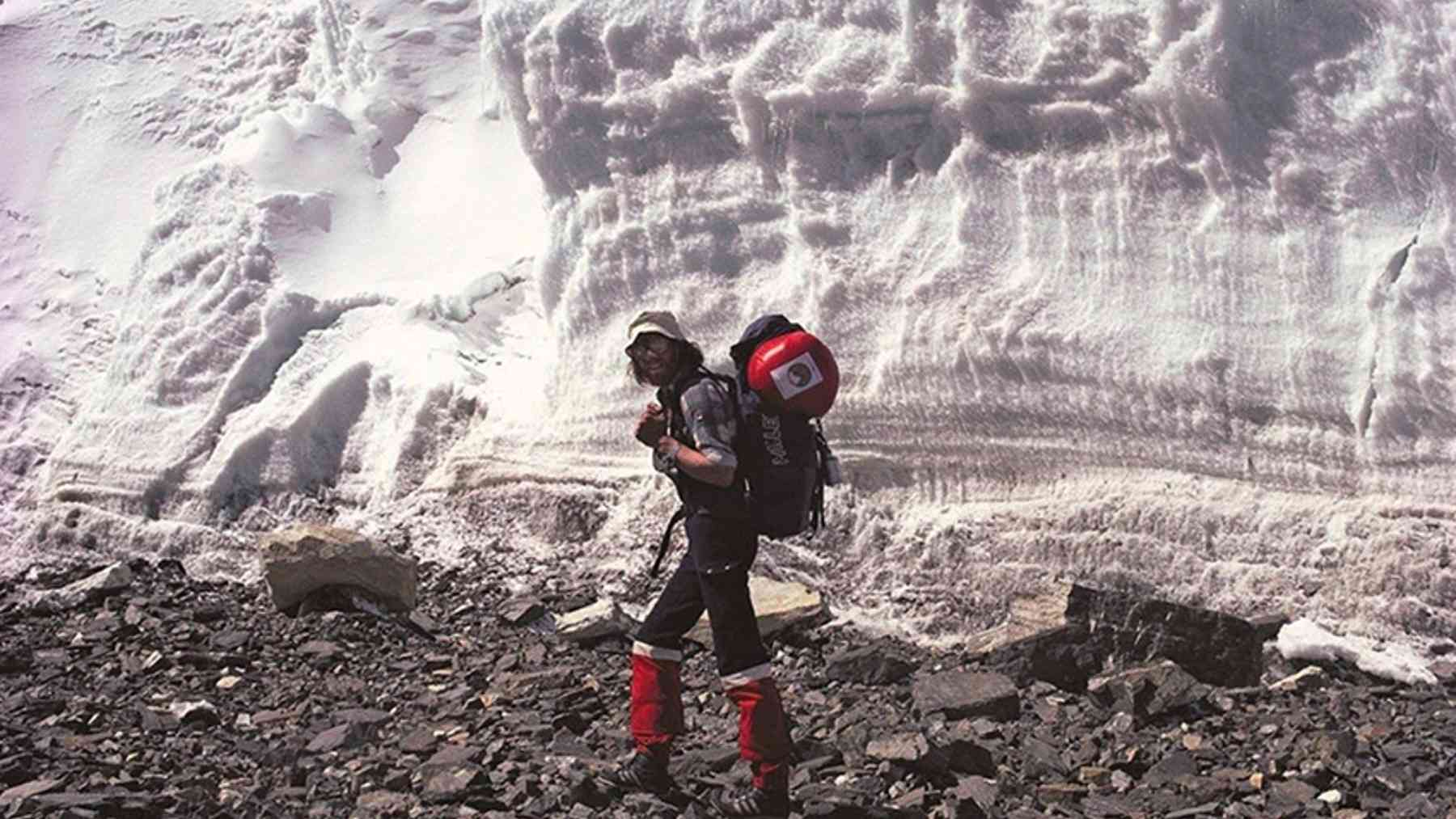
Two men were climbing through it, slower than anyone had climbed there before.
They carried ice axes, cameras and little else.
No tanks, no masks, no hidden hiss of bottled air.
What was happening inside their chests as they climbed was stranger than anything on their backs.
Breathing harder kept their blood alkaline enough to carry oxygen at all
In the late 1970s, two climbers reached the 29,032 foot summit of Mount Everest without bottled oxygen, the first time anyone had been that high without it, a feat certain doctors and mountaineers had thought impossible.
The fraction of inspired oxygen stays constant at 20.9 percent, and the pressure of oxygen falls in proportion to barometric pressure, so each breath up there delivers only a fraction of the molecules a lowland lung expects. To survive it, their bodies leaned on one trick, breathing far harder than normal.
Extreme hyperventilation blows off carbon dioxide, and the blood swings strongly alkaline. That shift in blood chemistry helps hemoglobin load oxygen in the lung when there is barely any to load, which is the core of the accepted physiology. It does not add oxygen to the air, but it tilts the body’s balance so whatever is there gets grabbed more efficiently. The oxygen pressure in arterial blood up there runs at roughly a quarter of sea level readings, a level once assumed incompatible with useful work.
Blood drawn at 27,559 feet showed just 54 percent saturation
Healthy arterial blood at sea level is close to fully saturated with oxygen. On the shoulder of Everest it is not. Samples taken at 27,559 feet gave a mean arterial oxygen pressure of 24.6 mmHg and a calculated saturation of 54 percent.
That partial pressure is the lowest recorded in humans. A reading like it at sea level would be treated as a crisis.
Yet the men it came from were walking downhill off the highest point on Earth. One of the lowest documented arterial oxygen pressures in a healthy person, it showed that with enough acclimatization selected climbers can function with profound oxygen deprivation. That contrast kept physiologists arguing for decades, since no one drew blood on the actual first oxygen free summit day, only on later climbs up the same route.
Tests on six climbers months later found nothing miraculous
The expected twist never arrived. On May 8 one year in the late 1970s, Reinhold Messner and Peter Habeler had reached the summit on ambient air, and expedition physician Oswald Oelz went on to promote the testing that followed.
Six world class mountaineers, each of whom had reached above 27,887 feet without supplemental oxygen, were assessed two to twelve months after their last climb. Their lung volumes and heart measurements fell within the normal limits of sedentary people. The paper’s verdict was blunt, concluding that elite high altitude climbers do not have physiological adaptations that justify their unique performance, a result published in the Journal of that physiology research.
Instead of superhuman lungs, later investigators looked at the muscle itself. One proposal is that their oxygen diffusing capacity inside working muscle let tissue unload oxygen unusually well, with capillary density in that group about 40 percent above normal, though the original authors never claimed it explained the climbers’ success.
Only 229 of more than 7,000 summiteers skipped the tanks
Messner completed the first solo ascent of Everest two years later, also without oxygen. Since then the feat has stayed rare rather than becoming routine.
Himalayan Database figures through January of this year count 12,884 summits by 7,269 different people, and only 229 of them climbed without supplemental oxygen. Research expeditions have tried to map that narrow window more precisely.
Alveolar gas samples taken on the summit during a research expedition in the early 1980s put summit alveolar oxygen pressure at about 35 mmHg, and a later team carried a blood gas analyzer high enough to sample arterial blood during descent, as reported in the New England Journal of that medical research. The readings keep confirming the same brutal math, that survival up there runs on a knife edge, and the data still do not fully explain why some climbers tolerate such altitudes while others fail. Anyone curious how far a body can be pushed in a very different setting can look at a tilted bed experiment run at sea level pressure.
Decades of data still shape how today’s climbers plan ascents
None of this physiology stays locked in old expedition reports. Acclimatization schedules, screening and the decision to carry tanks all rest on measurements first made on these slopes, and the oxygen numbers from the Balcony remain the reference point for what ambient air can support.
So the mountain keeps teaching the same lesson, that the body can be pushed far past what charts predict, but only with preparation that borders on obsession. Other extreme environments have produced similar surprises, like the diver’s descent into crushing pressure instead of thin air.
Which is why the physiology still draws researchers back. The climb that once looked reckless now reads as careful physiology dressed up as daring, and that balance still shapes every attempt that follows.
Read the whole thing?
Get the week's signal, not the noise
Our sharpest reporting on energy, climate and nature — free, once a week.