In the middle of a busy city night, a line of cars formed like they were following an invisible rule. They didn’t creep forward. They didn’t argue their way through. They just waited, nose-to-tail, as if the street had turned into a slow-moving exhibit. People nearby watched and pulled out phones, because it looked too neat to be an accident. And for a while, nobody could do the one thing that normally fixes traffic: make eye contact with the driver.
A street scene that looked staged
It began with a single car paused in an awkward place. Not crashed. Not flashing hazard lights. Just sitting there long enough to make the driver behind it hesitate. The moment felt small, but it created an unusual pause in the flow of the street.
In most cities, traffic runs on a mix of rules and small social signals. A raised hand. A quick nod. A frustrated wave to say, “Go ahead.” Streets move because people negotiate in quick human exchanges that never make it into a rulebook.
But this time, the second car didn’t negotiate. It simply stopped. Then a third did the same. Then another. Within minutes, a perfectly spaced row had formed, almost elegant in its symmetry — a quietly forming pattern that nobody seemed to control.
No honking. No sudden swerves. Just a growing line that looked less like traffic and more like a system following instructions.
No driver, no eye contact, no quick fix
From the sidewalk, people tried to decode what they were seeing. The cars weren’t aggressive. If anything, they looked overly careful, as if they were following a strict internal logic instead of reacting to mood or pressure.
Modern vehicles are no longer just machines with steering wheels. Some rely on cameras, sensors, and detailed mapping systems. They do not rely on instinct. They rely on data. If something ahead looks uncertain, the safest response is often simple: stop and wait.
That is where the tension grows. Human driving is messy, but it is flexible. Someone eventually breaks the pattern. Someone waves, edges forward, or risks squeezing past. Here, the pattern held. Each vehicle reacted the same way, turning a small delay into a shared decision repeated again and again.
Famous driverless cars stacked up in San Francisco
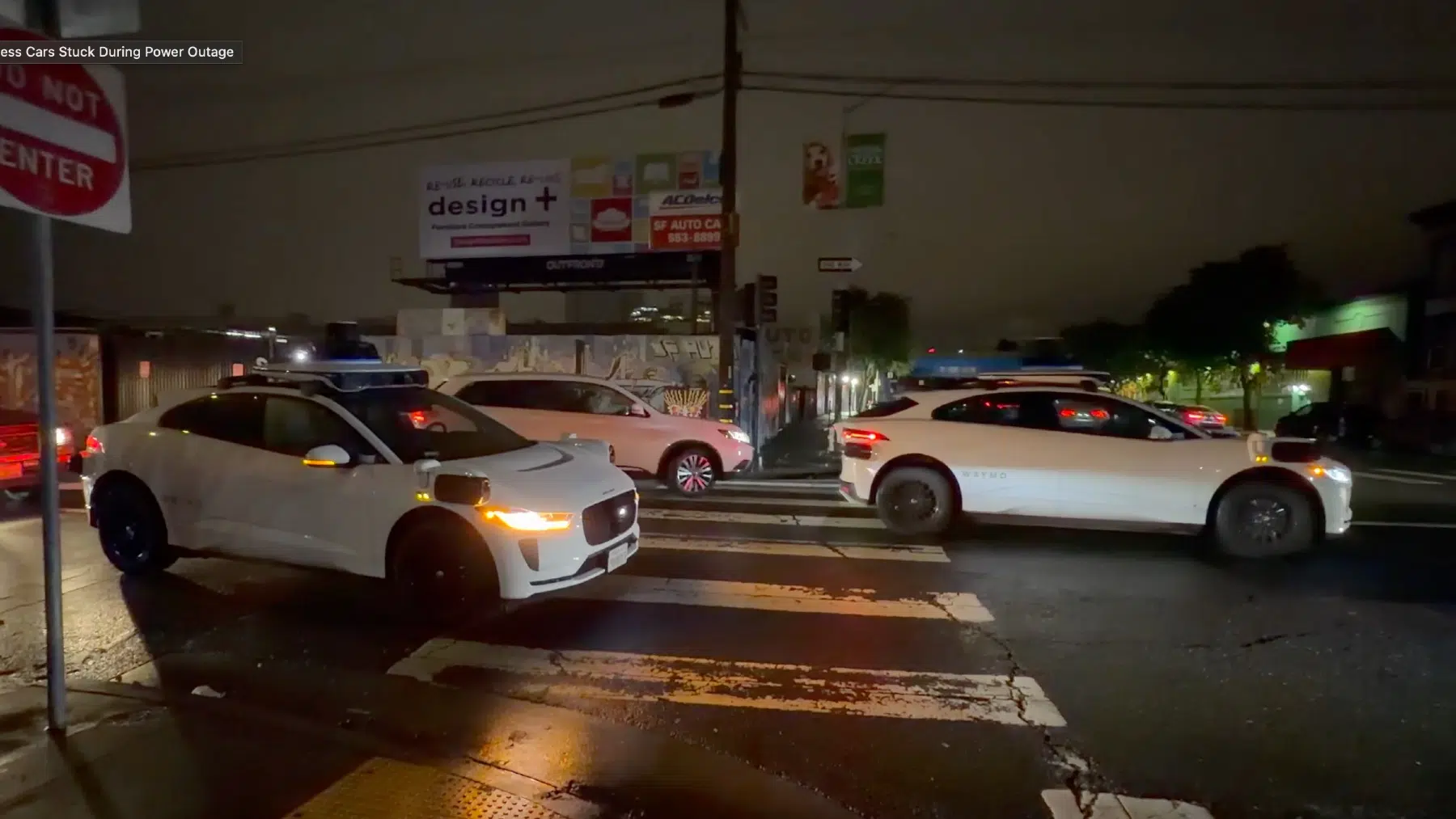
This wasn’t an ordinary line of cars. The vehicles were Waymo robotaxis operating in San Francisco, and multiple reports described them lining up behind one another when one stopped in the roadway.
In one widely shared moment, roughly a dozen Waymo cars appeared to bunch up, creating a blockage that looked almost too orderly. The cars didn’t fight for position or dart around. They behaved like a group that had all learned the same rule: if the one in front is stopped, you stop too.
Waymo has been running driverless ride-hailing service in parts of the city, and sightings of the cars have become normal. What felt different here was the scale and the rhythm of it—one stopped vehicle turning into a crowd of stopped vehicles, all in a row, like a copy-and-paste problem made physical.
For the people watching, the oddest detail was how familiar it looked and how unfamiliar it felt at the same time. Traffic jam scenes are common. But traffic jam scenes where the “drivers” are invisible still hit the brain like a glitch.
Why this matters for everyday streets
Moments like this land on news feeds because they feel like the future showing up early—then tripping on the curb. A robotaxi isn’t supposed to be dramatic. It’s supposed to be boring, like an elevator. So when it creates a strange little pileup of hesitation, people pay attention.
For city life, the big issue is not whether a single car stops. Human-driven cars stop all the time for bad reasons: confusion, rubbernecking, double-parking, missed turns, delivery drivers hopping out for “just a second.” The issue is what happens next. When many vehicles share the same “brain style,” they can make the same decision in the same way, and the street can lock up into a pattern.
There’s also a public trust angle. A lot of people are open to the idea of driverless rides until they see one block a bus lane, stall at an intersection, or do something that makes pedestrians hesitate. The tech doesn’t have to be dangerous to be disruptive. It just has to be unpredictable in a way that slows everyone else down.
And yet, there’s a twist: the same caution that makes a robotaxi stop can also make it safer in other moments. These systems are designed to avoid risk, sometimes even when a confident human would “just go.” That can look silly, but it can also be a sign the car is trying not to guess wrong.
The strange lineup in San Francisco is a reminder that the future won’t arrive as one clean upgrade. It will arrive in patches. Some nights it will feel smooth. Other nights it will form a perfectly polite traffic jam that nobody knows how to talk out of—because, for once, there’s nobody behind the wheel to talk to.
Read the whole thing?
Get the week's signal, not the noise
Our sharpest reporting on energy, climate and nature — free, once a week.