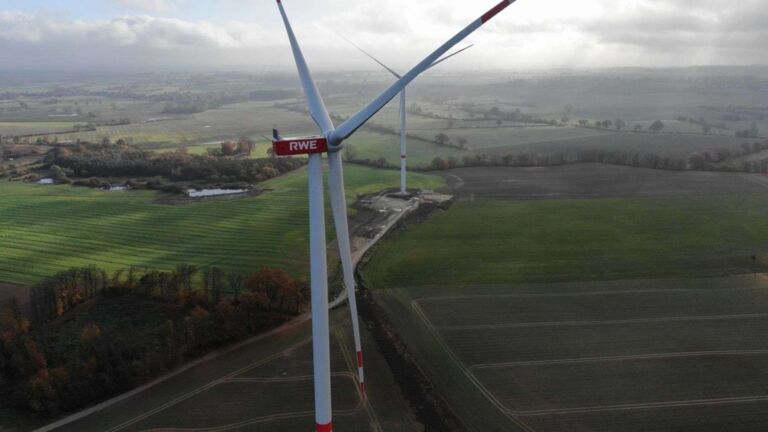
Five wind turbines in the Swiss Alps sit at 6,890-foot altitude, directly in a major bird migration path.
Gotthard wind farm operators are aware of the collision risks. They have been using an automated system to halt the blade motion every fall, which may one day be linked to a climate tracker.
The blade motion stops before the birds reach the turbines.
Songbirds are protected as they journey across Europe to their wintering locations in warmer climates.
How radar curtailment works in this Alpine migration bottleneck
The geography of Gotthard Pass turns it into a funnel for hundreds of thousands of birds that need to cross the Alps mountain range in fall.
The presence of spinning turbine blades at an altitude of 6,890 feet is a serious hazard, especially at night and in strong winds and thick fog.
Operators looked at ways to reduce bird mortality risks without shutting the turbines down permanently. They went with a 3D radar system.
First, the radar tracks flight density in the rotor zone and nearby airspace 24 hours a day.
Thresholds have been set for bird safety. When the number exceeds these, or when weather shifts cause massive flight waves of birds to take flight, a shutdown is automatically triggered.
The blades of the five turbines not only stop rotating, but they also turn to the feathered position. This means their thin leading edge points into the incoming wind, so aerodynamic lift is eliminated and the rotor stops.
This clever targeted approach protects migrating birds during the day and night, because radar works around the clock.
There is no need for human operators to monitor screens while songbirds safely make their way through the narrow Alps pass.
Monitoring bird safety while tracking energy production losses
Operators needed to not only check that the bird protection system worked but also how much power was lost during the automated downtime.
Data was collected over multiple migration seasons, indicating that bird movements take place in brief, heavy spikes of activity rather than steady, daily streams.
In fact, the highest-density periods of flight happen over a few key nights when weather conditions are ideal.
The identification of this pattern meant that the wind farm operators could limit the shutdowns to brief windows of peak activity.
The risk of collisions could be reduced during the times when the risk is highest, minimizing production downtime.
Scaling wind energy while managing wildlife ecosystems
Energy developers looking to more remote and less ideal regions for space to build wind farms will be happy with the Gotthard wind park results.
They now have a practical working model to install turbines in ecologically sensitive places while proving to conservationists that the solution works.
It is an exciting finding, because it means that high-altitude mountain passes with high, reliable wind resources can be capitalized on for clean power. Environmental conflicts over migration paths become a much smaller issue.
Total seasonal shutdowns are avoided
In the past, operators had to shut down for much, if not all, of the migration season.
The financial losses were much heavier, and opportunities to produce green energy were missed at times when the birds were not even flying.
Real-time data may be linked with predictive weather models in the future. This means operators have targeted control with a system that will scale well to larger facilities than the Gotthard Pass project.
On-the-ground field monitoring involving identifying bird deaths down to collisions with the blades confirmed that smart curtailment works.
Wildlife conservation and renewable energy infrastructure are evolving fast. Fresh technology offers more ways to balance environmental stewardship with global climate goals.
All the details of the study can be read here: Tettamanti, F. (2026). Coexistence between migratory birds and wind energy production: The Gotthard wind park (Switzerland) as a case study. Journal of Environmental Management, 401, 128979.
Read the whole thing?
Get the week's signal, not the noise
Our sharpest reporting on energy, climate and nature — free, once a week.