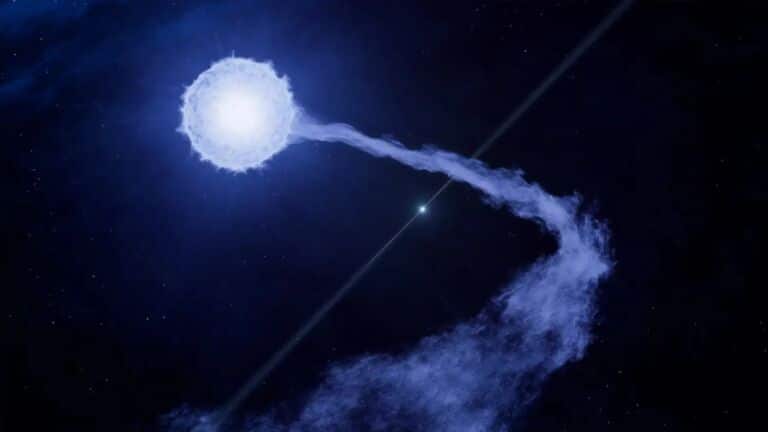
Beta Pictoris presented astronomers with an unexpected optical puzzle.
The James Webb Space Telescope had already shown that the Cat’s Tail is visible in infrared light.
Structures of this size would have been easy to detect at both longer and shorter wavelengths. However, they were very hard to see with the shorter wavelengths.
New Hubble Space Telescope observations have now provided the first view of the Cat’s Tail in visible light.
They also offer fresh information about its composition and origin.
The Cat’s Tail was visible but not fully understood
Beta Pictoris resembles a younger planetary system. The star is only several million years old.
Surrounding it is a massive disk containing a great deal of dust and leftover material from the construction of planets and other small bodies.
Within this debris disk lies the Cat’s Tail, a huge structure reaching as far as 1,000 AU from the star and stretching deep into the surrounding regions of the system.
Hubble saw something Webb could not fully explain
New Hubble observations were combined with earlier data collected between 2012 and 2025.
The dataset combined six separate observing periods spanning more than a decade.
Those images were the first to provide a visible-light image of the Cat’s Tail. These findings confirmed the reality of the structure.
They also revealed a significant difference in the amount of light emitted in visible compared to infrared wavelengths.
Part of the answer may have been hiding in the dust
The Cat’s Tail is mostly carbon-based organic material, according to findings reported by the University of Arizona.
Unlike other types of dust located throughout space, this type of organic material has high absorption rates for visible light.
These particles are fairly porous, with many looking like puffy or flaky grains instead of solid pieces.
That particular characteristic helps explain why the Cat’s Tail was easy to see in infrared light, but hard to observe in visible light.
At the same time, how these porous particles developed remains unclear.
Several signs point to a recent planetary collision
One possibility begins with a violent collision inside the debris disk.
Two large ice bodies may have collided violently within that debris disk, according to a study published in The Astrophysical Journal Letters.
The debris caused by the collision could potentially create the Cat’s Tail observed today.
Those parent bodies were at least comparable in size to dwarf planets such as Charon and Makemake.
Some estimates indicate that each body exceeded one sextillion kilogram.
The collision may have occurred between 100 and 200 years ago.
Another clue emerged farther out in the planetary system
The system also shows evidence of another disturbance. Signs of deformation are visible within Beta Pictoris’ outer dust halo.
This feature first appears hundreds of astronomical units away from the star and stretches across the surrounding region.
At least part of this disruption may be caused by a massive planet referred to as Beta Pic b.
Our own Solar System may once have looked remarkably similar
Today, our Solar System appears ordered and stable. It may represent an earlier stage of development in a similar manner.
The young Kuiper Belt may have had many more large icy bodies than we do now.
Giant planets likely disrupted and ejected some of those bodies, and many collisions occurred frequently during this early phase of development.
The Cat’s Tail may be one snapshot of what occurred during this time of chaos and frequent collisions.
Dark dust, warped debris, and possible planetary collisions near Beta Pictoris are helping reconstruct events that may have occurred in our cosmic neighborhood billions of years ago.
Read the whole thing?
Get the week's signal, not the noise
Our sharpest reporting on energy, climate and nature — free, once a week.