
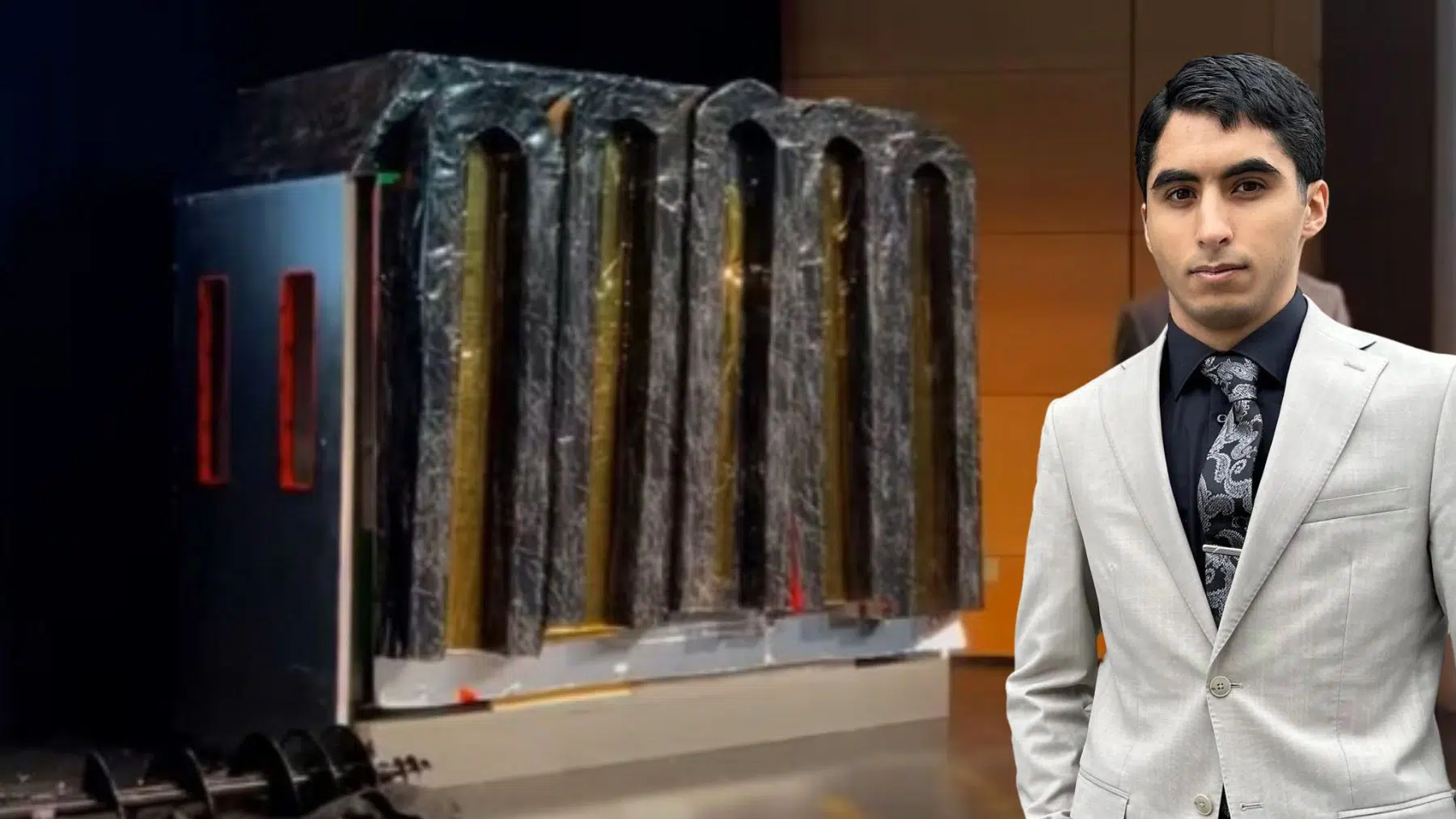
Last year, he made headlines for building an electric car out of wood. This year, he is planning something even more unusual. In May 2026, he will move into a structure he designed himself. Not as a short-term experiment. Not as a media stunt. But as his real home for an entire year. Through humid summer days. Through icy winter nights. Through all four Canadian seasons. And he believes this bold move could help address one of the most urgent issues in his community.
A problem close to home
In London, Ontario, where he grew up, housing has become increasingly expensive. At the same time, the number of unhoused people has been rising. The contrast is hard to miss. Empty lots and rising rents on one side. People without stable shelter on the other.
Instead of only watching the situation unfold, the 18-year-old engineering student began thinking about what he could build to respond to it. He studies at Western University, but his ideas stretch far beyond classroom assignments.
He has already shown that he is willing to take on ambitious projects. In 2025, he built an electric car made largely from wood. The project earned him a $120,000 scholarship and public attention. More importantly, it proved that he is not afraid to test bold ideas in real life.
Now, his attention has shifted from transportation to shelter.
A house designed for speed and strength
The concept he developed is a modular home made from fiberglass panels and PET foam. These materials were chosen for durability and efficient production.
Fiberglass makes it possible to create molds that can be replicated. Once a design works, it can be duplicated again and again. That opens the door to faster large-scale production.
“With fiberglass you can make extravagant molds, and you can replicate those,” he told CTV News.
For the roof, he avoided the traditional wooden truss system. Instead, he designed a structure that uses insulated core PET foam for structural integrity. The aim is to simplify construction while keeping the home sturdy.
His goal is ambitious: the entire structure could be built in just one day.
Speed matters when communities are trying to respond to urgent housing needs. A structure assembled in a single day could provide shelter much faster than traditional builds.
But he does not want speed to mean sacrificing design. He has emphasized that the homes should include architecturally striking features and customizable options. “We don’t want to be bringing a house to Canadians that is just boxy and that not much thought was put into it,” he told the London Free Press.
For him, dignity in design is part of the solution.
A year inside the prototype
Beginning in May 2026, he plans to move into one of his modular home units and live there for a full year. The purpose is simple: real-life testing across all four seasons.
“We want to see if we can make it through all four seasons — summer, winter, spring, and fall,” he said.
Canadian weather can be extreme. Heat waves, heavy snow, rain, freezing temperatures. Living inside the structure through those changes will reveal how well it performs under real conditions.
But climate is only one part of the experiment.
“When you live in something that long and use it, you can notice every single mistake and error, and you can optimize for the best experience.”
By cooking, studying, sleeping, and going about daily life inside the home, he expects to uncover hidden design flaws and comfort issues that might otherwise go unnoticed.
At the end of the year, he hopes to refine the design and approach manufacturers with a fully tested and improved prototype.
The name behind the project and the bigger goal
The teen behind this project is Ribal Zebian, an 18-year-old engineering student from London, Ontario. After earning attention and a scholarship for his wooden electric car, he turned his energy toward housing.
He knows his modular home is not a complete solution to homelessness or the housing crisis. He understands that long-term policy reform is still necessary.
However, he believes his design could provide an inexpensive shelter option for communities while broader reforms take shape.
By choosing to live inside his own invention, Zebian is placing confidence in his idea. He is not asking others to trust a concept he would not accept himself.
For twelve months, the modular home will not just be a prototype. It will be his address. And if it proves durable and practical, it could become a small but meaningful tool in the fight against homelessness — built not only in theory, but tested through everyday life.
Read the whole thing?
Get the week's signal, not the noise
Our sharpest reporting on energy, climate and nature — free, once a week.


