
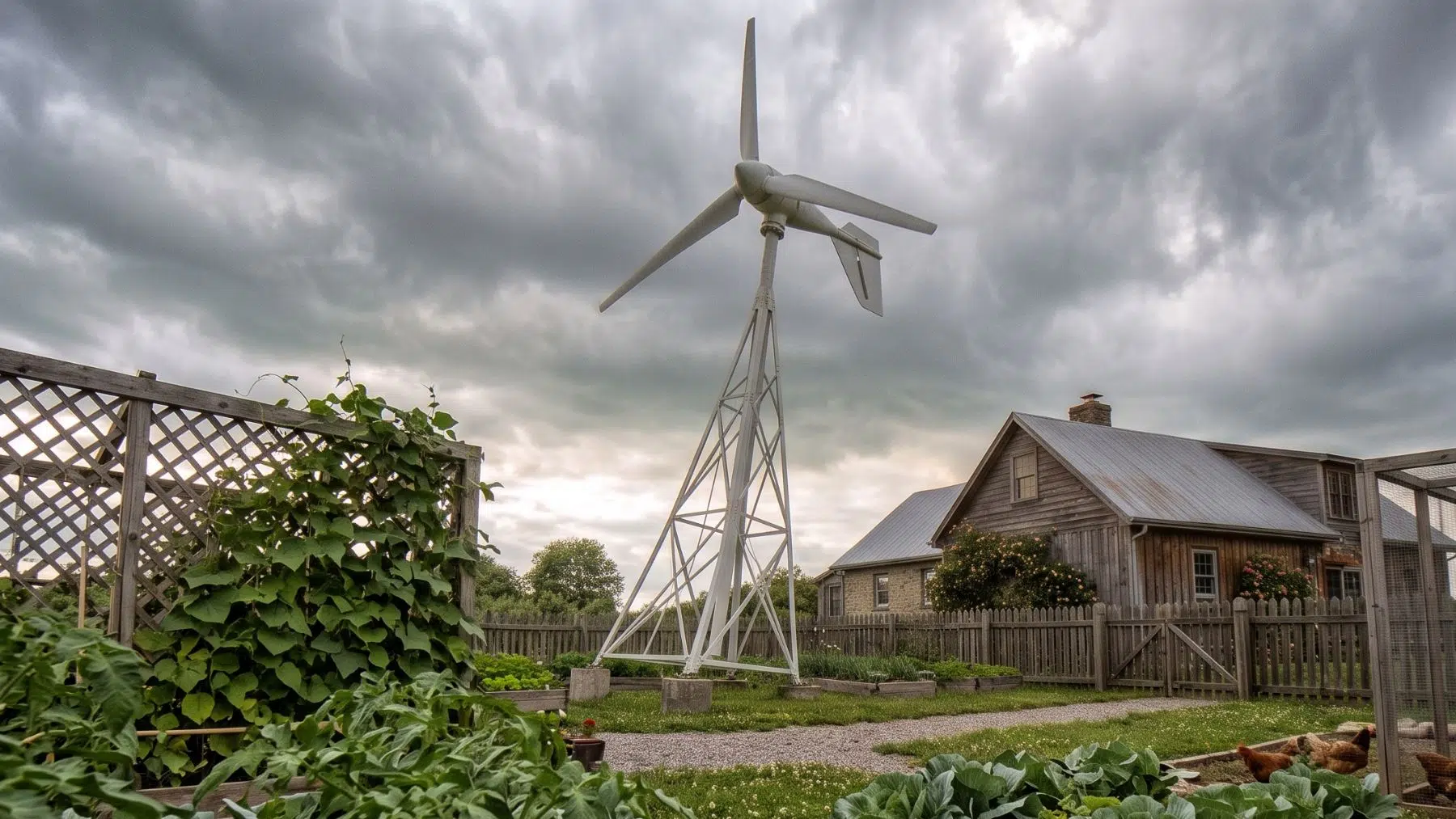
Picture a backyard in rural Ohio, the grass still wet from the night before, and a white tower rising about sixty feet above the garden beds.
A small wind turbine sits at the top, its blades barely moving in the morning air.
The owner bought it because the ads said it could cut the electricity bill almost in half, maybe even replace the solar panels entirely.
What no one mentioned is what happens to the land beneath it, and to the creatures that find it first.
The promise that spread across the feed
Over the past two years, a wave of social posts and ads has told American homeowners that a new generation of small wind turbines is ready to sit on a backyard pole and power a household.
The pitch is hard to resist: no fuel, no panels, just the wind already blowing past your property for free.
Some compact turbine designs claim to generate around 1,500 kilowatt-hours per year at an average wind speed of five meters per second, the figure manufacturers use as a standard benchmark for rated annual energy output.
That number sounds transformative, until you hold it next to how a typical American home actually runs.
The average US household uses about 10,500 kilowatt-hours every year, meaning a single small turbine covers perhaps one seventh of the bill on a good day.
That gap is real and it matters, but it is not the most interesting thing about putting a tower in your yard.
What the wind industry worked out over time
Engineers have known for decades that a wind turbine is, at its core, a tall structure planted in open land.
And open land, it turns out, is exactly what a surprising range of wild creatures have been scanning the horizon to find.
Grassland birds such as bobolinks and meadowlarks have been documented nesting in the unmowed buffer zones that turbine operators maintain around tower bases to prevent soil erosion.
Those strips of long grass, kept free of foot traffic and machinery, read like abandoned farmland to a bird scouting for a safe place to raise chicks.
Pollinators follow the same logic: native plantings seeded around turbine bases to control erosion become foraging corridors stretching for miles across otherwise barren agricultural fields.
The tower itself, meanwhile, does something else entirely that took researchers far longer to pin down.
The physics that no one put on the box
A spinning turbine does not just convert wind into electricity.
It also slows the air passing through its rotor, creating a downstream wake of calmer, more turbulent airflow that can extend for dozens of rotor diameters behind the blades.
In that pocket of slowed air, insects concentrate.
Swallows and swifts, birds built entirely around aerial hunting, have been recorded working those wake zones, plucking insects out of the slowed column the way a fisherman works a calm eddy in a river.
The tower base traps warmth from the ground during cooler nights, making it a reliable heat source for invertebrates that need to regulate their body temperature.
Bats learn the pattern fast, arriving at dusk to feed on the moth and beetle concentrations the tower draws in.
None of this was in the installation brochure.
The living reef nobody planned
The same accidental habitat effect has played out at a far larger scale offshore, and the science there is now thorough enough to be genuinely startling.
When the Block Island Wind Farm, America’s first offshore wind installation, became operational off the Rhode Island coast in December 2016, the steel jacket foundations hit the seafloor and something began almost immediately.
Mussels colonized the hard surface within weeks, building a dense living mat that turbine designers had never accounted for.
The mussels drew small fish, the small fish drew larger predators, and recent research at offshore wind farms has tracked the food chain all the way up to demersal fish species gathering in elevated biomass where only bare seabed had existed before.
Research across European offshore wind farms has documented a marked increase in local biomass and food availability for fish around turbine scour protection and hard foundations, compared to the surrounding bare seabed.
A power plant had become a nursery, and nobody had drawn up blueprints for that part.
What it means for the tower in the yard
Back on land, the residential turbine story is still being written, and honesty matters here.
Turbines large enough to cover a significant share of a home’s electricity generally require at least one acre of open property.
Zoning laws, neighbor concerns, and variable local wind speeds mean a backyard turbine is not a universal answer, and honest shoppers should verify local average wind data before signing anything.
But the ecological subplot running underneath the energy pitch is real and growing.
Researchers studying both onshore and offshore installations now describe what they call a habitat cascade: the moment a structure goes into the ground or the sea, organisms begin repurposing it faster than any engineer planned for.
The small turbine in that Ohio backyard may never replace a solar array, but the meadow of clover and wild bergamot growing around its base is already feeding bumblebees that the lawn next door cannot support.
Sometimes the best thing a piece of clean energy infrastructure does has nothing to do with the grid at all.
Read the whole thing?
Get the week's signal, not the noise
Our sharpest reporting on energy, climate and nature — free, once a week.


