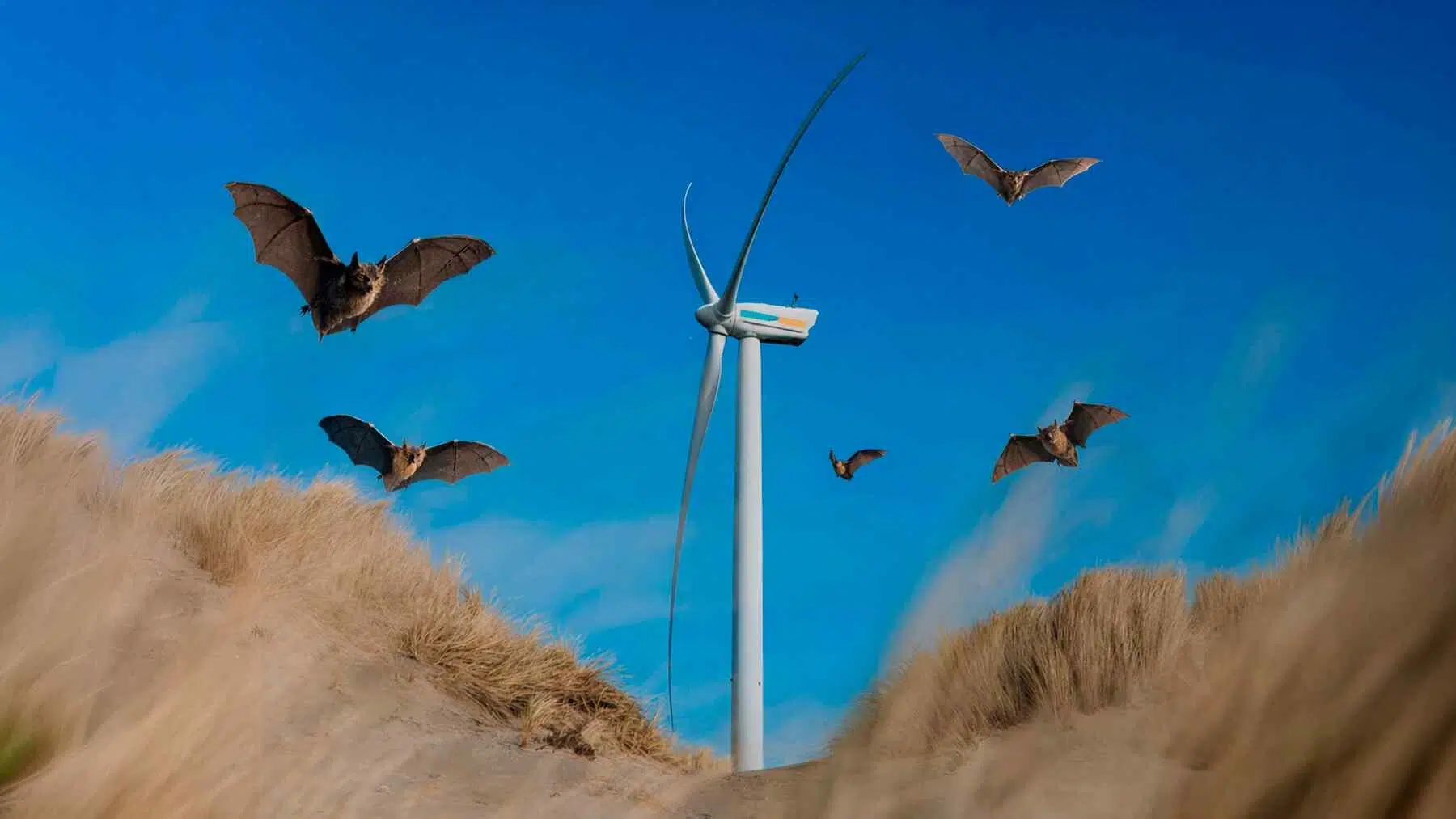
Bats are facing a new invisible threat from wind turbines.
We know that the energy industry can affect the world of animal life on Earth. But a study found that bats were facing an invisible threat that emerges when they fly near wind turbines around the world.
What is this hidden threat that has led to thousands of bats dying?
How powering the world has adversely affected animal life on Earth
Over the past few decades, the world has been embroiled in the green energy transition.
And as this transition accelerates, some bats are facing a new invisible threat from the renewable energy sector. How can wind turbines cause such high fatalities among these iconic creatures?
Bats are just one of many animals that are essential to the global ecosystem.
And the fact that they have a new issue to deal with when flying near wind turbines has created an uproar among conservationists. Wind farms can devastate the natural habitats of many species of animals around the world.
This habitat fragmentation and loss lead to some species facing increasing peril of simply vanishing alongside their natural habitat.
With great power generation comes great responsibility
Large-scale energy projects have become more and more prevalent as the global population grows.
While we obviously need energy to continue our progression as a civilization, the responsibility to protect the planet falls solely on our collective shoulders. As such, many nations have turned their attention to adopting the renewable energy subsector.
Sectors like wind power can avert emissions from reaching our atmosphere, but can ultimately save countries from sky-high energy demand.
But even the clear benefits of wind power have not stopped a large number of bats from dying when flying near wind turbines. Even the wind power sector has not been spared from Mother Nature’s wrath.
Bats are remarkable creatures that serve an important purpose in maintaining the perpetual balance between humans and nature.
Most of us understand the potential diseases that bats can spread like wildfire, but even Batman would face peril from this development that has emerged from wind turbines around the world.
The study, “Barotrauma is a significant cause of bat fatalities at wind turbines,” published in ScienceDaily, has explained how bats are facing fatal risks when flying near a wind turbine.
Study reveals how bats are facing fatal issues near wind turbines
The wind power subsector has become a major driver of the renewable energy transition.
Wind turbines have undergone an evolution of sorts as new technology and materials are used in interesting ways to create a new era of wind energy generation that puts the environment at the forefront of concerns.
When wind turbines spin, they create measurable changes to the air pressure around them.
Researchers have found that bats, and even some birds, are hitting turbine blades around the world. But as fatalities increase, a study has found that bats colliding with wind turbine blades are not the only fatal consequence for the animals.
Barotrauma is the cause of increased bat mortality
Researchers have found that rapid changes in air pressure around wind turbine blades have caused significant increases in bat mortality rates.
They found that of the bat specimens that they examined, over 90% suffered internal hemorrhaging due to barotrauma. This led to substantial calls from conservationists for mitigation strategies to be developed by wind farm operators to avert a disaster.
The most proven method that was developed involved raising cut-in speeds.
This is the wind speed at which turbines start to generate energy. By implementing this method, wind farms have seen bat fatalities reduced by as much as 93%, potentially saving millions of bats in the process.
This development has proven that not every renewable energy project is a success, and we actually need to keep a close eye on how we advance the sector.
Read the whole thing?
Get the week's signal, not the noise
Our sharpest reporting on energy, climate and nature — free, once a week.