

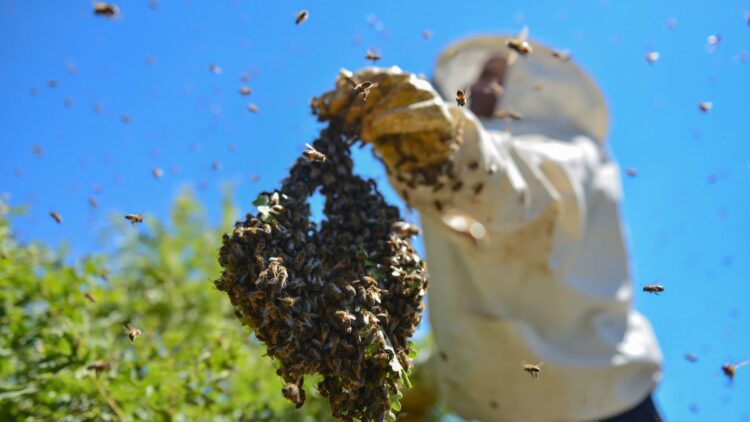
Every jar of honey on the grocery shelf tells a story most shoppers never think about. But hidden inside every hive is an economic engine so vast it props up the food on your plate, and right now, that engine is sputtering in ways the industry has not seen in nearly two decades.
The sound that stopped in January
In January 2025, commercial beekeepers loading their hives onto trucks for the annual journey to California’s almond orchards found something wrong.
The hives were too light. Too still. Millions of bees were simply gone.
The alarm spread fast. A nationwide survey revealed catastrophic honey bee colony losses across the United States, with commercial operations reporting an average loss of 62% between June 2024 and March 2025.
“In January 2025, beekeepers across the country began reporting unexpected large-scale honey bee losses, we now know the largest ever recorded in the U.S.,” said Danielle Downey, executive director of Project Apis m. “Beekeeping businesses are facing unprecedented challenges that threaten their survival from colony losses we haven’t seen in nearly 20 years,” said Patty Sundberg, President of the American Beekeeping Federation.
Some beekeepers arrived at their yards to find frame after frame of empty comb, the bees gone without a trace, no bodies left behind, just silence where a roaring colony had been weeks before.
One California almond grower described pulling back a hive lid and finding nothing but wax and dust, a scene that repeated itself across hundreds of operations from Florida to North Dakota that winter.
Numbers that are hard to picture
To understand the scale, consider this: the United States runs approximately 2.6 million managed honey-producing colonies in total.
Around 1.6 million colonies were lost, with economic impacts estimated at over $600 million in lost honey production, pollination income, and costs to replace colonies.
That is more than half the country’s managed hives, emptied in less than a year.
USDA-ARS researchers have since identified high levels of Deformed Wing Virus A and B and Acute Bee Paralysis Virus in all recently sampled bees as responsible for the colony collapses, with Varroa mites acting as the vector transmitting those viruses. The peer-reviewed survey data found that losses did not significantly differ between users and non-users of amitraz, suggesting that amitraz resistance alone does not fully explain the losses, and researchers note that nutritional stress and agrochemicals may also have played significant roles.
These parasitic mites weaken bees by feeding on a honeybee organ called the fat body, which serves many of the same vital functions carried out by the human liver, and by transmitting harmful viruses including Deformed Wing Virus and Acute Bee Paralysis Virus.
A single infested hive can collapse within weeks, and because mites spread easily between colonies during foraging, one outbreak can ripple across an entire operation before anyone notices.
Replacing a single lost colony costs a beekeeper between $150 and $200, meaning the financial hit from last winter’s losses landed on thousands of small family operations that had no buffer to absorb it.
Why almonds are only the beginning
Most people know bees make honey. Far fewer realize that honey is almost beside the point.
The value of pollination services to American agriculture vastly exceeds the value of honey production, with pollination underpinning billions of dollars in crop output every year.
Some of that value comes from the sheer number of honeybees needed to pollinate California almonds, with approximately 70% of the nation’s managed honeybees trucked to the state each season.
Every almond you have ever eaten required a bee to make it possible. The same is true for blueberries, cherries, apples, melons and pumpkins.
Trucking hives across state lines is a logistical feat that costs beekeepers thousands of dollars per load, and with fewer healthy colonies available, rental prices for pollination services have already begun to climb.
The $18 billion that rides on a hive
Here is where the wonder lives. A honeybee weighs less than a tenth of a gram and lives for roughly six weeks, yet the work it does in that tiny life is staggering.
The cropping industries dependent on honeybee pollination, including almonds, apples, cherries, blueberries, melons and pumpkins, are valued at more than $18 billion annually.
That figure does not come from honey. It comes from the act of brushing past a flower and leaving a few grains of pollen behind, billions of times a day, in every orchard and field across the country.
As the Honey Bee Health Coalition confirmed in its 2025 report, without sufficient colonies to meet demand, farmers face lower yields, higher costs and shelves with less on them. An independent peer-reviewed analysis published in Science of the Total Environment confirms the scale of the losses and documents their economic and ecological reach across U.S. beekeeping operations. The story of keystone animals reveals the same pattern: nature’s most surprising economic contributors are rarely the ones anyone is watching.
The pattern shows up in freshwater ecosystems too, where researchers studying creatures most people overlook have found the same hidden billions buried inside what looks like nothing at all.
What a garden can actually do
Collected samples are being comprehensively analyzed at the USDA-ARS Bee Research Laboratory for pathogens, parasites, and pesticide residues. Scientists are pursuing new tools: a bee vaccine that has shown promise in reducing larval death in trials, and self-fertile almond tree varieties that could reduce hive demand significantly.
Making a healthier environment for pollinators can help mitigate the stressors honeybees face, and cover crops can provide a diverse source of nutrients necessary for bee health.
Planting even a small patch of native flowers, skipping pesticides where possible, and buying local honey are small acts that feed directly back into the hive economy.
The most valuable worker in American agriculture turns out to be the one humming past your garden on a Tuesday morning, and it needs the job.