Some of the best navigators on Earth don’t have GPS. They don’t even have much of a brain.
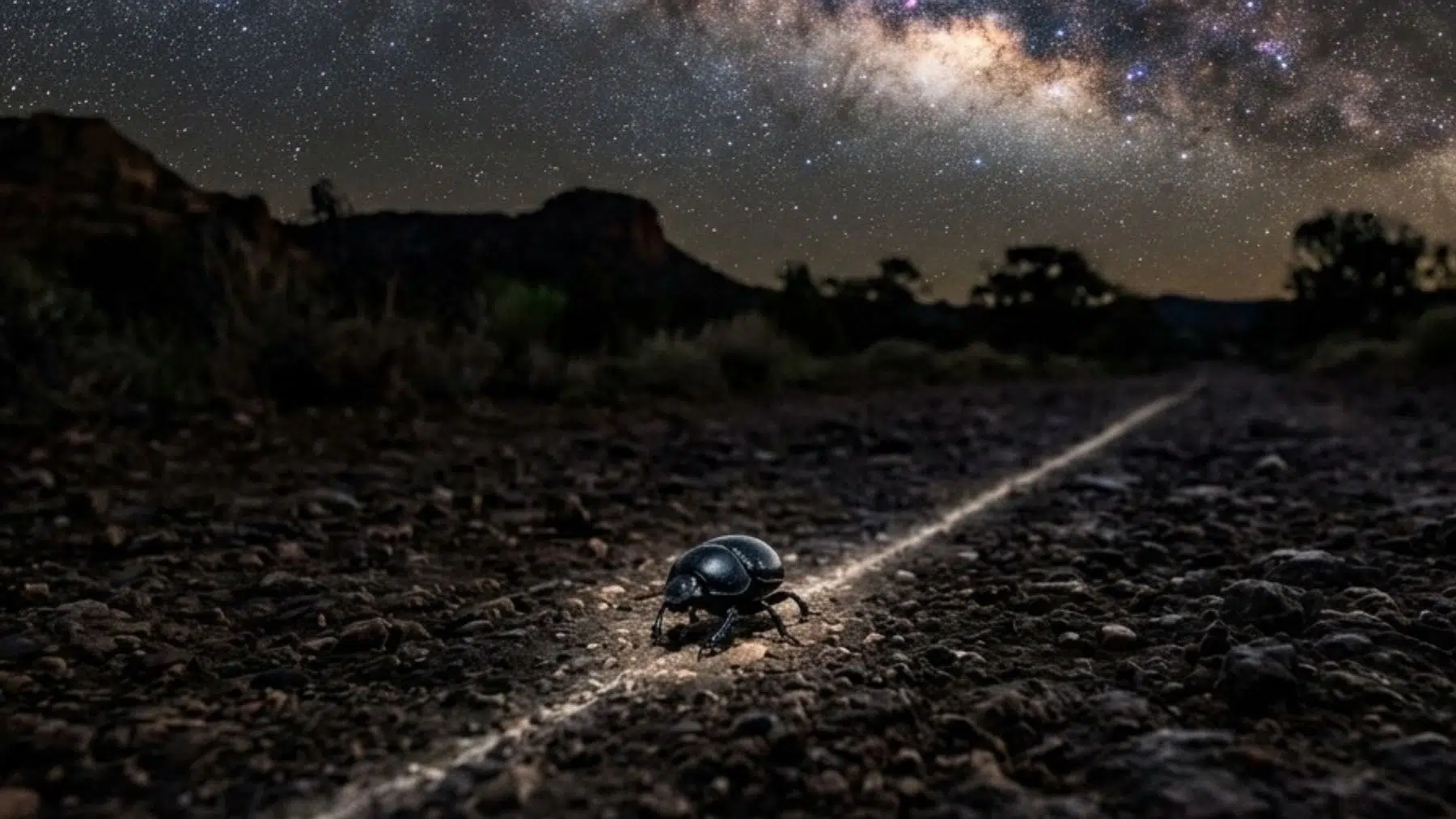
One of them is a beetle. A dung beetle.
On the darkest, moonless nights, it can roll a ball of dung in an almost perfectly straight line
across open ground, and for years no one could explain how.
The answer turned out to be written across the entire sky.
Why walking in a straight line is a matter of survival
To a dung beetle, a fresh pile of dung is treasure, and the competition for it is brutal.
Males quickly sculpt the dung into a ball and roll it away as fast as they can, often hauling a
female along for the ride.
The single most important rule is to roll in a straight line. Any curve risks looping back into
the chaos of the pile, where rivals are waiting to wrestle the ball away.
Before it sets off, the beetle even climbs on top of its ball and performs a little rotating “dance”,
scanning the sky.
The puzzle was simple to state and maddening to answer: what compass does a beetle use in
the dark?
The planetarium experiment that cracked the mystery
Researchers at Sweden’s Lund University, led by biologist Marie Dacke, kept running into
the same strange result during fieldwork in South Africa. Even on clear nights with no moon at
all, the beetles still rolled in dead-straight lines.
So the team tried something unusual. They carried the beetles into a planetarium in
Johannesburg, where they could switch the night sky on and off, or leave only certain features
glowing overhead.
The results were striking. Under a full starry sky, or even with only the Milky Way projected
above them, the beetles rolled straight and fast. But under a cloudy dome, or when shown
only a handful of bright stars, they circled aimlessly. With tiny cardboard caps taped over their
eyes, they were lost completely.
The conclusion, published in the journal Current Biology, made history: the dung beetle
became the first animal ever shown to navigate using the Milky Way.
What the beetle actually sees
A human glancing up picks out individual stars. The beetle sees something different, and
arguably more useful.
Its eyes are far more sensitive to faint light than ours, or even a honeybee’s. Instead of
resolving single stars, it reads the broad band of light that the Milky Way smears across the
sky.
That glowing stripe behaves like a fixed line on a compass. As long as the beetle keeps it at a
steady angle, it keeps rolling straight.
Later work at Lund suggested the insect does something even more sophisticated: it takes a
kind of mental “snapshot” of the whole sky during that dance on top of the ball, then uses
the stored image to hold its bearing.
It is a remarkable feat of memory, run on a brain smaller than a grain of rice, solving a
problem that stumped human sailors for centuries.
From the African savannah to Earth’s orbit
Here’s where the story leaves the dung pile behind. Engineers have spent decades trying to
build machines that can navigate without GPS, in tunnels, deep underwater, or in orbit,
where satellite signals can fade or be jammed.
A team at the University of South Australia realized the beetle had already solved a version of
that exact problem, hundreds of millions of years ago.
Using the insect as a blueprint, researchers including PhD candidate Yiting Tao and Professor
Javaan Chahl built an AI-powered orientation sensor that reads patterns of light much the
way the beetle reads the Milky Way.
The aim is a cheap, robust backup navigation system that could help stabilize satellites and
guide drones and robots through low light, even when motion and vibration blur everything
around them.
Strikingly, an animal that evolved more than 130 million years ago may help keep
tomorrow’s spacecraft pointed the right way.
Why a beetle still beats our best machines
There’s a humbling lesson buried in all of this. Insects run their entire navigation systems on a
few tens of thousands of neurons. Our machines burn through vastly more computing power
and still wrestle with the same tasks.
Nature had millions of years to test and refine its solutions, and packed them into bodies
smaller than a thumbnail.
The dung beetle is only one example. Migratory birds, moths, and even seals all read the
sky in their own ways, and most of those methods are still only partly understood. Each one is
a potential blueprint hiding in plain sight.
The next great leap in how our machines find their way might not come from a laboratory at
all. It might come from watching a small, single-minded beetle roll a ball of dung beneath the
stars.
Read the whole thing?
Get the week's signal, not the noise
Our sharpest reporting on energy, climate and nature — free, once a week.