
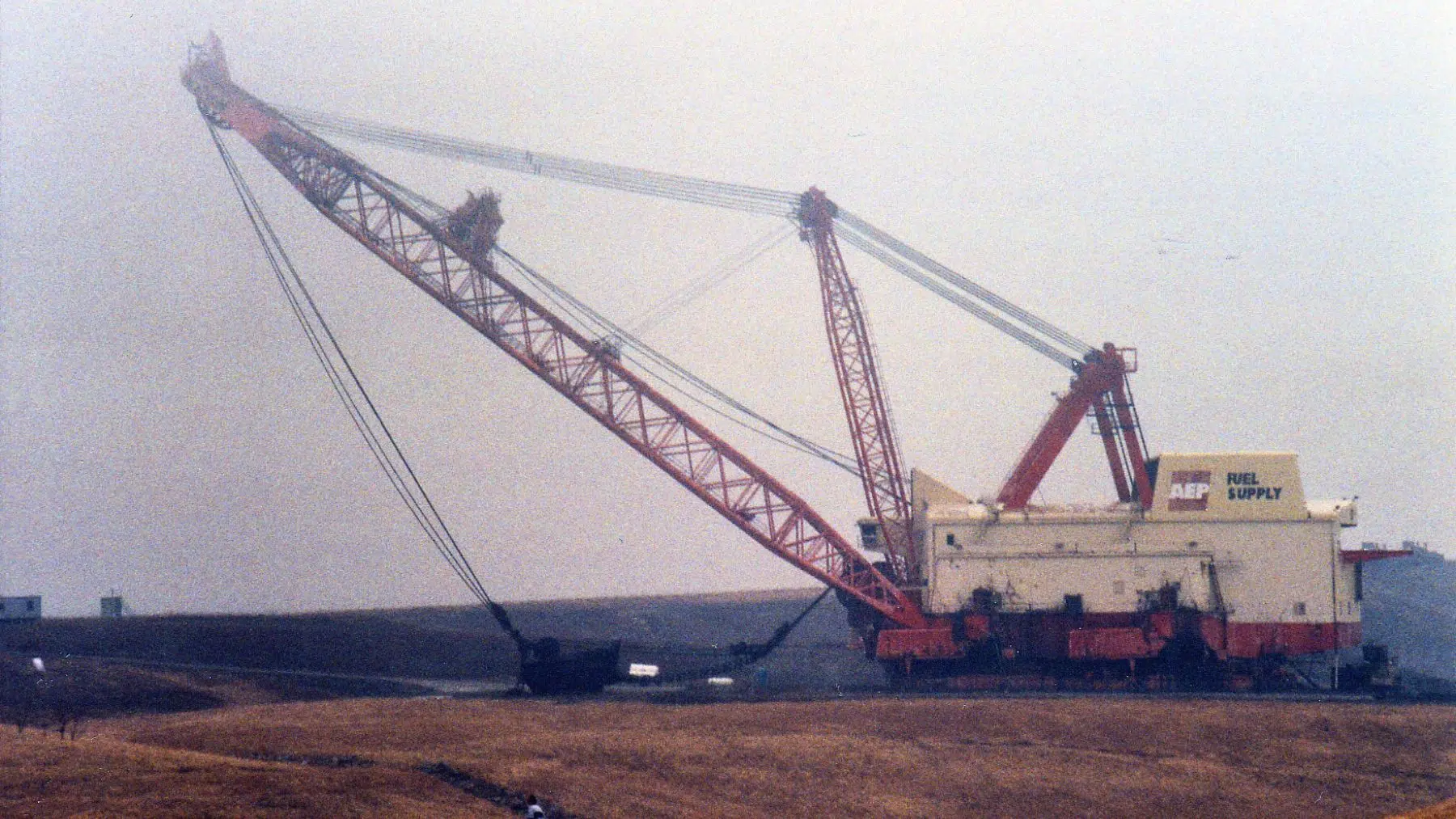
In the hills of rural Ohio, the largest machine that ever walked the Earth spent more than twenty years tearing the ground open for coal.
It left behind a raw, gray moonscape, mile after mile of ripped up land where the forest used to be.
For twenty two years it barely stopped.
For a while it looked like the kind of wound that never really heals.
What lives on that ground today is the part no one saw coming.
The machine the size of a skyscraper that walked
They called it Big Muskie, and there was only ever one.
It weighed about 13,500 tons and stood nearly twenty two stories tall, the biggest single bucket digging machine ever built.
Its boom reached out more than 300 feet, longer than a football field, and the operator sat about five stories above the ground.
Its bucket alone could hold two city buses side by side, or swallow a full sized bulldozer whole.
With every scoop it lifted around 325 tons of rock and dirt.
It had no wheels and no tracks, so it moved on giant feet, walking across the land at about a tenth of a mile an hour.
Running it drew as much electricity as a small town, and its crews kept it working around the clock.
Building it had taken two years and more than 200,000 hours of work.
People still talk about watching it take a slow, groaning step.
What it was actually for
Big Muskie belonged to a coal company in southeastern Ohio.
Its job was not to dig the coal itself, but to tear away the earth above it, the dirt and rock that buried the seams.
Once it stripped that layer, smaller machines moved in to pull out the coal beneath.
It never touched a single lump of coal itself.
Over twenty two years it moved more than 600 million cubic yards of ground.
That is twice the earth dug to build the entire Panama Canal, all of it torn from one corner of Ohio.
The coal it exposed was burned to power millions of American homes, around 20 million tons of it over the machine’s life.
The end of the giant
Then the world changed around it.
New clean air laws killed the demand for the high sulfur coal it was uncovering.
Big Muskie was switched off in 1991, and it sat silent on the hill for eight years.
By then it had become one of the most famous machines in the country.
Efforts to save it as a museum failed, and in 1999 it was scrapped and melted down, some of it into car parts.
All that survives is the bucket, parked beside a road as a monument, big enough that a car can drive inside it.
The machine was gone, but the torn land it left behind still had to be dealt with.
What roams the ground today
Here is the part almost no one expects.
By law, the coal company had to heal the land, so crews reshaped the raw ground and seeded it with fast growing grass.
Those wide new grasslands happened to look a great deal like the plains of Africa.
The company donated nearly 10,000 acres of it, and it became The Wilds, one of the largest wildlife centers in North America.
The park works alongside the Columbus Zoo and opened to visitors in 1994.
Those fast growing grasses turned out to mirror the exact habitat that giraffes and rhinos need.
Today, on the very ground Big Muskie tore apart, rhinos, giraffes and cheetahs roam across open savanna.
More than two dozen rare and endangered species are bred there, while otters and grassland birds have returned to the restored ponds and prairie.
Herds now graze where the machine once crawled.
What the strange afterlife really means
None of this makes the damage disappear.
The savanna at The Wilds is not the old Appalachian forest that stood here before the machines came.
Strip mining tore up an enormous stretch of Ohio, and no reshaped grassland fully undoes that.
Reclamation like this cannot replace an ancient forest, and it was never meant to.
But the land did not stay a wasteland either.
It became a working refuge, breeding some of the rarest animals on Earth, the same surprising twist behind a solar farm that gives back to the ground beneath it, and a wind farm that unexpectedly filled with wild animals.
The biggest machine ever built to take from the land ended up clearing the way for giraffes.
It took for twenty two years, and then, oddly, it gave.
The bucket sits empty on its hill, and a few miles away, the rhinos graze on everything it left behind.
Read the whole thing?
Get the week's signal, not the noise
Our sharpest reporting on energy, climate and nature — free, once a week.


