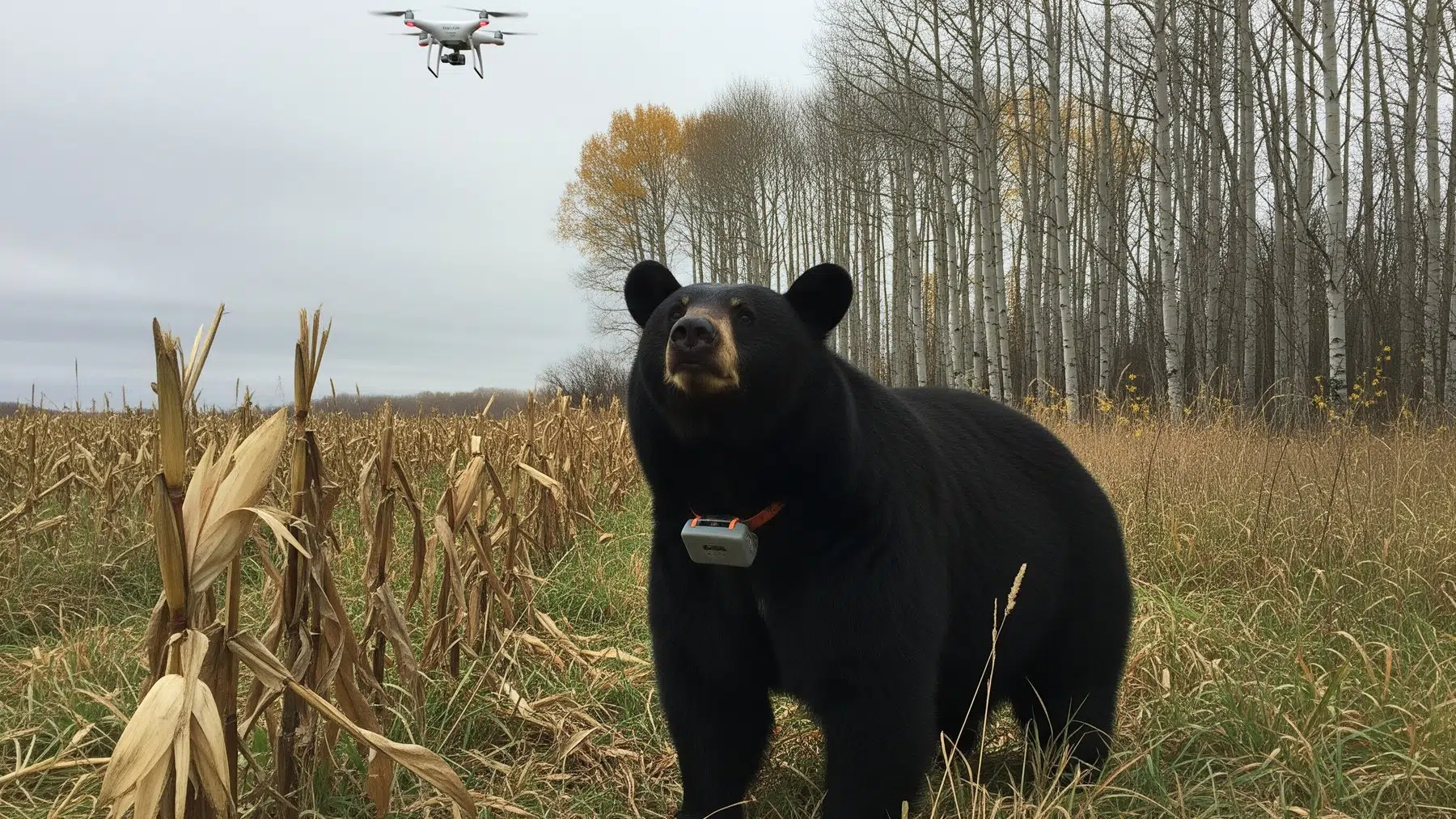
A bear stands in a harvested Minnesota cornfield with its head down, working steadily through the broken stalks.
A small quadcopter comes over the treeline and holds position above it, and the animal does not look up.
On the video it reads as an animal that could not care less about the thing above it.
Sewn in under its skin is a monitor quietly recording something else entirely.
The gap between those two records is the whole point, and it is bigger than anyone expected.
From 41 to 162
Four wild black bears carried implanted cardiac loggers while a drone was flown over them 18 separate times.
Across all 18 flights, the animals showed a major behavioral change exactly twice.
One of those two was a bear in a cornfield that ran roughly 15 feet, then stopped and stood there watching the machine circle overhead.
The heart data tells an entirely different story. The steepest response took one bear from 41 beats a minute to 162.
That is a fourfold jump, and it happened in an animal that a camera would have logged as undisturbed.
Every bear in the group showed the response to some degree, which is what makes this a pattern rather than one unusually nervous individual.
Why a calm animal can still be in trouble
The finding matters because of the way wildlife disturbance is normally judged in the first place.
Almost every rule about how close a machine may come is written around what people can see, meaning does the animal flush, does it run, does it abandon a nest.
A bear that keeps eating scores as perfectly fine under that test, and gets written down as undisturbed.
But not moving is a strategy, not a verdict, and a large predator with nothing above it in the food chain has little reason to bolt from a noise.
The lead researcher put the problem plainly, which is that not being able to see an effect does not mean there is no stress response happening.
Until the loggers went in under the skin, nobody had a way of checking whether that test measured anything real.
How many machines are actually up there
The scale of this is not a niche research question, because the sky over rural America has filled up remarkably fast.
Recreational registrations in the United States passed well over a million cumulative owners by the end of 2024, roughly 1.6 million of them.
The active recreational fleet is a good deal smaller, around 455,000 aircraft, because plenty of people register once and then stop flying.
Commercial registrations sit near 966,000, with roughly 388,000 in active service, and that side crossed a million during last year.
Recreational growth is slowing noticeably, from about 7,900 new registrations a month down to 5,800.
Commercial flying is doing the opposite of that, which means steadily more machines over farmland, forest and coastline rather than fewer.
The follow up almost nobody quotes
Here is the part that changes the conclusion, and it came from the same researcher four years later.
A later study put loggers into five captive bears and flew over them repeatedly rather than once, as the follow up describes.
The animals habituated. Over roughly three to four weeks the heart response faded back toward normal, flight after flight.
More striking, the habituation held through a 118 day break with no flights at all, and did not reset when they started again.
None of that cancels the first result, which stands exactly as it was published, as the work reported at the time set out.
It is the same pattern seen around an offshore array or a fenced solar site, where the first encounter and the fiftieth are not the same event.
What it means for a flight over open ground
The researcher’s own summary of all this is a good deal more balanced than either headline version of it.
Close flights near wildlife should be avoided without a valid purpose, and a hobby flight over a feeding animal does not count as one.
But drone work with a real job, such as counting a population or patrolling against poaching, appears to deliver that benefit without lasting harm.
The caveat sits in the species. Bears are large, bold and hard to frighten, and habituation rates almost certainly vary from one animal to the next.
An animal that nests on open ground, or one that already has predators coming from above, has far less room to shrug a machine off.
What the loggers really proved is narrower and more useful, which is that a camera pointed at a calm animal is not evidence of anything at all.
Read the whole thing?
Get the week's signal, not the noise
Our sharpest reporting on energy, climate and nature — free, once a week.