

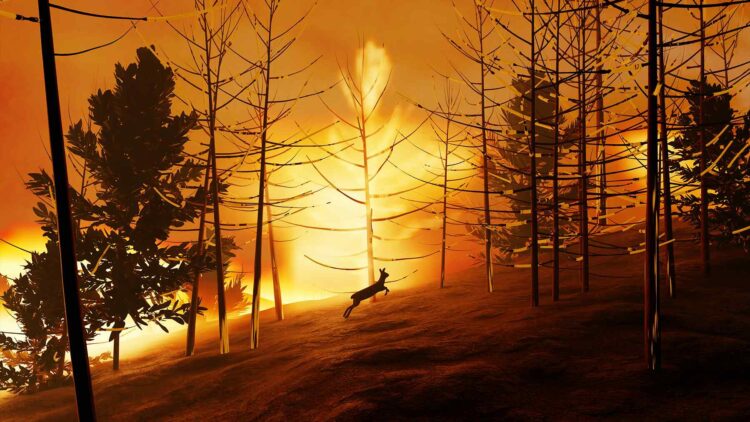
Mid-May is supposed to feel far from peak fire danger in California. This year, it doesn’t.
Three major fires are already burning across Southern California, and the numbers are stark: nearly 41,000 acres scorched before summer has even arrived. That’s close to double the five-year average for this point in the year. And the conditions driving those flames — record heat, near-zero snowpack — show no sign of easing.
Three fires, one alarming early warning
The fires currently burning across Southern California share a common cause: a punishing combination of high winds and extreme heat. The largest is the Santa Rosa Island Fire, which has consumed roughly 16,600 acres — nearly a third of the entire island — in Channel Islands National Park. The Sandy Fire, burning near Simi Valley about 35 miles northwest of downtown Los Angeles, has spread across approximately 1,400 acres and forced thousands of residents to evacuate. A third blaze, the River Fire in Kern County, has burned 3,535 acres.
Containment remains elusive across all three. The Santa Rosa Island Fire stands at 0% contained. The Sandy Fire, where homes and businesses are directly threatened, has received more aerial resources and reached 5% containment. The River Fire sits at 15%. Together, these fires have pushed California’s statewide burn total to nearly 41,000 acres — well above the five-year average of 23,380 acres for this point in the calendar year. That gap isn’t a minor statistical blip. It’s a signal.
A stranded sailor, a flare, and one of Earth’s rarest trees
The Santa Rosa Island Fire has an unusual origin. A stranded sailor in Channel Islands National Park used signal flares to call for help over the weekend, and those flares ignited the blaze that has since consumed a substantial portion of the island. Its path ran directly through a grove of Torrey pines — a species the International Union for Conservation of Nature classifies as critically endangered.
The stakes were high before the first flame reached the grove. The IUCN had previously identified the Santa Rosa Island population as facing a “high potential risk from destructive fires.” Torrey pines rank among the rarest trees on Earth, and this particular grove is one of only two naturally occurring populations anywhere.
There is, however, cautious reason for optimism. Mike Theune, the federal fire information officer assigned to the incident, noted in an email that early assessments suggest the fire intensity was low and that the stand may remain largely intact. A full fire effects crew will conduct a formal evaluation once conditions allow. The picture is incomplete — but not yet the worst-case scenario.
Snowpack at historic lows — the drought beneath the flames
Fire needs fuel, and this spring provided an abundance of it. Record-breaking heat arrived early across the West, accelerating the melt of an already-depleted snowpack. California’s Sierra Nevada range now holds just 9% of its typical snowpack for this time of year, according to federal data. Across many basins elsewhere in the West, there’s no measurable snow at all.
Snowpack matters far beyond water supply. When mountain snow melts faster than normal — or vanishes entirely — the vegetation below dries out earlier in the season, and dry grass and brush ignite more readily, burning hotter and extending the window during which fires can take hold. That connection between low snowpack and elevated fire risk is well-established in the scientific literature. This year, the mechanism is playing out ahead of schedule.
The long-term trend adds further weight to this year’s numbers. An analysis by Climate Central found that April 1 snowpack across the West has declined by 18% since 1955. What California is experiencing now isn’t a sudden departure from normal — it’s the latest chapter in a decades-long shift.
Climate change is reshaping the fire calendar
The early-season severity playing out across California fits a broader, well-documented pattern. Rising temperatures, driven by climate change, are extending and intensifying fire conditions across the American West. What was once considered off-season fire weather is increasingly becoming routine. The calendar no longer offers the buffer it once did.
Peak fire season in California typically arrives in late summer and fall, when vegetation is at its driest and Santa Ana winds are most likely to gust. The fires burning now are arriving months before that window opens. The conditions that produced them — extreme heat, low humidity, high winds — are expected to persist or intensify as summer deepens, which makes the current situation especially concerning.
The early numbers are a preview, not a summary. Nearly 41,000 acres burned before June is a troubling benchmark, but it represents only a fraction of what the coming months could bring. Fire managers, forecasters, and communities across the state are watching the same data and arriving at the same conclusion: the season ahead carries elevated risk, and the margin for error is shrinking. How California responds in the weeks ahead — through resource deployment, evacuation planning, and public readiness — may well determine how the rest of 2025 unfolds.