

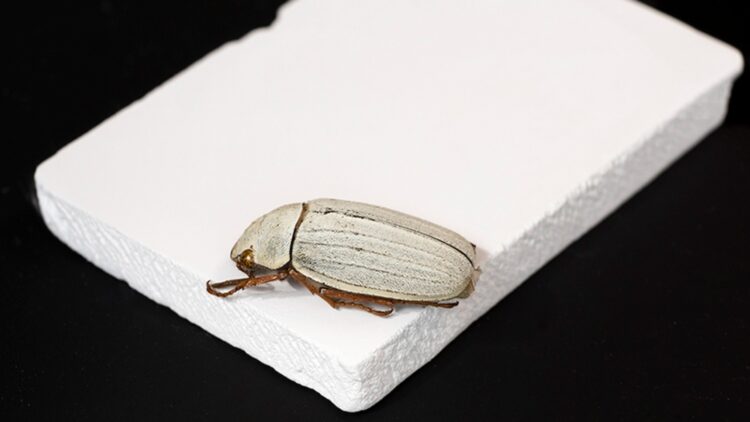
Cooling buildings accounts for a substantial share of global energy consumption — and as temperatures climb, that burden keeps growing. Researchers at The Hong Kong Polytechnic University may have found an unlikely path through the problem by studying one of the smallest, brightest things in nature: the Cyphochilus beetle, known as the world’s whitest insect.
Their answer is a passive radiative cooling ceramic that reflects 99.6% of incoming sunlight — a figure no comparable material has previously reached. The inspiration was straightforward. The implications are considerably less so.
A beetle’s secret: how biology became a blueprint
The Cyphochilus beetle is unremarkable in size, but its scales are far from ordinary. They scatter light with exceptional efficiency, producing a whiteness that outperforms nearly every other biological structure known to science. White paint or chalk achieves its appearance through relatively simple reflective chemistry; the beetle’s scales, by contrast, rely on a densely packed, hierarchically porous internal architecture that disrupts and redirects light at multiple scales simultaneously.
Prof. Wang Zuankai’s team at PolyU studied that architecture carefully. What they identified was a scattering system refined over millions of years of evolution — one that could, in principle, be translated into an engineered material. The result was a cooling ceramic built around a hierarchically porous structure mimicking the beetle’s scales, enabling highly efficient light scattering across the full solar spectrum.
The 99.6% solar reflectivity figure warrants a moment’s consideration. Solar reflectivity measures how much incoming sunlight a surface sends back rather than absorbs. At 99.6%, the ceramic absorbs almost nothing — meaning almost no solar energy converts into heat at the surface. For a building material, that distinction from conventional options isn’t a minor one.
Beyond whiteness: cracking the Leidenfrost barrier
The ceramic’s story doesn’t end with reflectivity. Embedded in its hierarchically porous structure is a second, less obvious capability — one that addresses a phenomenon called the Leidenfrost effect.
When a liquid contacts an extremely hot surface, it can generate a thin vapor layer between itself and the solid. That vapor acts as insulation, dramatically reducing heat transfer and making liquid cooling far less effective. A well-documented engineering obstacle, the Leidenfrost effect had never previously been examined in the context of passive radiative cooling materials.
The ceramic’s porous structure changes the equation. Because the material is super-hydrophilic — meaning water spreads across it immediately rather than beading up — droplets are drawn rapidly into the interconnected pores, suppressing vapor layer formation. This allows the ceramic to inhibit the Leidenfrost effect at temperatures above 800°C. Prof. Wang’s team describes this as a major milestone: efficient liquid cooling becomes viable at temperature ranges where it previously broke down, opening new directions for both building applications and Prof. Wang’s broader structured thermal armor work targeting ultra-high-temperature cooling.
Built for the real world
A material can achieve impressive laboratory results and still fail the practical test. The PolyU ceramic appears designed with that challenge in mind.
The team reports high weather resistance and mechanical robustness — properties that matter considerably for any material intended for long-term outdoor use on building exteriors. Self-cleaning properties and favorable recyclability address concerns about maintenance costs and end-of-life environmental impact, while passive radiative cooling requires no electricity at all. The material works by reflecting sunlight during the day and emitting heat as infrared radiation, reducing surface temperature and translating directly into lower cooling demand for the building interior.
The researchers note the ceramic’s suitability for commercialization, citing cost-effectiveness, durability, and versatility across diverse building construction scenarios. These aren’t incidental features. They’re what separates a promising laboratory result from a technology that could realistically reach rooftops and facades at scale.
Nature as engineering lab
This research sits within a broader intellectual project at PolyU’s Research Centre for Nature-Inspired Science and Engineering, which Prof. Wang leads. The Centre’s premise is that nature, having solved complex physical and structural problems across vast timescales, represents an underutilized engineering resource.
The cooling ceramic work, published in the journal Science, was a collaboration between PolyU and City University of Hong Kong, with Prof. Christopher Chao serving as co-author. Biomimicry in materials science is a growing field, but results of this precision remain relatively rare. Most engineered surfaces approximate nature’s solutions; this one appears to have come unusually close to matching one.
What that suggests is worth sitting with. A beetle that evolved its extraordinary whiteness as a survival strategy — likely for camouflage in its native habitat — may end up contributing to how humanity cools its cities in a warming world. The distance between those two things is both vast and, it turns out, surprisingly bridgeable.