
Chinese civilization has been around for more than 5,000 years, making it one of the oldest in the world. China is world-renowned for its famous sight, the Great Wall, and it seems as if the Chinese are working on their next biggest project inspired by the famous sight. They will be hitting two birds with one stone with this project that will stretch 250 miles, as it will also result in a maximum production capacity of 100 gigawatts. Have we piqued your interest yet?
China is starting its next biggest megaproject
China has always been a go-getter when it comes to renewable energy solutions, especially solar energy. According to Global Energy Monitor’s Global Solar Power Tracker, the Chinese has taken the global first place once again by accounting for more than 50% of the global solar farm capacity. China had 386,875 megawatts of functioning solar farm capacity as of June 2024, with an average increase of 39,994 megawatts annually.
When comparing those numbers to the United States, which is currently globally second, China is significantly ahead. The United States had 79,364 megawatts of functioning solar farm capacity as of June 2024, which is 11% of the global capacity. It seems as if China is not quite finished yet, and plans to secure its first place for the coming years with its next biggest megaproject since the Great Wall.
Beijing’s power will be bigger and better
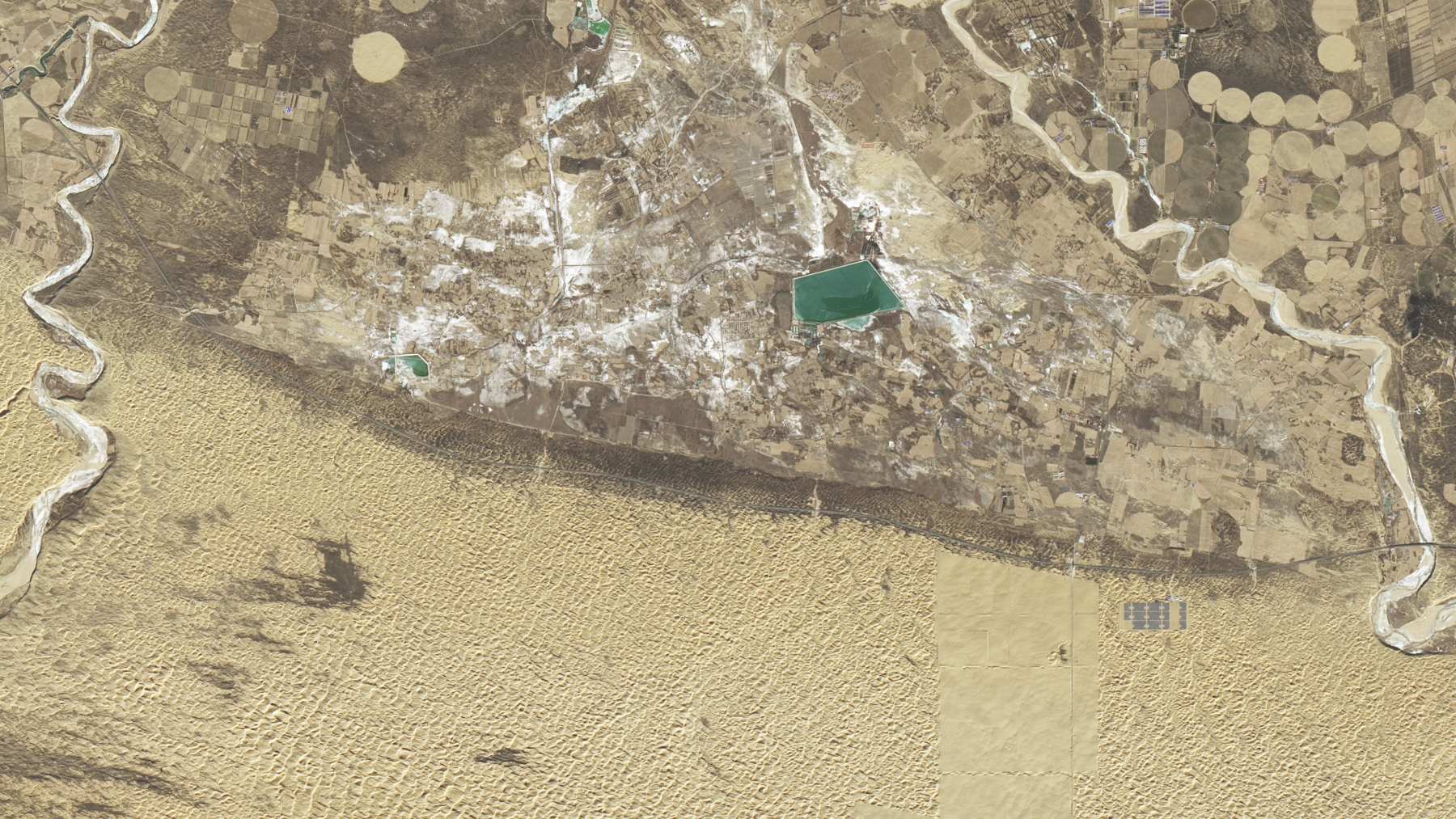
The megaproject is situated in the Kubuqi Desert in Inner Mongolia. This sandy region was described by NASA as a “sea of death.” Now, the Chinese have given the desert new life and energy (literally). The megaproject should be completed in 2030, and once complete will be 250 miles long and 3 miles wide.
China has had various megaprojects, but this one is known as China’s Great Solar Wall. The Kubuqi Desert’s dune fields have become the ideal location for the Great Solar Wall, which will be constructed according to a multi-year plan and will produce enough electricity to power Beijing. Its maximum production capacity will reportedly be 100 gigawatts, and as of late August 2024, 5.4 gigawatts of solar capacity have already been installed, according to China Daily.
Another key role player in the megaproject’s development is State Power Investment Corp., which constructed the horse-shaped Junma Solar Power Station completed in 2019. The name is appropriate for its shape, as Junma is Mandarin for “fine horse.” The Junma Solar Power Station also managed to snatch a Guinness World Record by being the biggest image made of solar panels. Besides its record, it also produces a whopping 2 billion kilowatt-hours of power annually, which meets the annual energy demands of 300,000 to 400,000 people. “Fine horse” indeed!
Junma will be so much more than power
“The Kubuqi’s sunny weather, flat terrain, and proximity to industrial centers make it a desirable location for solar power generation. Panels are being installed in a long, narrow band of dunes just south of the Yellow River between the cities of Baotou and Bayannur.” – Official NASA statement
Chinese developers and planners have high hopes that the Great Solar Wall will have other advantages in addition to producing power. They believe that the mega-installation could assist in preventing desertification by halting dune movement and slowing winds. The raised panels will also result in additional shade, which will slow evaporation and enable the growth of pasture grasses and various crops beneath the panels.
According to Landsat data analysis, solar projects have played a role in the greening of deserts across China. Deserts have untapped potential, and the Chinese know how to utilize it. China’s Great Solar Wall will play a significant role in the global transition to renewable energy solutions.
Read the whole thing?
Get the week's signal, not the noise
Our sharpest reporting on energy, climate and nature — free, once a week.


