

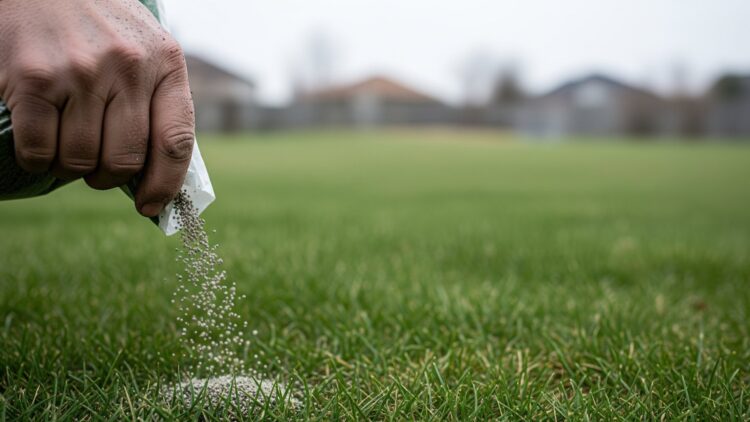
Every spring, the same ritual plays out across tens of millions of American yards.
A bag comes home from the garden center, the spreader rolls out, and green granules scatter across the turf with a satisfying hiss.
The promise on the label is always the same: a thicker, greener, healthier lawn.
What the label does not mention is what happens after the rain.
The bag that promised a perfect lawn
Fertilizer is one of the most trusted products in America.
It sits beside the seed and the mulch at every big-box hardware store, marketed as a simple tool that works with nature.
The logic feels airtight: grass needs nitrogen to grow, and the bag delivers nitrogen.
But crops and lawns only absorb a fraction of what is applied, and the rest has to go somewhere.
Scientists have measured exactly where it goes, and the answer is one of the most unsettling findings in American environmental economics.
The gap between what is applied and what the plant actually takes up has been known for decades, yet the bags keep moving off the shelves every March.
A river carries the secret south
Rain washes across a fertilized lawn, a farm field, a suburban park, and picks up the nitrogen it finds there.
That water finds a drain, a ditch, a creek, and eventually a river.
The Mississippi River and its tributaries meander more than 2,000 miles through parts of 31 US states, collecting nutrients from a drainage basin of more than 1.2 million square miles and carrying them south toward the Gulf of Mexico.
Along the way, every tributary adds its own nitrogen load from fields and yards spread across the American heartland.
Crops take up on average just 40 percent of the nitrogen applied each season, and the excess pours into waterways.
Suburban lawns compound the problem because homeowners rarely test their soil first, so many applications go onto ground that does not need them at all.
What happens when too much green meets the sea
When all that nitrogen finally reaches the Gulf, it does not simply dissolve into the deep water and disappear.
It feeds a massive, uncontrolled explosion of algae.
Algal blooms grow out of control, stripping the water of light.
When they die, they drain the oxygen from everything below.
What is left is a zone so starved of oxygen that fish, shrimp and crabs either flee or suffocate.
Scientists call it a hypoxic zone, a word that simply means not enough oxygen to support life.
The Gulf has been producing one of these biological deserts every single summer for decades, and the zone has consistently remained far above the task force’s long-term reduction target.
A dead zone larger than New Jersey, and the bill that goes with it
The Gulf of Mexico’s dead zone was measured at around 6,705 square miles in 2024, roughly the size of New Jersey and the twelfth largest on record in 38 years of surveys, according to the National Oceanic and Atmospheric Administration.
That measured figure came in larger than NOAA’s own summer forecast, and the five-year average now stands at more than twice the task force’s long-term reduction target.
The fisheries inside those waters, including shrimp, oysters and fin fish that feed millions of American families, face direct pressure every summer.
According to peer-reviewed research published in Environmental Research Letters, the total annual impact of agricultural nitrogen pollution on health, drinking water, recreation and fisheries reaches a staggering $157 billion.
A recent analysis found that reaching the EPA’s own goal of shrinking the dead zone would cost around $7 billion, and nitrogen runoff must be reduced by about 45 percent to meet the intended objective.
The economic research on aquatic dead zones keeps confirming the same hard truth: the price on the fertilizer bag does not include the price paid by every shrimp boat captain working the Louisiana coast.
An ordinary oyster, which can filter dozens of gallons of water a day and scrub excess nitrogen from the estuary, is one of the very creatures being pushed out of the Gulf’s most affected zones as the dead zone expands.
The tab is real, but so is the turn
None of this means the bag of fertilizer in the garage is a weapon.
It means the system around it, the application rates, the timing, the absence of buffer strips along waterways, is badly miscalibrated.
Farmers who adopt cover crops and smarter nutrient timing are already cutting input costs while reducing runoff.
A nutrient management plan can save farmers approximately $30 per acre in fertilizer costs alone.
For homeowners, slow-release fertilizers applied only when soil tests show a real deficiency can deliver the same green lawn with a fraction of the runoff.
The dead zone did not appear overnight, and it will not shrink overnight either.
But every shrimp that survives a Gulf summer, every oyster bed that holds on in the estuary, is already doing the patient work of rebalancing a system that millions of well-meaning Americans tipped out of balance one bag at a time.
The label on the fertilizer bag has always been right about one thing: what you put into the ground grows something big.
The question is whether that something is the lawn, or the underwater desert downstream.