

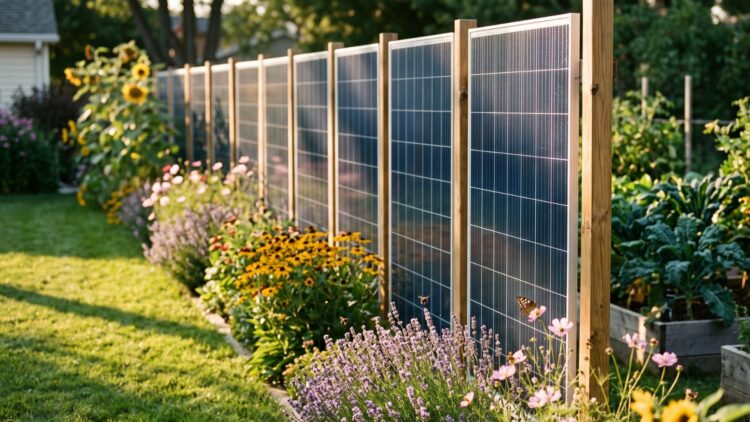
There is probably a fence running along the edge of your yard right now.
It keeps the dog in, the neighbors out, and does absolutely nothing else.
But a growing wave of engineers and homeowners are looking at that ordinary boundary line and seeing something completely different: a power plant hiding in plain sight.
What researchers found when they tested a vertical bifacial system over a full year upended a basic assumption that the solar industry has held for decades.
The thing everyone thought they understood about sunlight
Most people picture a solar panel lying flat on a rooftop, tilted toward the sky, soaking in the midday sun.
That image is basically correct, and for years it was considered the only way to get serious energy out of photovoltaic cells.
The trouble is that flat rooftop systems generate most of their electricity at midday, and that flood of power arrives when demand is only moderate.
The grid gets overwhelmed at noon, then goes thirsty in the early morning and evening when people most need it.
Engineers call this the duck curve, and it is one of the biggest headaches in renewable energy today.
Utilities have spent billions trying to solve it with battery storage and demand shifting, yet the answer may have been simpler all along.
The fix, it turns out, may have been standing in your backyard the whole time.
What happens when you simply stand the panel up
The idea sounds almost too simple: instead of laying the panel flat, stand it perfectly vertical, the way a fence post stands.
A vertical panel no longer faces straight up at the noon sun.
Instead it faces east and west, one face greeting the morning sun, the other catching the afternoon glow.
This geometry fundamentally changes the production curve.
Instead of one sharp midday spike, vertical systems deliver two gentler peaks, one in the morning and one in late afternoon.
Those two peaks land close to when families are making breakfast and cooking dinner, the two highest-demand moments of any ordinary day.
Picture a kitchen at 7 a.m., lights on, kettle boiling, the panel outside catching the same low slant of light that is warming the window.
There is also a second trick hidden inside the panel itself, and it changes the math entirely.
The two-faced panel that changes the whole equation
Modern solar fence panels are built with photovoltaic cells on both sides of the glass, a design known as bifacial.
Unlike standard panels that only capture direct sunlight from one face, bifacial modules harvest energy from front and rear at the same time.
The rear face picks up light reflected from the ground, from concrete paths, pale gravel, or a snow-covered lawn.
Snow that would bury a rooftop panel simply slides past a vertical one, and studies show vertical bifacial panels can deliver up to 24.52 percent more electricity in winter than traditional tilted installations.
The vertical orientation also reduces the heat buildup that drags down efficiency.
For every degree above 25 degrees Celsius, solar panel output drops by roughly 0.5 percent.
A fence panel running cool in a light breeze is working more efficiently than the hot panel baking on your roof in August.
What a full year of real data actually showed
The performance claims are not just manufacturer promises.
Researchers at the University of York published the first comprehensive study of a vertically mounted bifacial photovoltaic system, monitoring a rooftop-mounted vertical array across all seasons and weather conditions for a full year.
The results showed gains of 26.91 percent in early morning hours and 22.88 percent in late afternoon periods compared with conventional tilted panels.
That is the core promise of the solar fence concept: a bifacial panel stood on its edge along your property line, designed to generate power at the two periods every day when your home needs it most.
Companies including Next2Sun and Sol Fence have brought solar fences built on this principle to residential yards.
Homeowners can also pair a fence system with a rooftop array, using the morning and evening output to complement the midday harvest from the roof.
It is worth noting that the University of York measurements were taken on a rooftop installation in a UK climate, and that vertical panels can produce somewhat less total annual energy than optimally angled rooftop panels in sunny southern states, so the advantage is strongest in northern latitudes and cloudy climates.
The fence your yard already has room for
The practical appeal goes beyond the science.
A solar fence acts as a privacy screen, a design element, and a private power plant all at once.
Most installations use the same post spacing as a standard timber fence, so the footprint is familiar and the permits are straightforward in most municipalities.
The panels are ground-mounted, making them easier to access, clean, and maintain than a rooftop array, and the modular post-and-panel design means sections can be removed or reconfigured if you move home.
The University of York study gives that combination a firm scientific foundation, and grid operators may find the two-peak production curve genuinely easier to manage than the noon flood from conventional panels.
The fence has stood at the edge of the American yard for generations, doing one job.
It turns out it was always one pane of glass away from doing something remarkable.