
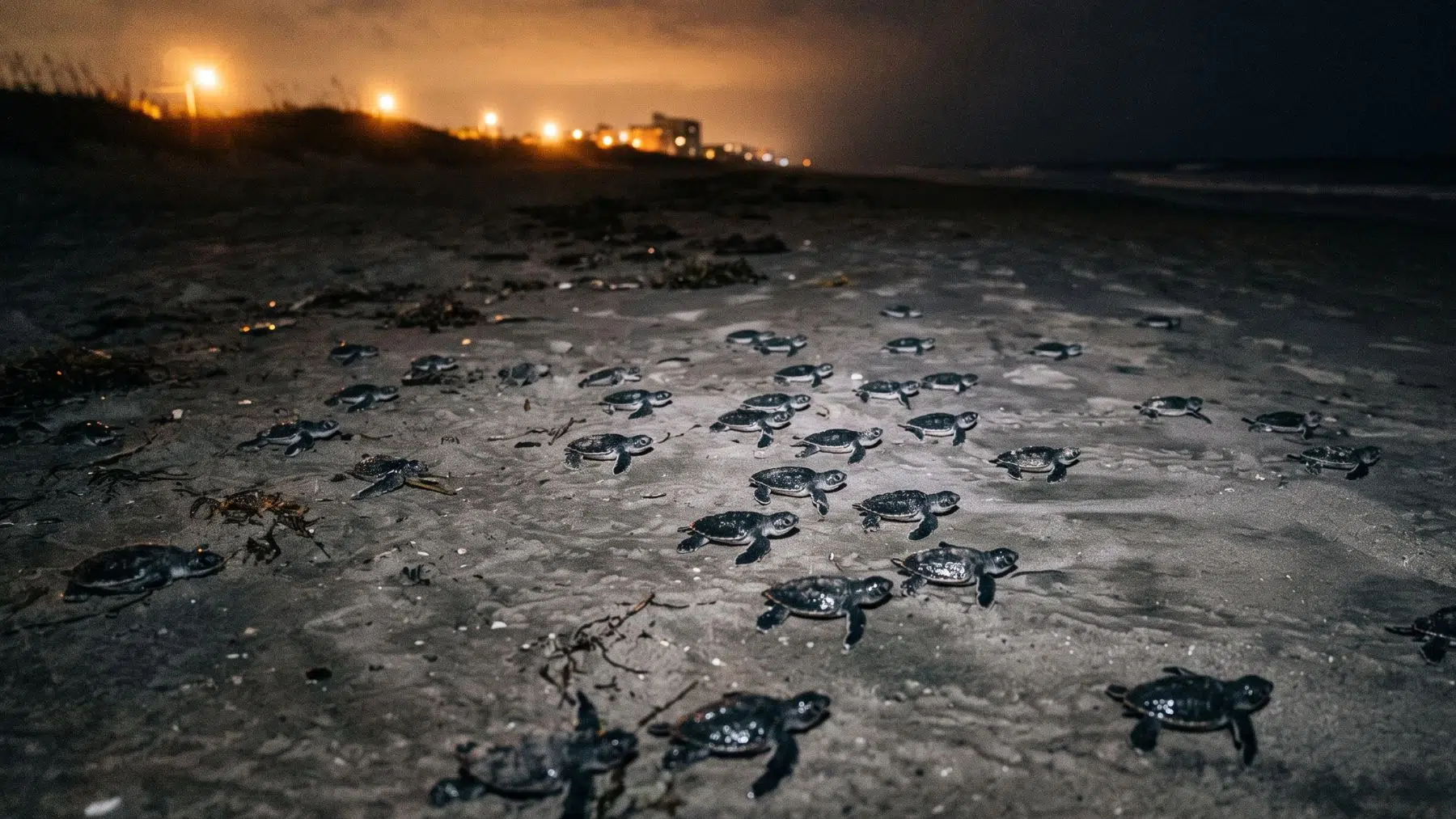
On a Florida summer night, a nest stirs beneath the sand and dozens of hatchlings claw their way up.
For millions of years, one simple rule has carried them safely to the water.
The sea has always been the safest place a newborn turtle can reach.
They crawl toward the brightest patch of horizon, which once always meant the open sea.
But along the built up coast, the brightest glow now comes from the land.
So thousands of tiny turtles turn their backs on the waves and head the wrong way.
The light doing it is the same bulb sold as a clean energy upgrade.
It was meant to help the planet, not strand its smallest travelers.
The bulb that promised to fix everything
Over the past 15 years, the LED swept through outdoor lighting almost everywhere.
It uses at least 75 percent less energy than the old incandescent bulb.
It also lasts up to 25 times longer, according to the U.S. Department of Energy.
Cities, hotels, and families swapped their warm yellow lamps for crisp white ones.
The savings were real and the switch made obvious sense.
Streetlights, porches, and parking lots all glowed brighter for less money.
But the new light carried something the old warm bulbs never had.
That hidden extra would land hardest on a quiet stretch of beach.
The trouble was written into the light itself, not the power bill.
What makes an LED different after dark
The whole story is hiding in the color of the light.
Most white LEDs lean heavily on blue and short wavelength light.
The old incandescent and sodium lamps glowed in warmer amber and red tones.
To a human eye the difference can look almost trivial.
To a sea turtle it is enormous.
Their eyes are tuned most sharply to short blue and green wavelengths.
They barely register the amber and red end of the spectrum.
So the warmer old lights were far easier to ignore.
The cool white LED, by contrast, shouts straight into a hatchling’s eyes.
What looks like a mild white lamp to us reads as a blazing beacon to them.
The very feature that makes LEDs crisp and modern is the part that misleads.
A Florida beach, a dark night, and the wrong direction
Picture a nest hatching a few hundred feet from a lit parking lot.
The hatchlings scan for the brightest and lowest horizon to find the sea.
Under a natural sky that cue points them straight at the water.
A lamp full of blue light behind them hijacks that ancient signal.
They turn inland and crawl toward the glow instead.
Out there wait roads, storm drains, raccoons, and the rising heat of morning.
A crawl that should last a minute can stretch into a deadly detour.
Most never reach the water, and the ones that stall die before dawn.
The number nobody wanted to count
For years the true scale of the loss was hard to pin down.
The Sea Turtle Conservancy now estimates that artificial light disorients more than 100,000 sea turtle hatchlings in Florida every year.
State biologists at the wildlife commission log hundreds of disorientation events each season.
Those counts only capture the beaches that people actually walk and check.
Their own records tie thousands of hatchling deaths directly to coastal lighting.
David Godfrey, who runs the Sea Turtle Conservancy, has spent decades pushing beach towns to dim down.
He points out that the fix is often cheaper than the bulbs already doing the harm.
Florida now carries more lighting ordinances than any other state.
Even so, a single bright window can undo a whole night of nesting.
Insects, salmon, and a problem bigger than one beach
The turtles are the loudest warning, but they are not alone.
The same blue light pulls moths and other insects to their deaths.
Young salmon feel it too, as street lighting scrambles their night migration.
Bright water also hands their predators an easy meal after dark.
The same glow that guides a late driver home reshapes the wild around it.
The pattern is always the same, with short blue light doing the damage.
The repair is refreshingly simple and often cheap to install.
Swap the white LED for a warm amber one and aim it down.
The turtles, the moths, and the salmon stop reading it as a false sun.
Like the wind that turns an offshore wind farm, good light works best when we barely notice it.
It is the same trade as a fox pushed off its den by solar panels, one gain hiding a hidden cost.
The greenest bulb ever made still had to learn the color of night.
Read the whole thing?
Get the week's signal, not the noise
Our sharpest reporting on energy, climate and nature — free, once a week.


