

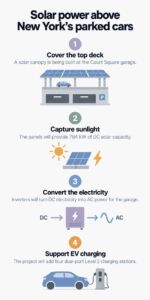
In New York, construction crews are building a vast solar canopy system rated at 784 kilowatts DC (with a 480-kilowatt AC output) located above an uncovered parking garage deck.
The huge structure made of steel is holding hundreds of photovoltaic panels that are expected to produce renewable electricity for urban use and protect cars from bad weather conditions.
The engineers developed the rooftop microgrid system to reduce the facility’s energy consumption and possibly provide power for electric car fast chargers.
Here we have a multi-functional infrastructure solution that allows urban property owners to utilize uncovered parking spaces for electricity production.
Anchoring heavy steel frameworks to open garage decks
The top concrete surfaces of urban parking garages are subjected to summer heat without any contribution of energy from the facility itself.
Steel beams extend upwards 10 feet above driving lanes to provide clearances for 784 kW DC worth of solar panels, expected to generate approximately 1,235,000 kWh annually.
Steel anchor plates are drilled into the concrete deck down through columns, providing structural support below.
Load distributions have been calculated by structural engineers for underlying columns to confirm the strength of the concrete before installing machinery.
Structural load distribution through existing columns prevents structural failures through structural shear in open parking structures.
Clearances allow for every parking spot to be preserved below, making roof surfaces productive power generators.
Intercepting solar radiation before concrete absorbs heat
When concrete does not have a protective cover, it absorbs heat in summer, especially when the temperature remains high, even at night after sunset.
Solar panels absorb sun rays initially, thus keeping asphalt and concrete underneath from being exposed to any sunlight.
Shading provided by the canopy shelters parked vehicles from direct weather and sun exposure.
This reduces overall heat absorption on the top deck.
Balancing direct solar generation against heavy local power loads
The meters measure continuous electrical usage by the ventilation fans, lighting, and elevators in the facility.
The solar panels on the roof produce direct current (DC) electricity, which is converted by inverters into up to 480 kW of alternating current (AC) power.
This AC electricity supplies baseline facility equipment before resorting to the city power grid.
It helps to cut down expensive utility demand charges during the peak period in summer when the cost of electricity is very high.
Additional electricity will be diverted to the level three electric car charging stations to prevent overloading of the neighborhood grids.
The power control units adjust the current according to the rate of charging of the vehicles.
Securing elevated panel canopies against winter storms
Winter storms in New York hit the elevated open-air structures through large snow drifts and high wind gusts near the shore.
Snow accumulation causes pressure on horizontal flat panels, and there is a risk of deflection of the structure in case of failure of the drainage system.
Elevated open-air structures in New York must be engineered to withstand severe winter weather, including heavy snow loads and high wind gusts along coastal corridors.
Heat elements have been incorporated to avoid formation of ice dams on the bottom ends of the panels during extremely cold weather conditions.
Managing retrofit load limits and grid interconnection hurdles
Elevated roofs are efficient space-wise, although transforming older concrete garages has its own share of difficulties too.
Transforming older concrete garages presents unique engineering considerations.
It requires precise structural assessments of the open deck columns to support the elevated canopy framework, as stated by New York City DCAS.
The grids connect via the adaptation of transformers within the utility to transfer the full capacity of the grids.
The long-term energy savings that will be achieved will motivate the commercial enterprises to install the same elevated structures in their parking garages.
Read the whole thing?
Get the week's signal, not the noise
Our sharpest reporting on energy, climate and nature — free, once a week.


