

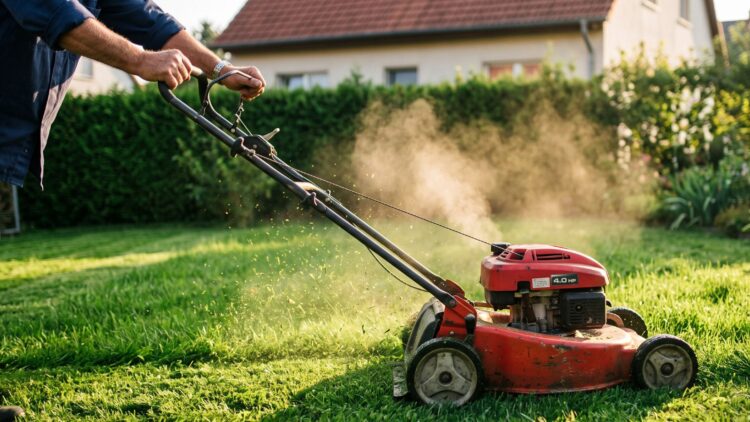
Few sounds say American summer like a mower running somewhere down the street on a Saturday morning.
The machine promised something simple and satisfying, a neat, even carpet of green the whole block would admire.
Pull the cord, walk the rows, and in half an hour the yard looks cared for.
It is one of the most ordinary chores in the country.
What almost no owner pictures is the invisible cloud the little engine leaves hanging in the air behind them.
The machine in almost every garage
The lawn is the largest thing Americans grow.
Turf covers more than 40 million acres of the country, more ground than any irrigated crop, from front yards to ball fields to golf courses.
Keeping all of it short takes a small army of engines.
By some counts more than 50 million Americans mow every week in season.
In some states, turf now covers more than a fifth of the available land.
Tens of millions of gas mowers run most weekends through the growing season.
Together they burn something like 800 million gallons of gasoline a year just cutting grass.
Keeping it green and short has become a national habit few ever question.
The engine that never got cleaned up
Your car has spent decades getting cleaner.
A small mower engine has not.
Most gas mowers still run without a catalytic converter, the part that has scrubbed car exhaust since the 1970s.
For decades these small engines were barely regulated at all.
So the engine burns its fuel messily, throwing out far more smog forming gas per drop than a modern car does.
The EPA estimates that gas powered lawn and garden equipment makes up around 5 percent of the nation’s air pollution, and more than that in cities.
California air regulators have warned that landscaping engines could soon out pollute every car on the state’s roads.
An hour behind the mower can put out as much smog forming pollution as driving a new car dozens of miles, and an older machine far more.
The little engine works hard for its size, and burns dirty the whole time.
The spill nobody counts
The exhaust is only half of it.
The other half never makes it into the engine at all.
Every summer, topping off mowers and gas cans, Americans spill fuel onto driveways and grass across the country.
The EPA puts that number at more than 17 million gallons a year, more than the Exxon Valdez leaked into the sea.
That gasoline soaks into soil, evaporates into the air, and washes toward storm drains.
Even small spills keep evaporating off the driveway and feed the summer smog.
And then there is the noise, since many mowers scream past 100 decibels, into the range that can damage hearing.
Neighbors a few doors down can hear it, and so can your own ears up close.
What the short green carpet costs the living world
Here is the part the tidy look hides best.
A lawn kept short and uniform is close to a dead zone for the small life that used to fill it.
Cut every week, the clover and dandelions never flower, and the ground nesting insects never get a foothold.
A sharp weekly trim looks tidy and leaves those small pollinators shut out.
Then scientists at the USDA Forest Service tried something almost lazy.
They mowed suburban yards less often, every two or three weeks instead of every week, and simply counted what came back.
The lawns cut every three weeks grew up to two and a half times more flowers than the ones cut weekly.
The yards filled with flowers, and the researchers logged 93 species of bees feeding in ordinary lawns that had been near silent before.
That was nearly a quarter of every bee species native to the region.
What this actually means for you
None of this means your yard is the enemy, or that you have to let it run wild.
The point is how little it takes to change the math.
Mowing a bit less often, even every other week, lets the lawn feed pollinators without looking neglected.
Switching to an electric or battery mower erases the exhaust and most of the noise in one move.
It also skips the oil changes, the fouled plugs and the trips to the gas station.
Even leaving one corner of the yard to grow gives those bees somewhere to land.
Skipping the spill with a careful can, or shrinking the mown area even a little, does the rest, the same small awareness behind so much everyday yard care.
The neat green lawn was never the whole story.
What lives in it, and what drifts off it, was the part no one was selling.