
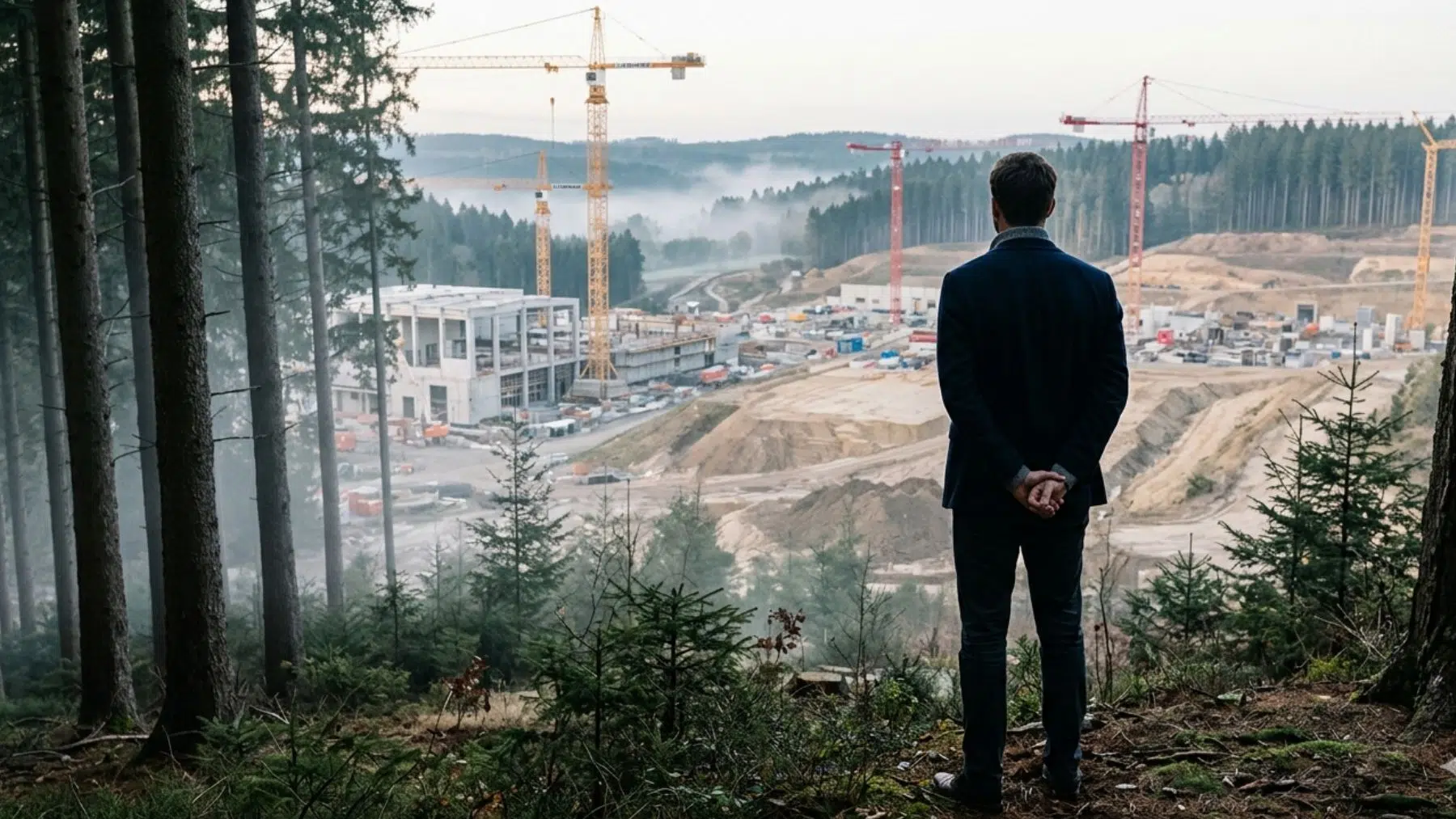
It is a story that sounds almost like a modern fable.
One of the most powerful companies on the planet, led by one of the richest men alive, arrives in a quiet stretch of German pine forest with a bold vision and almost limitless resources.
And then, before the shining future it has promised can even begin, the whole thing simply stops. Not because of money. Not because of rivals, or some flaw in the technology. But because of who was already living in that forest.
A factory the size of a small town
In early 2020, the company set its sights on a patch of land in Grünheide, in the German state of Brandenburg, just outside Berlin.
The plan was enormous. It claimed a site of around 300 hectares, of which roughly 153 hectares were living forest, and announced it would build a gigafactory there to produce 500,000 electric cars a year.
Production was meant to roar to life as soon as July 2021. It was exactly the kind of fast, world changing project the company had become famous for.
There was only one thing standing between the bulldozers and the future. The forest was not empty.
But this was Germany
Building a factory in Germany is not simply a matter of buying the land and clearing it.
It means stepping straight into one of the strictest sets of environmental rules anywhere in the world. Before a single tree could legally fall, the company was required to comb through the woodland, find every protected creature living in it, and move them somewhere safe.
So the most futuristic carmaker on Earth had to pause its march toward tomorrow and send people walking slowly through 153 hectares of pine trees, searching the bark, the soil and the hollows for signs of life.
What they found is the heart of this story.
What they found among the trees
The crews searched the forest for hibernating bats, and they found them. In one hollow, a tiny pipistrelle, one of the smallest bats in Europe. In another, at least three noctule bats of a different species. The trees those animals slept in were to be left standing, completely untouched.
It was not the first time these creatures of the dark have quietly changed the plans of the people building around them.
But the bats were only the beginning. In the sandy ground lived sand lizards, a strictly protected reptile, which had to be gathered up and relocated by hand once their winter sleep was over. Scattered through the undergrowth sat the great domed nests of wood ants, entire miniature cities that each had to be lifted and carried to safety. And to repay the home it was taking, the company promised to put up 400 nest boxes for birds across the surrounding land.
When the smallest residents set the pace
Picture the scene. A company that wanted to reshape how the entire world drives, with billions behind it and a date already circled on the calendar, suddenly forced to wait.
Wait for sand lizards to wake from hibernation. Wait for ant nests to be relocated. Leave certain trees standing because a handful of bats happened to be asleep inside them. For all its speed and ambition, the future had to move at the pace of the forest’s quietest tenants.
We like to imagine progress as unstoppable, flattening whatever lies in its path. Yet again and again it turns out the other way around, from these German lizards to a half mile bridge now being built for wildlife over one of America’s busiest freeways.
And the forest is still fighting back today
Years later, that quiet stretch of Grünheide pine has become a battlefield once more.
The factory opened in 2022, and now the company wants to roughly double it, clearing more of the surrounding forest for warehouses, a rail yard and a second plant aimed at a million cars a year. Local residents have pushed back hard. In a 2024 vote, about 65 percent rejected the expansion, worried most of all about the water, since the plant sits in a protected drinking water zone in one of Germany’s driest regions.
Activists occupied the woodland for months, living in treehouses high in the canopy until police finally cleared them out.
The animals were moved years ago. The fight over who the forest really belongs to is still going on. And it still comes down to the same stubborn rule the billionaire ran into the first time. Before you get to build the future, you answer to the things that were already home.
Read the whole thing?
Get the week's signal, not the noise
Our sharpest reporting on energy, climate and nature — free, once a week.


