Take a look at the road next time you’re stuck at a light. Things look a bit different lately: markings, lanes, and bright colors are there that weren’t around a few years back.
Across the U.S., streets are being redesigned to make room for more types of vehicles than just cars.
If you’ve spotted green paving, there’s a good reason. These changes have a purpose, and they affect how you’re expected to use the roads.
Roads won’t be just for cars. We need to make space
Roads in America are changing right in front of you.
They’re not going to be just highways for cars anymore.
Driverless vehicles that could one day navigate city streets with little or no human input are becoming closer to reality every day. Self-driving tech isn’t pie-in-the-sky material—companies and cities are getting ready for autonomous vehicles that will have to share the road with people and bikes at the same time.
The way we design streets has an impact on a number of factors, from safety to traffic flow right down to where people choose to live and work.
Instead of squeezing everyone into narrow roadways meant mainly for cars, road design is moving toward multi-use spaces. The intention is for cars, bikes, pedestrians, and even autonomous vehicles to coexist in safe and predictable ways.
That doesn’t just make life easier for cyclists and future robotaxis; it also makes roads more human-centered than they’ve been in decades.
What if we simply make more lanes? It’s not that easy
Here’s the catch: more cars, more bikes, and more driverless vehicles are all trying to use the same space on American roads.
So when people say, “Just build more lanes,” it sounds simple, until you look closer.
Adding new lanes for cars has been shown time and again to not fix congestion — a phenomenon planners call induced demand, where more road space just fills up with more traffic.
It’s not just about cars. Bikes and scooters need protected space too, and they can’t simply be shoehorned into leftover gaps without creating safety issues and more complex traffic interactions.
And yes: there’s room on the road for everyone. We just need to organize ourselves (well, and stop honking to rush the car in front). Or at least, that’s what the transport authorities have told us. And yes, they’ve gotten to work.
So if adding lanes isn’t the magic fix and demand keeps growing from all sides, what’s the real solution?
Simple: Just paint them green and get the drivers out
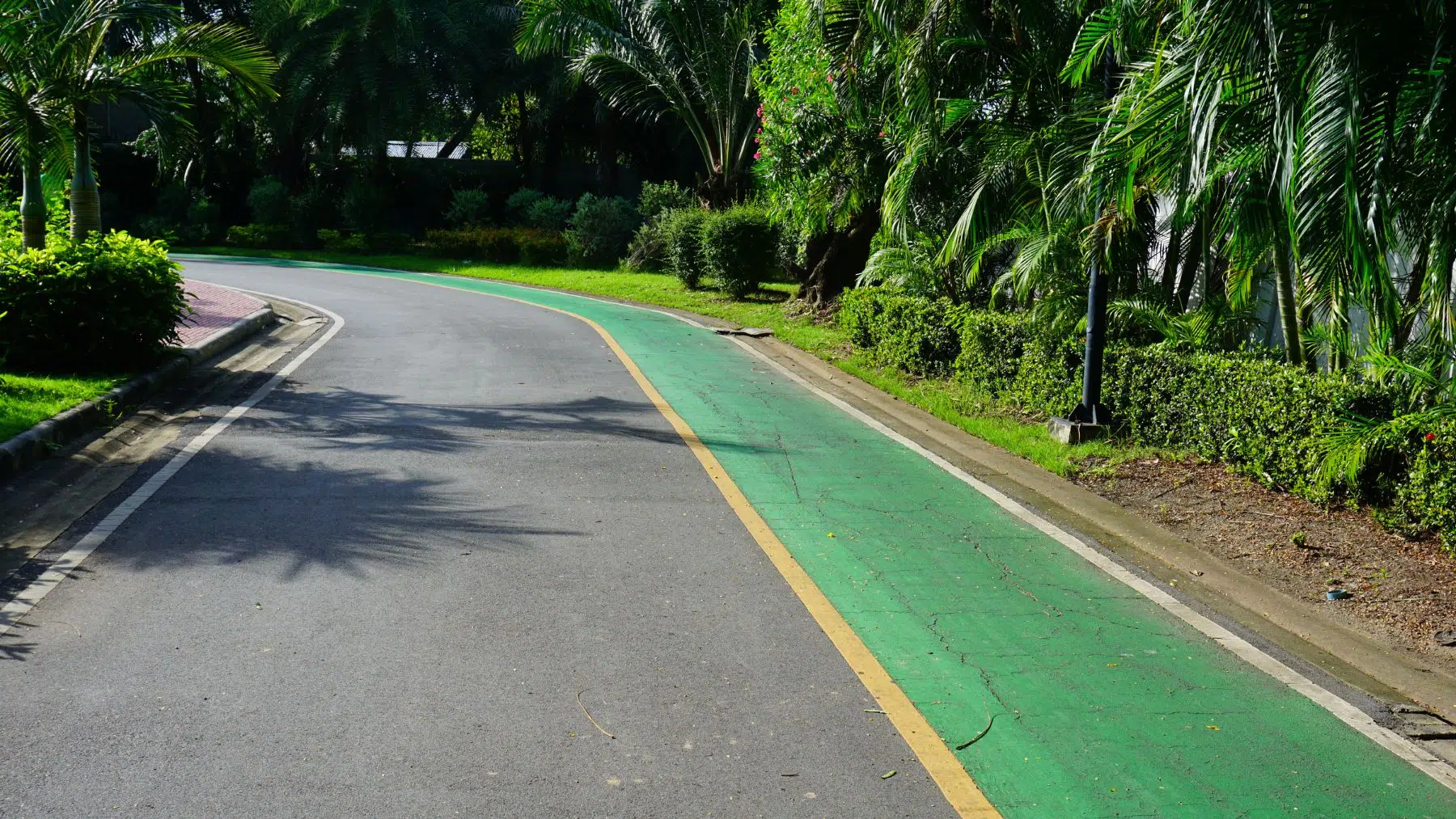
Green pavement lanes aren’t just a rumor anymore — they are rolling out across America, especially for bicycle facilities and so-called conflict zones where motorists and cyclists interact.
The Federal Highway Administration has given interim approval under the national Manual on Uniform Traffic Control Devices (MUTCD) for the optional use of green colored pavement in marked bike lanes to boost visibility and alert drivers to where bicycles are expected to operate.
If there’s one state that’s leaned into this trend, it’s Florida. Transportation agencies there have adopted MUTCD-aligned design and installation requirements for green-colored pavement markings on bike lanes and multi-use paths.
Under the MUTCD rules, green is not just decorative. It’s a legitimate traffic control device meant to communicate a reserved space (usually for cyclists) and to increase conspicuity.
But the shift goes beyond paint. Or at least, so says the Florida Department of Transportation.
Drivers are being conditioned to expect these different colors, to watch for vulnerable road users, and to adjust behavior accordingly. You’ll literally be driving on green lanes now, and you won’t be able to ignore them.
Read the whole thing?
Get the week's signal, not the noise
Our sharpest reporting on energy, climate and nature — free, once a week.