
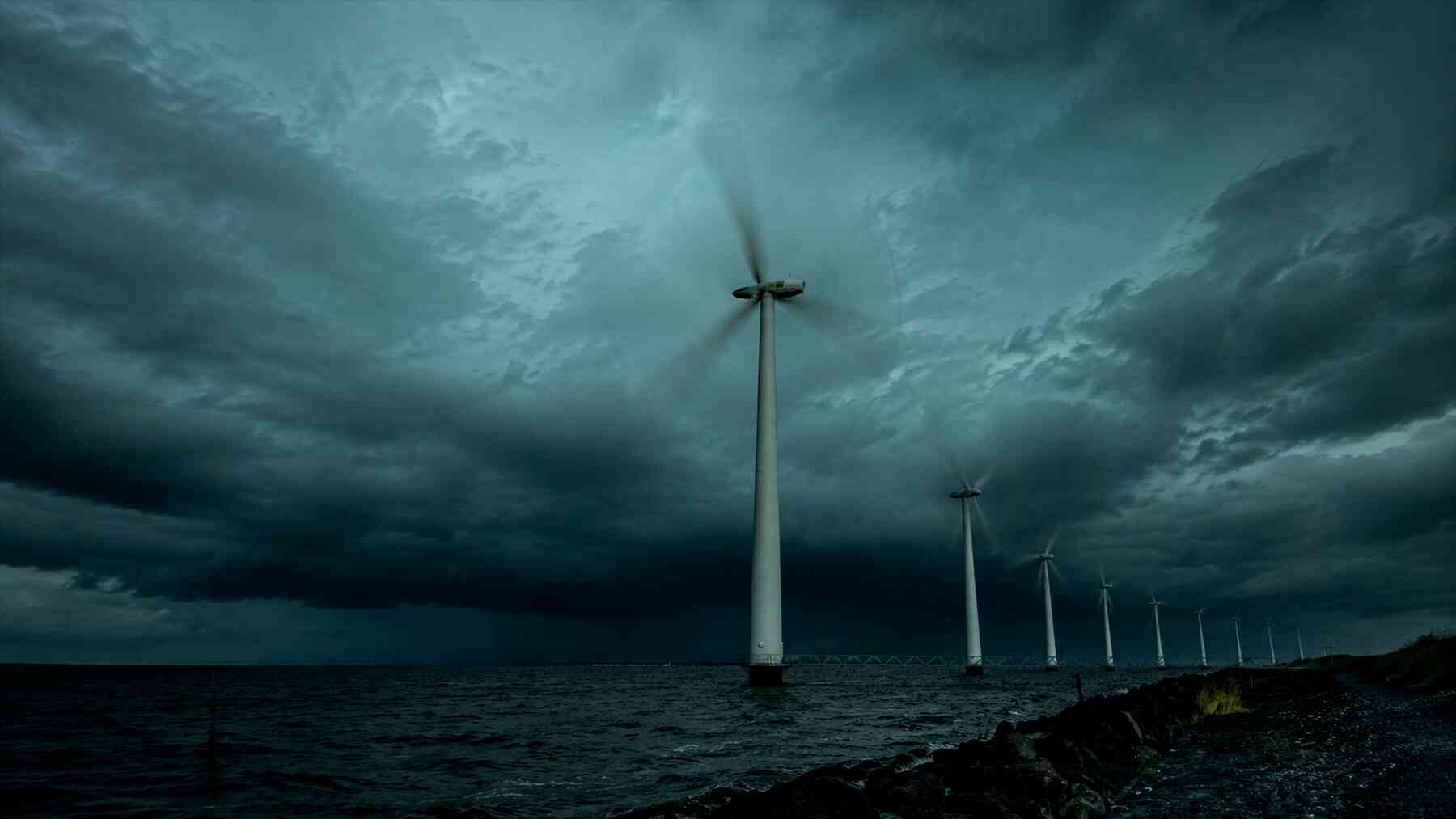
Far out in the German North Sea, the Global Tech I wind farm towers above the water.
There are 80 turbines whose only job is to harvest wind energy. This shouldn’t be difficult, considering the intense ocean gales over the ocean.
But something strange happens on perfectly clear days.
The wind suddenly vanishes, like all the energy has been sucked out of the atmosphere.
What could be stealing the wind miles before it reaches the farm out at sea?
How 80 turbines suddenly hit a wall of windlessness
The Global Tech I wind farm is responsible for sending 400 megawatts of clean power to hundreds of thousands of homes.
The 80 turbines are designed with top-class green engineering. There’s no reason why they shouldn’t perform.
But sometimes, the control room is faced with a mystery in the tracking. The supervisory control and data acquisition system (SCADA) starts recording sudden dips in power production.
Yet the weather forecast promises strong gales. And the blades are angled perfectly. And there are no mechanical problems.
But the kinetic energy is nowhere to be found.
It’s almost as if there’s a great big wall between the turbines and the air currents. And it must be because the air is being intercepted before it gets close to the farm.
The wind isn’t just dying down; it’s being altered and extracted by some force.
An investigation into wind theft
Researchers trying to get to the bottom of the kinetic energy loss had to become high-tech detectives. Cutting-edge tools were brought in to scan the atmosphere.
First, they pulsed long-range Doppler lidar laser beams from the turbine platforms. Then, they gathered wide-area radar snapshots from space satellites. The data pointed to a phenomenon more widespread than the researchers suspected. It comes down to atmospheric stability.
The atmosphere is stable when warm air blows over the cold water of the ocean. There’s no vertical turbulence, so the air layers do not mix.
This means that the wake from a wind turbine doesn’t recover quickly. Instead, it functions like a low-friction path for the air that gets drained.
In turbulent conditions, the wakes dissolve within six miles. But under stable conditions, the satellite imagery revealed a different story. A ‘wind shadow’ was stretching across the ocean, extending 160 feet above the tips of the rotors.
Where did this shadow end, and what cast it?
The culprit was the wind farm’s cousin
The mystery was solved, and the answer was unexpected. Could another wind farm miles and miles away really take another farm’s wind?
The satellite and laser data tracked the wind loss over the horizon and found it led to a cluster of turbines upstream. These spun so powerfully that they got to the energy first.
What they left was a 34-mile-long wake of slower air.
But it didn’t end there, because the wakes of individual turbines merge into a much bigger wall of depleted atmosphere.
By the time it got to the Global Tech I farm, there was no energy left to harvest.
A new planning complication: Ensuring everyone gets a fair share of the sky
The discovery has got renewable energy engineers hopping. The study proves that offshore turbine clusters can accidentally rob their neighbors from many miles away.
There’s now a major spatial planning crisis.
Germany alone is expanding its offshore capacity, aiming for 15 gigawatts. If countries keep crowding the ocean with large-scale farms, they will inevitably block each other’s air supply.
Offshore wind is no longer about isolated green installations. The wind industry has to work as a shared ecosystem if it’s going to expand.
As the demand for ocean real estate grows with the boom in global renewable energy projects, how will it be decided who gets to install where?
If you want to learn more about these findings, you can check the complete study here: Schneemann, J., Rott, A., Dörenkämper, M., Steinfeld, G., and Kühn, M.: Cluster wakes impact on a far-distant offshore wind farm’s power, Wind Energ. Sci., 5, 29–49, https://doi.org/10.5194/wes-5-29-2020, 2020
Read the whole thing?
Get the week's signal, not the noise
Our sharpest reporting on energy, climate and nature — free, once a week.


