


The idea that a color or light can be invisible yet detectable seems like a contradiction.
Yet the latest research indicates this is not only possible, but proven.
And the discovery has far-reaching beneficial health applications, crossing the border between insect and human life.
How would you imagine the day-to-day workings of the eye of a dragonfly could one day lead to a medical revelation that extends people’s lives?
Dragonflies and humans: What we have in common
Despite the immense differences in biology and physiology, there are some overlaps between humans and insects. And medical researchers want to tap into that.
It’s now known that dragonflies and humans share a fundamental biological foundation for vision.
But the dragonfly can zone in on a “hidden” spectrum that we may one day understand, but never perceive.
The main similarity between dragonflies and us is the reliance on opsins. These specialized proteins react to light and prompt the brain to interpret the color.
But this is where the dragonfly levels up.
Humans can detect a spectrum of blue, green, and red light. But these insects draw on a far more complex ability that pushes the boundaries of the visible spectrum.
Humans can get by with “basic” three-color vision. But what do dragonflies have that fortifies them with “super-vision” perception?
Beyond the human rainbow: The dragonfly’s hidden edge
A dragonfly’s enhanced vision is by no means a minor adaptation; it’s a specialized perception.
The unique opsin proteins in a dragonfly’s eye absorb light at wavelengths of around 580 nanometers. They can perceive shades of light on the edges of the spectrum, way beyond our capacity.
To humans, this color of light may as well be nonexistent.
But the dragonfly wouldn’t be able to navigate its environment without it.
One of the features that makes dragonfly visual pigments remarkable is “bistability.” This means they can switch between states when exposed to different shades of light.
This ability facilitates the extreme speed and responsiveness needed for high-velocity flight. It also enables tracking of prey against complex backgrounds like water and the detection of subtle movements of predators.
When it comes to red sensitivity, dragonflies possess a highly sensitive red opsin. They can see “deeper” into the red spectrum, nearing the infrared range.
A feat impossible for the human eye.
This is according to the study, “Dragonflies can see a color humans can’t and it could change medicine,” published by the Osaka Metropolitan University in Science Daily.
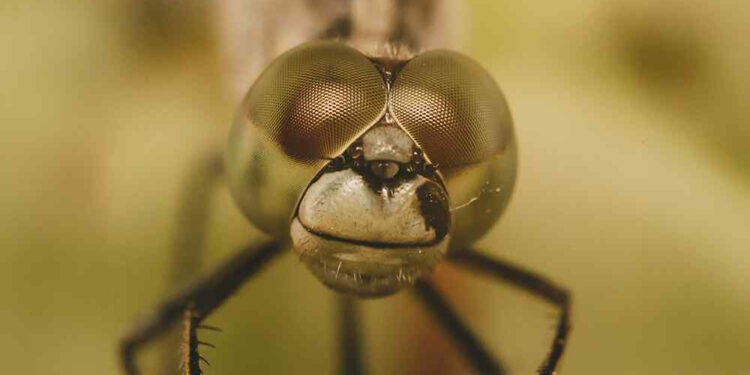
How can medical science leverage this insect’s “invisible color” ability for the benefit of our health?
Precision light: Decoding the future of optogenetic science
The deep-red-sensitivity discovery is more than just a biological curiosity.
It has practical implications for our future and our health.
By studying how these insects process deep-red light, scientists believe we can develop more sophisticated medical tools and imaging sensors.
But it’s the field of optogenetics that will likely reap the greatest benefits from this research.
Optogenetics is a cutting-edge biological technique that uses light to control neurons in real time.
Turning neurons into biological “light switches”
Researchers can shine a laser or LED onto these cells, which will either activate or silence the neuron instantly.
It’s a game-changer in medicine because the electrical stimulation currently being used for brain studies has shortcomings.
But optogenetics provides millisecond precision and high selectivity.
Imagine new treatments for memory loss, Parkinson’s Disease, and blindness.
As we learn to look to nature for solutions, we move closer to a future where the “limits” of our health are simply solvable problems we haven’t yet shed light on.