

Picture a machine that goes from a dead stop to 100 miles per hour in less than a single second.
Not a sports car, not a rocket sled, a wheeled machine on a strip of asphalt with a person strapped inside.
The forces packed into that one second are violent enough to bend the imagination.
It is the kind of speed that turns a second into a blur of fire and smoke.
And yet the fastest launch humans have ever engineered is wildly outclassed by an animal you could hold in one hand.
The launch that feels biologically impossible
Top Fuel dragsters are the quickest accelerating racing machines on the planet.
They reach speeds beyond 330 miles per hour and cover a 1,000 foot run in about 3.6 seconds.
To feel what that means, think of the last time you merged onto a freeway.
Now imagine covering the length of three football fields before you could finish saying the word acceleration.
You pressed the pedal and reached 60 miles per hour in maybe seven or eight seconds.
A Top Fuel car reaches 100 miles per hour in as little as 0.8 seconds, less than a third of the time a production sports car needs to hit 60.
That gap between an ordinary car and a dragster is wider than the gap between a bicycle and that car.
It feels almost biologically impossible for a wheeled thing to move that way.
What that speed does to the driver
The forces inside the cockpit are not abstract numbers.
The driver rides an average of about 4 g across the run, with peaks above 5 g.
Fighter pilots train for years to stay conscious under that kind of sustained g force.
A Top Fuel driver takes those peaks in the first breath of a run that lasts under four seconds.
When the run ends, it does not end gently either.
The parachutes snap open at over 310 miles per hour, yanking the driver close to negative 5 g in the opposite direction.
This is the outer edge of what a human body and a human machine can survive together.
The thumb sized striker that leaves it behind
Now shrink the whole story down to something the size of a candy bar.
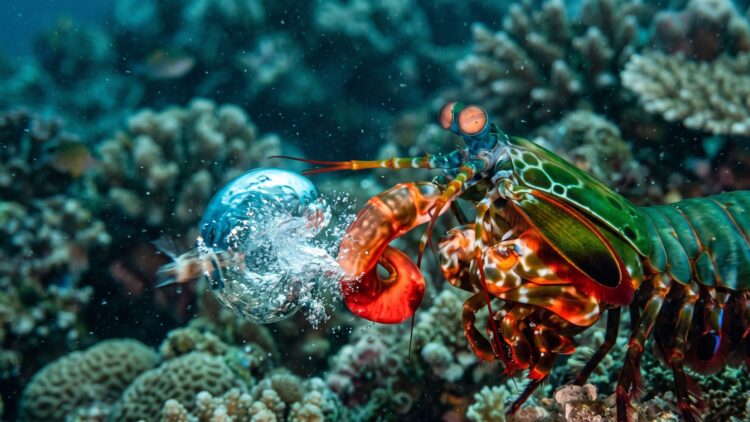
In warm, shallow reef water lives the mantis shrimp, a creature built like a cross between a lobster and a loaded catapult.
It looks almost cartoonish, painted in bright greens and reds, right up until it decides to strike.
Its striking claw outruns a Top Fuel dragster’s acceleration by a margin that is hard to hold in your head.
A smasher’s claw fires with an acceleration around 10,400 g and reaches 23 meters per second from a standing start.
A dragster peaks at just over 5 g.
That makes the little animal roughly 2,000 times quicker off the mark than the fastest machine on the strip.
All of it happens in less than a thousandth of a second, faster than your eye can register.
Fast enough to boil the water around its claw
The claw moves so fast that it does something water is not supposed to do.
The pressure in front of the strike drops so low that the water briefly flashes into vapor, forming a bubble in the middle of the sea.
That bubble collapses almost instantly, hitting the prey a second time like a shockwave arriving just after the first blow, a one two punch confirmed by high speed cameras.
The collapse is so extreme it releases a flash of light and a burst of heat for a fraction of an instant.
For that split second the tiny pocket of water heats to thousands of degrees.
The blow is strong enough to shatter shells and even crack the glass of an aquarium.
Curious minds who love strange ocean creatures tend to meet the mantis shrimp and never quite forget it.
Why the smallest striker changes how engineers think
The mantis shrimp does not reach this speed with brute muscle.
It stores energy in a springy, saddle shaped piece of its arm, held under tension by a latch, then lets it go all at once like a loaded crossbow.
Roboticists and engineers have studied that spring and latch to build faster small robots and tougher materials that borrow from the claw.
The claw survives its own strike thousands of times without breaking, which is its own engineering puzzle.
The same trick shows up across nature, in the snapping limbs and tongues of other animals that punch far above their size.
A dragster burning a river of nitromethane and a shrimp the weight of a granola bar are running on the same basic physics, just at opposite ends of the scale.
One is the fastest wheeled thing people have ever built.
The other was already doing it for millions of years before we thought to ask how.