
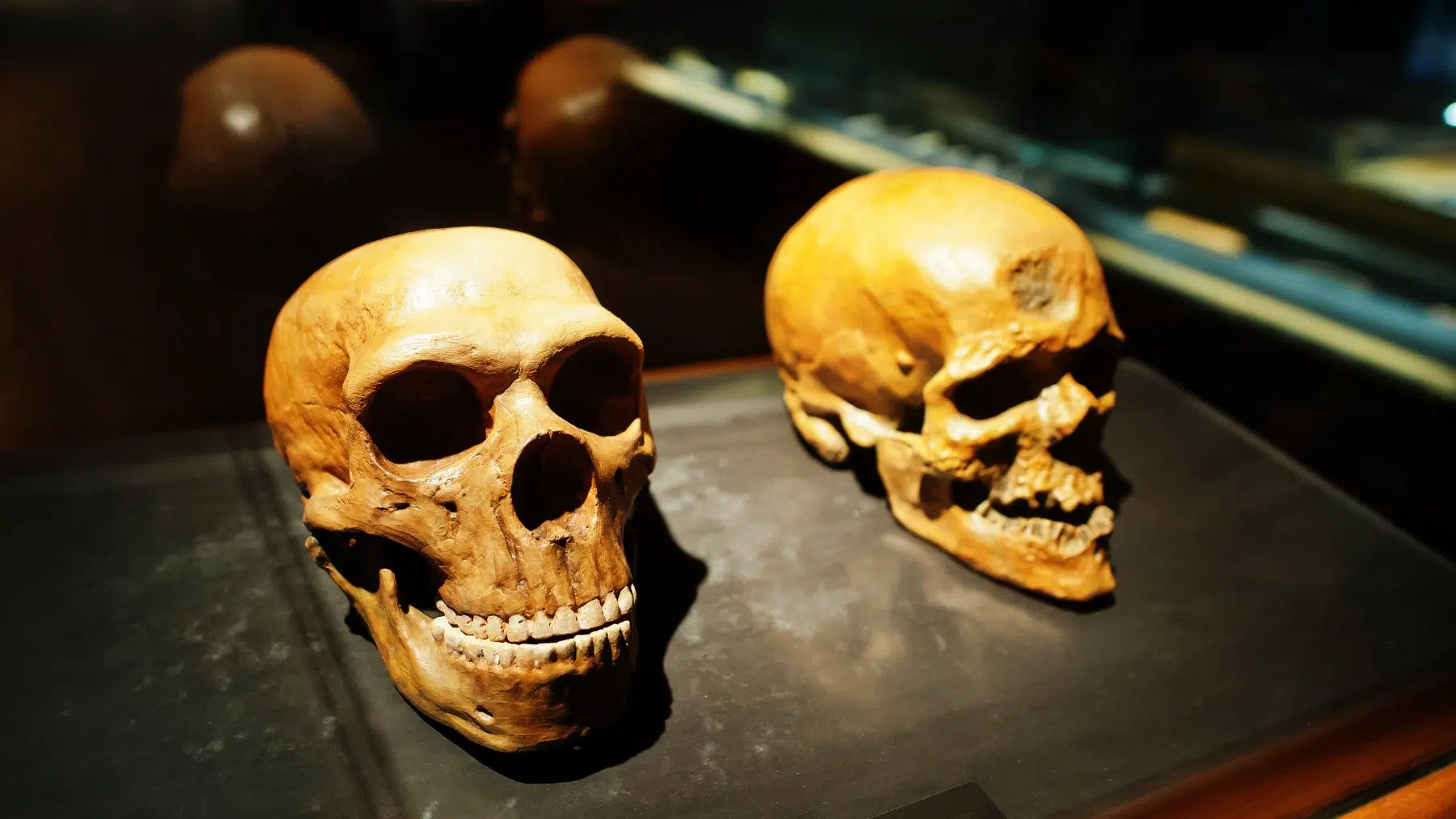
For decades, the story of our origins seemed almost settled. Modern humans appeared around 300,000 years ago. Before that, other human species walked the Earth. The timeline felt structured, carefully arranged like chapters in a book. Then a damaged fossil, long stored and largely accepted for what it was thought to be, was examined again. What scientists saw forced them to reconsider one of the most fundamental moments in our history.
A discovery buried in the past
The fossil was not new. It had been discovered years ago in Hubei Province in central China. At roughly one million years old, it was already ancient beyond imagination. When researchers first studied it, they placed it into a familiar category and moved on.
That classification fit the accepted evolutionary timeline. Nothing about the fossil seemed dramatic enough to challenge it.
But there was one problem: the skull had been crushed and distorted over time. Its true shape had been hidden by pressure, age, and damage. Some features looked unusual, but they were easy to dismiss under layers of deformation.
For years, it remained quietly filed under an existing species name.
Technology opens an unexpected door
A new team of researchers decided to look again. Using advanced scanning methods and computer modelling, they digitally reconstructed the skull. They removed the distortions, restoring its original structure as accurately as possible. Then they created 3D-printed replicas to study it from every angle.
The result surprised them.
“From the very beginning, when we got the result, we thought it was unbelievable,” said Prof Xijun Ni of Fudan University, who co-led the study published in the journal Science.
They ran the tests again. Different models. Different methods. Each time, the answer pointed in the same direction.
The fossil did not match what they had thought.
A skull that changes the timeline
The skull, known as Yunxian 2, is now believed not to belong to Homo erectus, as previously assumed, but to an early form of Homo longi — a sister species at a similar level of development to Neanderthals and Homo sapiens.
That identification carries enormous implications.
If Yunxian 2 represents Homo longi and lived one million years ago, then early versions of Neanderthals and Homo sapiens may also have existed at that time. Genetic evidence suggests these groups overlapped.
That would push back the emergence of large-brained humans by at least half a million years.
Currently, the earliest widely accepted evidence for Homo sapiens dates to around 300,000 years ago in Africa. But this new analysis suggests that our lineage may have begun emerging much earlier.
Prof Chris Stringer of the Natural History Museum, who co-led the research, said there are likely to be million-year-old fossils of Homo sapiens somewhere on Earth — they just have not yet been discovered.
The revised timeline would mean that Homo sapiens, Neanderthals, and Homo longi may have co-existed for around 800,000 years. During that long overlap, they may have interacted and even interbred.
The new framework could also help solve what scientists call the “muddle in the middle” — human fossils dating between 800,000 and 100,000 years ago that have been difficult to classify. With an earlier split between major groups, those fossils may now fit more clearly into the human family tree.
“Human evolution is like a tree,” Prof Ni said. “This tree included several branches, and there were three major branches that are closely related, and they may have some interbreeding to each other, and they coexisted for almost 1 million years.”
A debate far from over
Not everyone is ready to redraw the timeline.
Dr Aylwyn Scally, an evolutionary geneticist at Cambridge University, cautioned that both skull analysis and genetic timing estimates come with considerable uncertainty.
“It is very difficult to place a time when these populations may have co-existed to within 100,000 years, or even more,” he said.
He described the conclusions as plausible but far from certain. More supporting evidence — especially additional genetic data — would be needed before the wider scientific community could fully accept such a major shift.
There are also million-year-old human fossils in Africa and Europe that must be incorporated into the analysis before firm conclusions can be drawn about where Homo sapiens first emerged.
For now, Yunxian 2 stands as a fossil that challenges the established narrative.
If the study’s conclusions are confirmed, the beginning of our story will not just move slightly. It will stretch far deeper into the past — reshaping the way we understand how and when humanity truly began.
Read the whole thing?
Get the week's signal, not the noise
Our sharpest reporting on energy, climate and nature — free, once a week.


