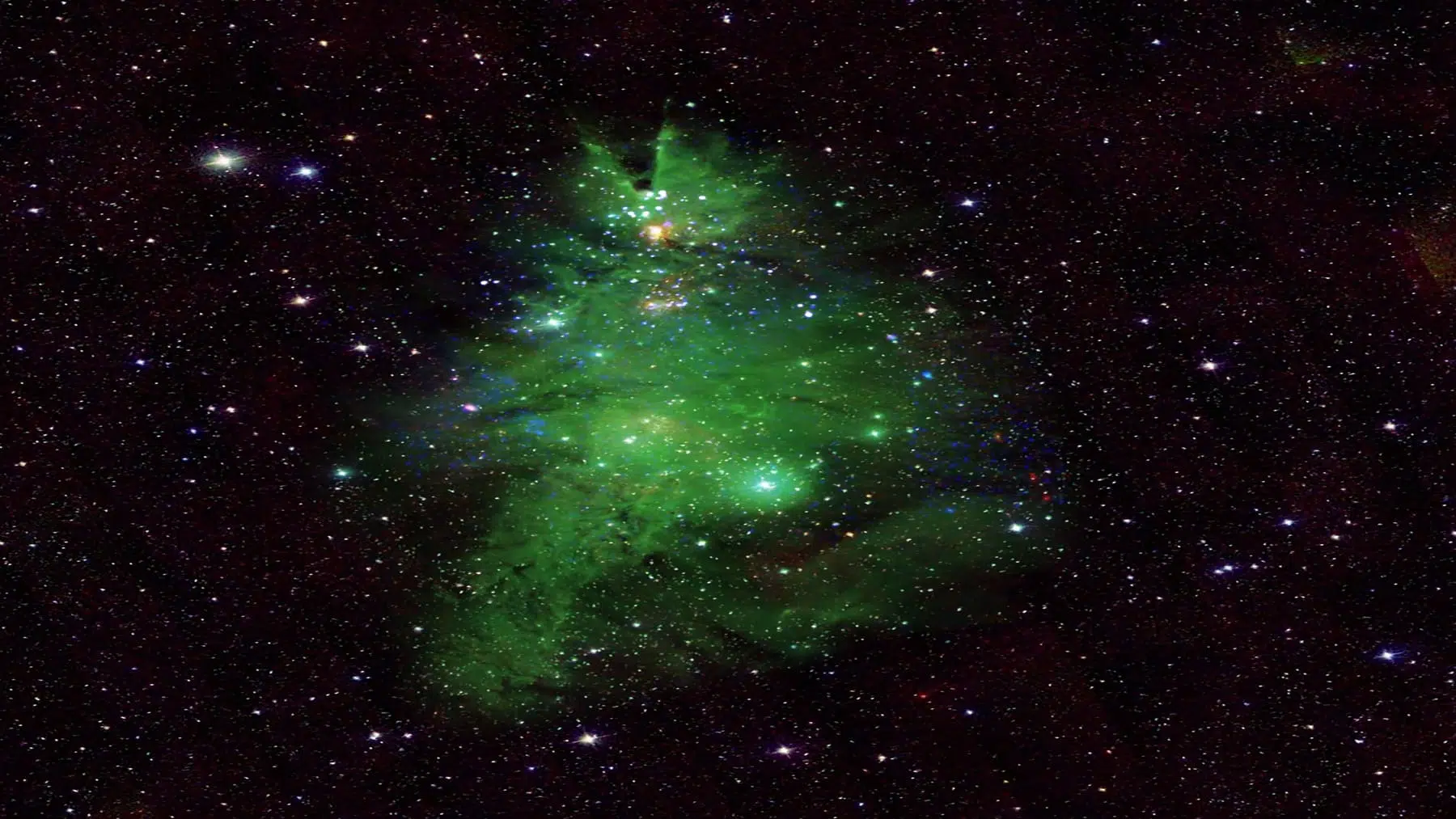
In the far distance of space, astronomers and scientists have continued to find celestial objects that pose more of a mystery than a discovery. However, as we will see in today’s article, NASA has discovered that some of these objects have coincidental resemblances to objects on Earth. Today’s article takes a winter turn as we discuss a celestial cluster with a striking resemblance to a Christmas tree.
Astronomers discover rare star cluster in space
One of the greatest joys of astronomy is the ability to see our world beyond the night sky. Every time astronomers scan the endless expanse of space, there is always something new to discover. However, there are exciting moments when astronomers stumble upon objects that look familiar. Their most common appeal is to name their discovery after it.
Following this narrative, scientists at NASA have found a cosmic Christmas tree in space. It is called so because it resembles a typical Christmas tree. It was found in our Milky Way galaxy and was observed to be a triangular cluster of stars. Despite its familiar appearance, there was something quite mysterious about this cosmic Christmas tree.
This led scientists at NASA to carry out further analysis of what is now known as NGC 2264. This triangular and glowing green spectacle was found at a distance of 2,500 light-years away from Earth. It hosted a convergence of young stars that ranged in age from one to five million years.
NASA unravels mystery behind cosmic Christmas tree
NASA discovered NGC 2264 via the Chandra X-ray Observatory. The images obtained showed the object to be made of stars, some of which have masses less than the Sun, and others with sizes up to seven times the mass of the Sun. NASA also analyzed optical data from the National Science Foundation’s 0.9 m telescope.
The results from the optical data revealed gases originating from the green nebula. This is in a manner that is similar to the structure of pine needles on a tree. However, it is essential to note that the image had been rotated at about 160 degrees clockwise from the astronomer’s North point to resemble a Christmas tree.
In addition, the young stars in NGC 2264 were seen to be volatile. This was because they gave off strong flares when observed under X-ray or any other type of lighting, just like the unexpected cosmic anomalies, stunning scientists. However, in order to replicate the imagery, NASA simulated an artificial model with coordinated variations to show the location of each star on the cosmic Christmas tree.
NASA used color mapping for representation
Aside from the Chandra telescope, the agency combined several other telescopes to observe different physical conditions. This came back as wavelengths that represented different physical conditions, like temperature or energy. Therefore, in order to form a collective understanding, NASA represented each wavelength in colors.
The relevance of this discovery for astronomers
For years, astronomers have continued to observe stars and nebulae in peculiar conditions. NGC 2264 is an open window, as it gives astronomers an opportunity to observe nearby stars, plus a unique cluster and structure.
Notwithstanding, the cosmic Christmas tree contains an envelope of stars in different stages of development. This allows scientists to perform a comparative study of stars within a single spatial frame. However, given their masses, certain objects would provide clearer development maps than others.
Eventually, scientists would be able to combine the optical, infrared, and X-ray data obtained. This would open them to radiation, stellar, and magnetic fields within the framing of NGC 2264. Any conclusions drawn would help refine stellar models and help expand on the birth and death of stars, like the Methuselah star discovery, breaking cosmic logic.
Read the whole thing?
Get the week's signal, not the noise
Our sharpest reporting on energy, climate and nature — free, once a week.