
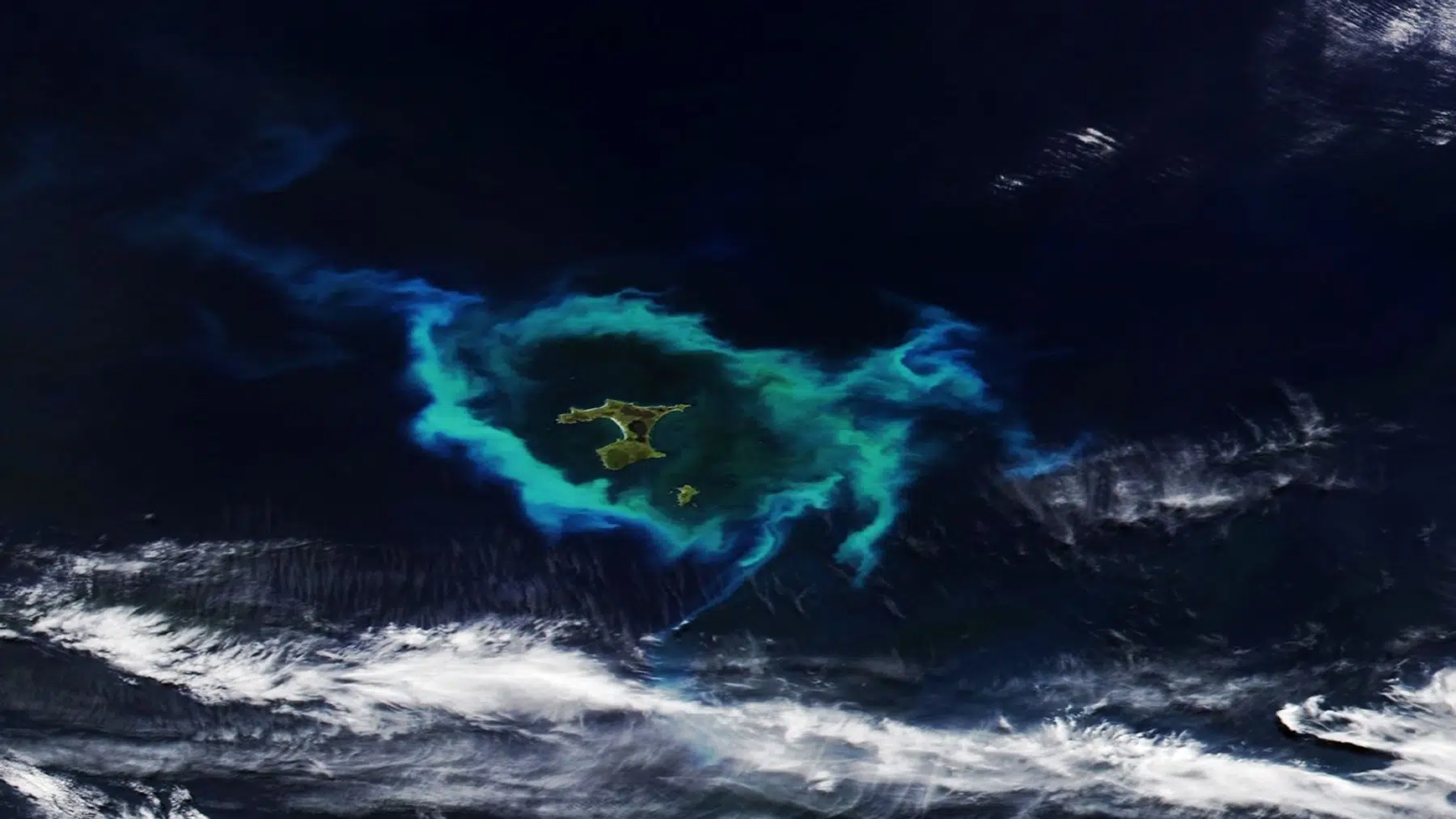
The South Pacific Ocean is known for its wild beauty and rich marine life, especially in remote regions far from major human activity. From space, this vast stretch of water usually looks calm and endless. But recently, something extraordinary appeared beneath the surface. NASA satellites detected glowing rings in the ocean—shapes so striking they resembled underwater auroras. What looked like abstract art from above turned out to be a powerful signal that life below the waves was thriving.
What makes the South Pacific so special?
The South Pacific is not just large—it is one of the most biologically active ocean regions on Earth. Powerful currents move through it, carrying nutrients from deep waters up toward the surface. These nutrients act like fuel for life, allowing ecosystems to grow even far from land.
Some areas benefit especially from this natural circulation, creating hotspots where marine life gathers in astonishing numbers.
A unique meeting of two oceans
One of these hotspots lies near the Chatham Islands, where cold southern waters collide with warmer subtropical currents. This meeting creates an environment rich in nutrients and energy.
The constant mixing of water prevents stagnation and ensures that food is always available for organisms of all sizes. It is an underwater crossroads where life finds everything it needs to grow.
Life above and below the surface
Because of these conditions, the region supports an incredible variety of marine animals. Fur seals, sea lions, dolphins, and whales move through these waters, alongside fish species like cod, hoki, and ling.
But while these larger animals often steal the spotlight, the real stars of NASA’s discovery are far smaller—and far more numerous.
A glowing signal seen from space
Earlier this year, NASA satellites spotted something unusual around the Chatham Islands: a massive circular bloom of microscopic life. From above, it appeared as blue and green rings swirling gently in the ocean.
On land, the islands remain quiet and sparsely populated. Underwater, however, a spectacular natural event was unfolding on a scale large enough to be seen from orbit.
The tiny organisms behind the glow
The glowing rings were caused by phytoplankton, microscopic organisms that form the foundation of ocean life. Like plants, they use sunlight to produce energy, and when conditions are right, their populations can explode.
NASA explained that well-mixed waters and long daylight hours created the perfect environment for this bloom to flourish.
Why this matters for the entire ecosystem
Phytoplankton may be tiny, but they are the base of the marine food chain. When they thrive, everything above them benefits.
Fish feed on them, larger animals feed on the fish, and entire ecosystems grow stronger. That is why regions like this support productive fisheries and long-standing coastal traditions.
A vital resource for people and wildlife
The waters around the Chatham Islands are known for valuable species such as rock lobsters, blue cod, and pāua, a culturally important sea snail in New Zealand.
For Indigenous communities, pāua has deep cultural meaning. For fishermen, it represents an essential and sustainable food source. All of it depends on the health of the smallest organisms in the sea.
Where else do these glowing blooms appear?
Although this circular formation was unusual, phytoplankton blooms are found in many nutrient-rich coastal regions. Similar displays occur in places like Florida, the Caribbean, the Philippines, and famous bays such as Mosquito Bay in Puerto Rico or Vaadhoo Island in the Maldives.
Warm water, sunlight, and nutrients are the key ingredients—and when they align, the ocean can appear to glow.
A clear sign of a living ocean
These glowing patterns are more than beautiful images. They are a visible sign of healthy, active waters.
Thanks to NASA’s satellite technology, we can now witness these events from space and better understand how alive our oceans truly are. Sometimes, the strongest signs of life are not loud or dramatic—but quietly glowing beneath the surface.
Read the whole thing?
Get the week's signal, not the noise
Our sharpest reporting on energy, climate and nature — free, once a week.


