On a blazing July afternoon, two blocks can feel like two different planets.
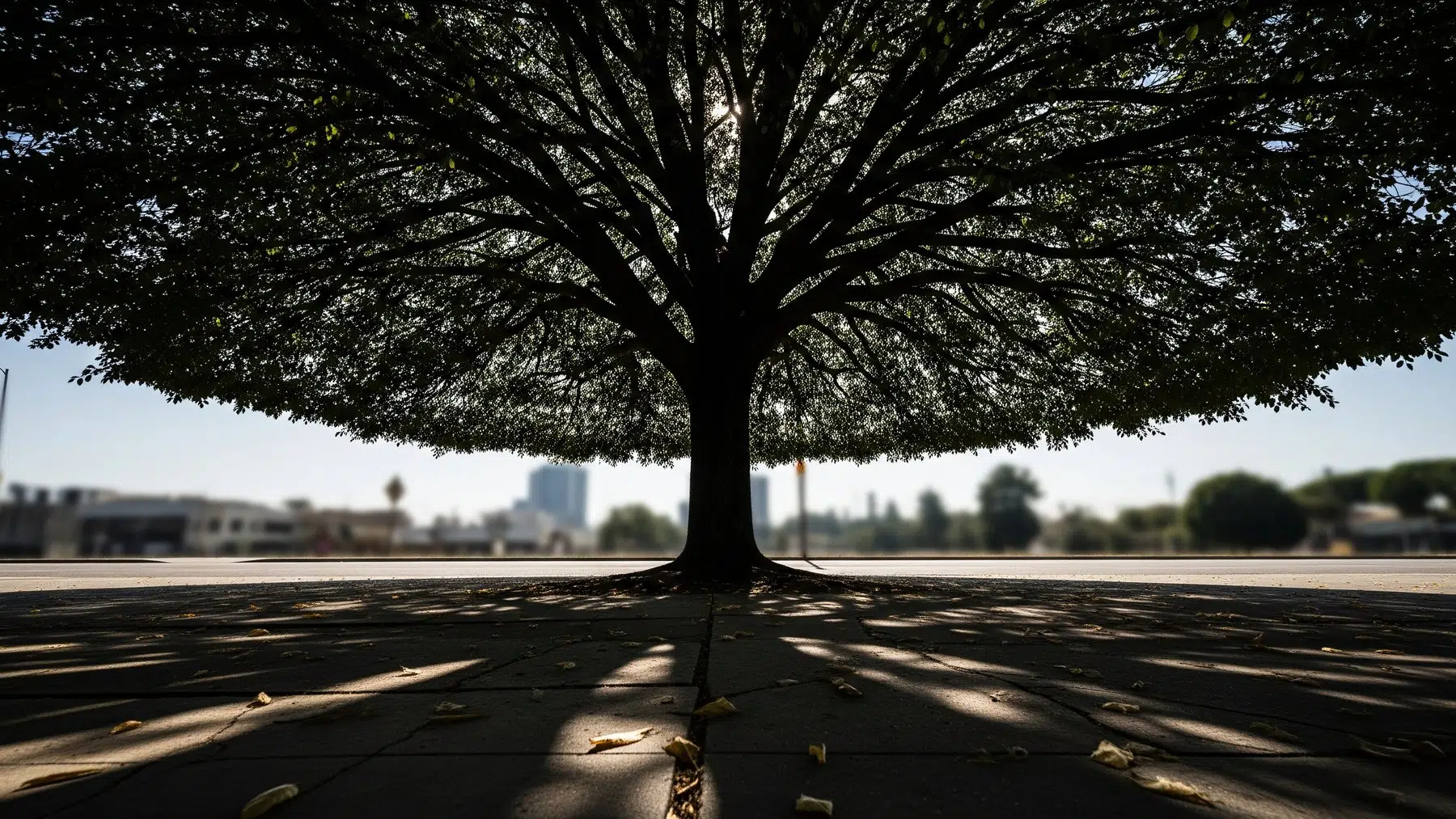
Turn down the street lined with tall maples and the air softens almost instantly.
Walk one block over, where bare concrete bakes under open sky, and the heat hits like a wall.
Same city, same hour, same sun.
Researchers have now measured that gap across 8,919 cities, and the trees turn out to cancel half the heat a city makes.
The strange part is which block gets them.
The city is running a heat engine
Cities trap heat in ways the countryside simply does not.
Concrete, asphalt and rooftops absorb sun all day and release it through the night.
Towns and cities usually sit 1 to 3 degrees Celsius hotter than the land around them, and some run as much as 7 degrees hotter.
Scientists call it the urban heat island, and it is separate from climate change itself.
It is heat the city manufactures on its own.
Trees fight it with two weapons at once.
They shade the ground before it ever heats up, and they release water vapor from their leaves, which cools the air around them.
The result works like a natural air conditioner, running on sunlight and rainwater.
The number that surprised the researchers
The team, led by The Nature Conservancy, pooled data from every one of those 8,919 large cities, home to roughly 3.6 billion people.
Then they modeled a scenario nobody wants to see, every urban tree removed.
Published in Nature Communications, the results found that existing tree cover cancels out about 48.6 percent of the heat island effect.
Put plainly, the canopy already cancels half the heat a city makes for itself.
Without those trees, the world’s urban heat islands would be roughly twice as intense.
More than 200 million people are already living in air more than half a degree cooler than it would otherwise be, simply because of the canopy overhead.
One co author described the effect as much larger than the team had anticipated.
That is cooling nobody paid for, delivered every summer, at no cost to the city.
No wiring, no compressors, no electricity bill.
The catch hidden inside a map of your city
Here is where the story turns.
The cooling is real, but it is nowhere near even.
Wealthier, more suburban and more humid cities have more trees on average.
Poorer cities, in hotter and drier climates, have the least.
Inside a single city the gap repeats itself, since one survey of American communities found low income neighborhoods carried about 15 percent less tree cover and ran hotter than wealthier districts.
Look at a canopy map of almost any American city and you are looking at a map of old housing policy, not of climate.
The people sweating through the worst of the summer are usually the people with the fewest trees on their block.
The canopy that could save lives is standing in the wrong zip code.
What the shade is actually worth in lives
This is not an aesthetic argument, and the number that proves it is grim.
A 2023 modeling study in The Lancet examined 93 European cities and the summer of 2015.
Roughly 6,700 premature deaths that year were attributable to the urban heat island effect.
Close to 40 percent of them could have been prevented if those cities had lifted tree cover to just 30 percent of their land area.
Not a forest, not a park system, a third of the ground in shade.
Heat kills quietly, mostly indoors, mostly among the old, the sick and the poor.
It rarely makes the news the way a flood does.
Which means the difference between those two blocks on a July afternoon is not merely comfort.
What trees can do, and what they cannot
The honest version of this story has a limit written into it.
The same study found that even with ambitious planting, trees can offset only about 10 to 20 percent of the urban warming projected by mid century.
The authors say it plainly, cities cannot rely on trees alone.
Cool roofs, reflective pavement and less waste heat all have to arrive alongside the canopy.
A tree is not a substitute for cutting emissions.
What trees do is buy time on your street, for the neighbors most likely to die without it.
Analysis of more than 60 cities worldwide finds large stretches of plantable land, especially along streets, sitting unused.
The gap is closeable, and the cheapest cooling technology available is already growing in half the city.
Trees also carry value no spreadsheet captures, from the birds nesting in the canopy to the child learning what shade feels like on a scorching afternoon.
The researchers behind it are clear that planting is a start, not a solution, and planting where it counts is the whole game.
Read the whole thing?
Get the week's signal, not the noise
Our sharpest reporting on energy, climate and nature — free, once a week.