Drive through Duplin County, North Carolina, and the county announces itself before you see a single barn. The smell hits first — thick, inescapable, somewhere between ammonia and rot. Beneath it lies a system of open waste lagoons holding millions of gallons of hog feces, serving nearly 1.8 million animals across 459 industrial farms.
Twenty-five years ago, North Carolina struck a landmark legal agreement with the country’s dominant hog producer — a binding deal, announced with fanfare, that was supposed to end all of this. It didn’t. The lagoons are still there. So is the smell. So are the communities living beside them. What happened between the promise and the present is a longer, harder story.
When Hurricanes Exposed a System Built to Fail
North Carolina’s Coastal Plain was never a sensible place to concentrate millions of hogs. Its shallow water table, broad floodplains, and regular hurricane strikes made large-scale waste storage a disaster waiting to happen. Yet the region became the birthplace of the American CAFO model anyway, driven by cheap grain and federal policies that pushed consolidation. Swine farms dropped from 15,000 to 5,800 while the hog population surged past 10 million — more than North Carolina’s human population.
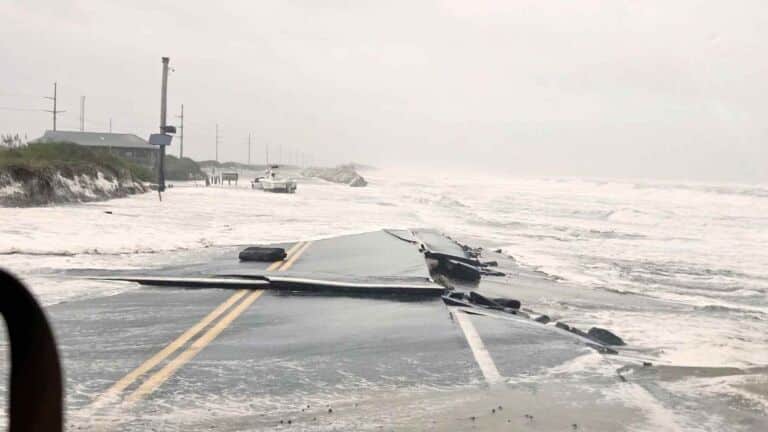
Hurricane Fran made the consequences undeniable in 1996. Lagoons breached, dead hogs floated down country roads, and tens of millions of gallons of waste contaminated rivers and private wells. Hurricane Floyd repeated the disaster in 1999. The state assembled a Blue Ribbon Commission, and a 1997 law introduced a moratorium on new lagoon-and-sprayfield operations.
The promise: A deal to replace the lagoons
In 2000, Attorney General Mike Easley negotiated the Smithfield Agreement — a binding pact requiring Smithfield Foods to fund research into “environmentally superior technologies” and eventually adopt them. The deal included $15 million for research and up to $2 million per year for 25 years in environmental enhancement grants. Easley announced it with confidence: “Industry leaders have agreed to fund the development of new technology to replace current lagoon systems.”
Scientists delivered. Engineers developed viable alternatives, with Super Soils — later rebranded Terra Blue — reducing ammonia by up to 99.9% and cutting pathogens, greenhouse gases, and odors by 90 to 99%. The technology worked. Negotiations, though, happened entirely behind closed doors. Michelle Nowlin, then an attorney with the Southern Environmental Law Center, later called it ethically wrong: “The community groups deserve to have their own seat at the table.”
How ‘economic feasibility’ became a veto
Smithfield held seats on the economic subcommittee tasked with evaluating whether the alternatives were “economically feasible.” The company argued that any net increase in cost was automatically disqualifying — and comparisons were made against existing, already-depreciated lagoons rather than the cost of building new ones. That framing made every alternative look prohibitively expensive. Public health benefits to neighboring communities were never adequately factored in.
A majority of the subcommittee’s economists concluded Smithfield could afford the transition. The industry’s dissenting minority prevailed in practice. Nowlin’s summary was blunt: “We knew we’d been played.”
The human cost of inaction
Residents near Duplin County’s CAFOs describe feces and urine misting from sprayfields onto their homes, cars, and skin. They can’t open windows or sit outside. Multiple studies link CAFO proximity to elevated rates of asthma, cardiovascular disease, infant mortality, and overall death. Ammonia from hog waste accounts for nearly half of North Carolina’s annual ammonia emissions, forming fine particulate matter — PM 2.5 — tied to lung cancer, COPD, and dementia. These risks fall disproportionately on Black and low-income communities.
Federal juries awarded CAFO neighbors $550 million in damages in 2018, later capped at $98 million under state law. Smithfield settled 21 remaining cases out of court in 2020. Based on construction and operational costs, that $98 million could have funded Super Soils on at least 17 corporate farms for a decade.
Grant money frozen, communities left to fight alone
The agreement’s environmental enhancement grants produced real results over two decades: $43 million funded 230 projects — wetland restoration, floodplain buyouts, forest preservation, and the closure of 250 abandoned lagoons holding 290 million gallons of waste.
Since 2023, all of it has been frozen. Lawsuits challenging the attorney general’s authority to disburse the funds have left nearly half of that year’s $2.2 million allocation in limbo. Ryke Longest, who helped draft the agreement, called the plaintiffs “disgruntled operatives who seek to restrict the powers of the attorney general.” Smithfield — now a subsidiary of WH Group, the world’s largest pork producer — reported $15 billion in sales and a record $1.3 billion in operating profit in 2025. Community groups aren’t waiting: REACH has partnered with Johns Hopkins University on independent air monitoring that could support future EPA lawsuits over CAFO toxic air exemptions.
Twenty-five years is long enough to judge an agreement. The Smithfield deal shows what happens when the communities most harmed are excluded from the solution — and when the industry causing the harm gets to define what “affordable” means. The lagoons are still there.
Read the whole thing?
Get the week's signal, not the noise
Our sharpest reporting on energy, climate and nature — free, once a week.