
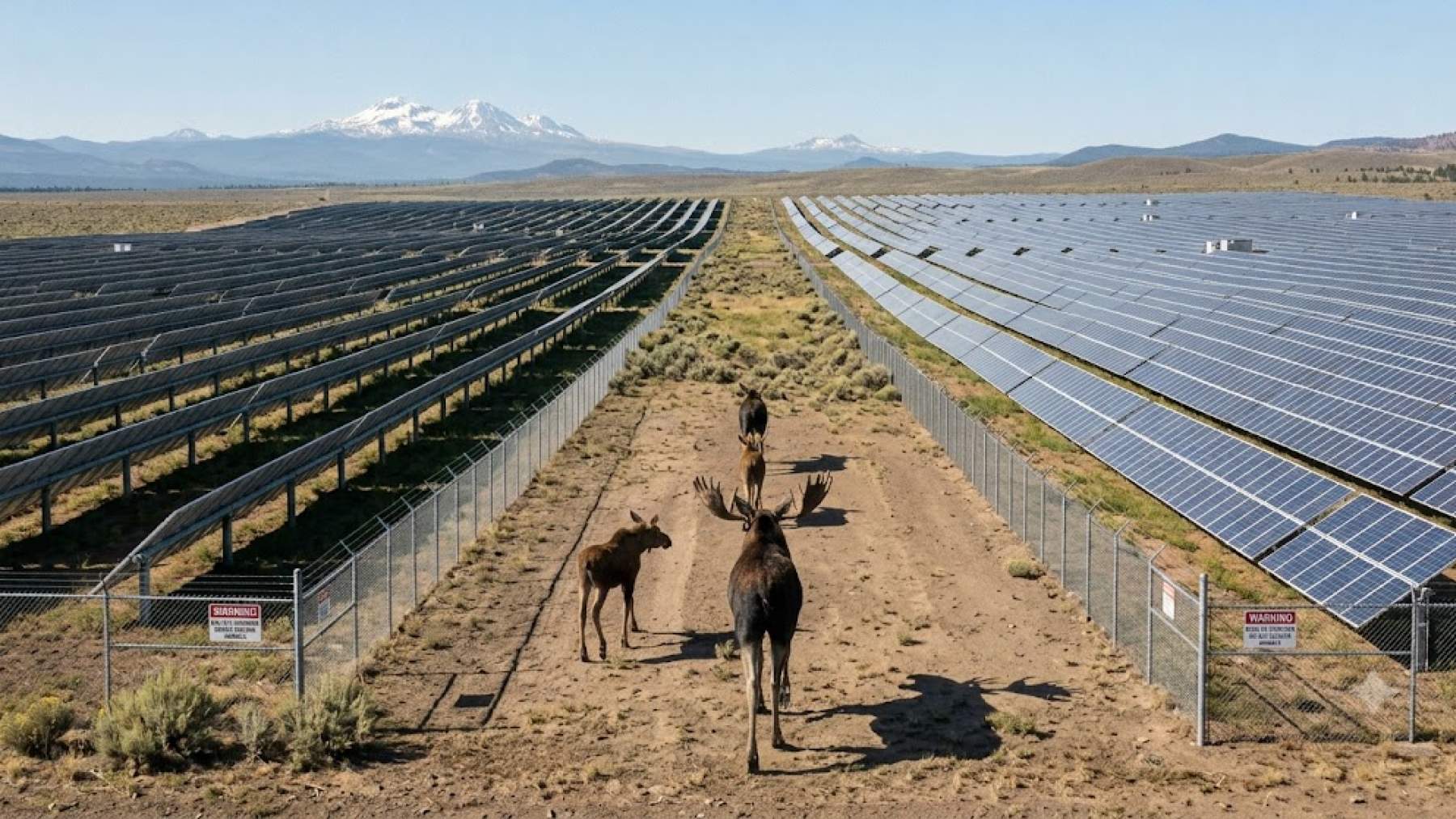
One of the largest solar installations ever in the state has just been approved in Klamath County, Oregon.
The decision means that hundreds of thousands of photovoltaic panels will soon replace the sagebrush rangeland. But standard perimeter fencing normally erected around the arrays is a barrier to wildlife.
Developers need to work around animal movement corridors while delivering power to the grid as renewable energy expands across rural landscapes. What solution did they come up with for the Oregon moose?
How solar power is leaving a fresh footprint in the Klamath Basin
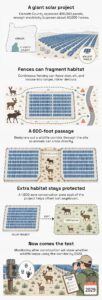
The Klamath Basin will soon be home to 406,000 solar panels after Invenergy got permission to build its Diamond Solar Energy Project.
The expected power output will be enough to power around 40,000 homes, which is actually more than the number of residential households in the county.
Naturally, security is essential around high-voltage equipment. Traditional methods involve high, continuous fencing around the whole perimeter of the project. While the fencing does its job of protecting the panels and battery storage units, it has effects on the desert ecosystem.
The native game species of the area have been using these open pathways in the landscape for as long as they have been around. They need to make their way over long distances to find food and follow the seasonal water.
When thousands of acres are enclosed, established grazing grounds are divided, and suddenly, the game are unable to cross the landscape like they used to.
Wildlife officials are considering the ecological impact
Habitat fragmentation is an important consideration for state wildlife officials when developers propose utility-scale energy projects.
Oregon’s Department of Fish and Wildlife pointed out some problematic aspects of the Diamond Solar layout. Originally, Invenergy described the land as degraded, saying it had minimal habitat value and could be utilized with little disruption to wildlife.
Biologists disputed this. They say that the rangeland is essential for migration. Without large spaces to use as passes, animals like deer, elk, and moose have to add many more miles to their journeys to get around perimeter fencing. This is detrimental to the animals’ health, because they have to use a lot more energy in the winter months. There is also an increased risk of traffic collisions along rural highways when they are forced to use bypass routes.
These safety risks were taken into account when local approval was first granted. Planning commissioners have stipulated that sites must incorporate water storage facilities and emergency access roads. There is a known risk of fire tied to these kinds of battery storage systems.
Changes had to be applied to the plans before the final approval was granted.
Coexistence was integral to the design
The habitat fragmentation issue was resolved by working a 600-foot-wide wildlife corridor into the facility. It runs straight through the middle of the site, allowing moose and mule deer populations, among other species, to maintain their migration routes without having to follow the fencing.
Invenergy also agreed to maintain a 1,900-acre conservation zone to the east of the main infrastructure. It is a protected offsite parcel of habitat intended to compensate for the loss of native sagebrush during construction.
A practical framework to apply
The project is expected to be operating by the end of 2029. This Klamath County plant will be a test of whether this kind of layout design is enough to protect the movement of wildlife.
The long-term success depends on how the animals actually behave when they find the new site in their way. Biological monitoring will be ongoing after construction is finalized.
Working movement corridors directly into solar plant plans sets an example for balancing renewable power expansion with wildlife conservation.
There are other smart strategies being conceptualized to keep migration routes open, like permeable fencing and planting native vegetation. Developers are increasingly realizing the value of coexistence with wildlife as we forge forward with green energy endeavors.
Read the whole thing?
Get the week's signal, not the noise
Our sharpest reporting on energy, climate and nature — free, once a week.


