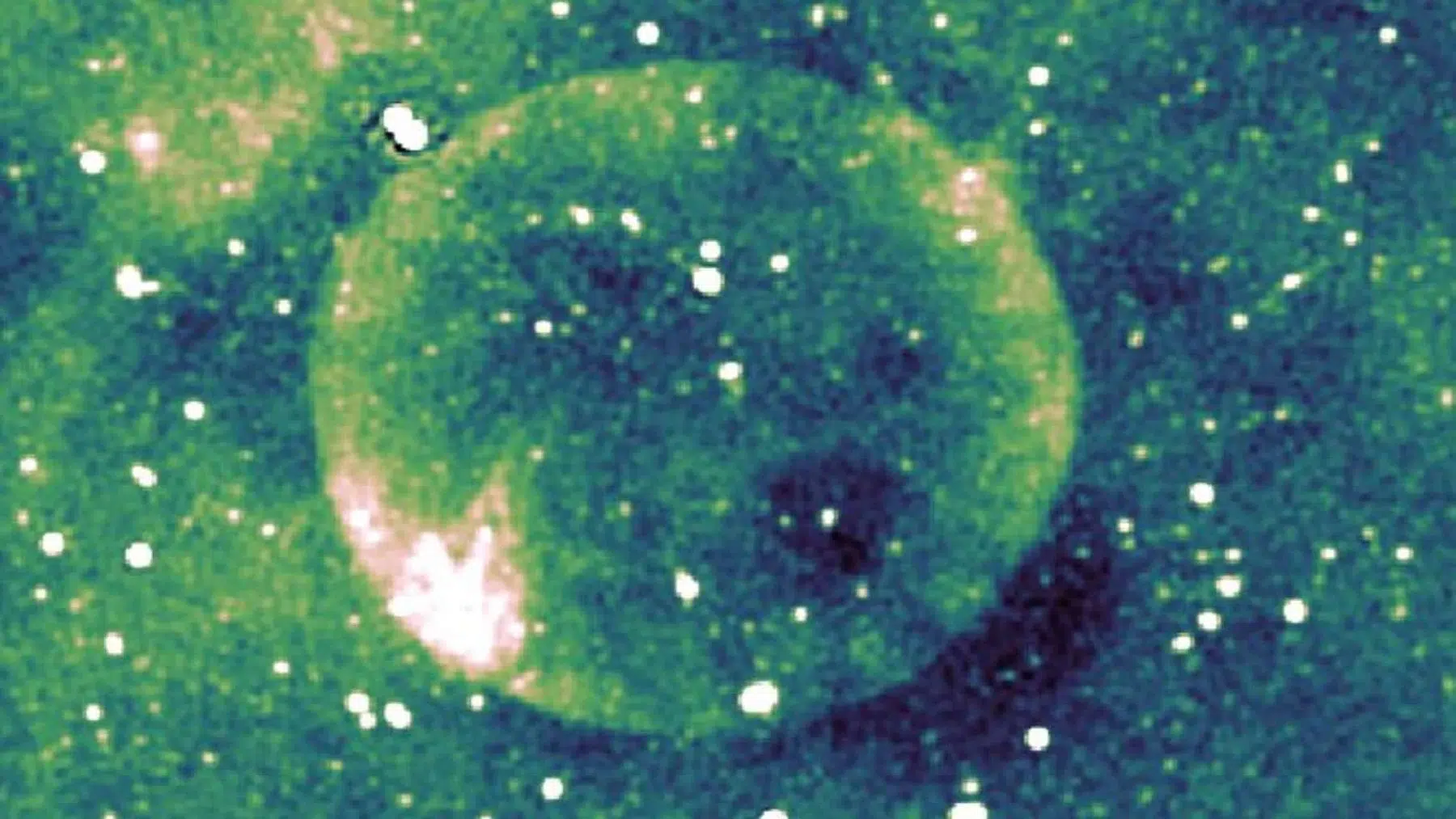
Ever wondered why all matter in our galaxy is often portrayed as a sphere? That’s because gravity pulls matter equally from all sides towards the center, where there’s more gravitational force. The only things that escape from the ‘bubble’ format are smaller objects like asteroids or small moons because the gravity is not strong enough to pull them into a sphere. Although not everything has a sphere-like shape, most things are, and the perfect examples are objects with more mass.
The perfect sphere shape is common in our galaxy, and gravity is to thank for creating it
Black holes have a gravitational force nearly unescapable, and only a few particles can escape from this cosmic giant. The supermassive black hole in the middle of the Milky Way, Sagittarius A, is supposed to be the most perfect circle in our galaxy, but this has changed.
Over time, scientists have developed new ways to search the cosmos and go beyond our solar system to learn more about the universe, and they have made discoveries almost every week thanks to radio telescopes. Scientists use these for collecting and amplifying radio waves from space. Later, they are converted into images or data about a distant object, like the one they found in the Australian Square Kilometre Array Pathfinder (ASKAP).
Astronomers have found a perfect, symmetrical spherical object in our galaxy named Teleios, which is a Greek word for “perfection”. The most accepted theory is that it is a remnant of a supernova explosion. When these stars explode, they leave behind a cloud of gas and dust, and the bigger the remnants, the older the supernova is.
The dead star is still alive and it’s called Teleios
Teleios is close to Earth, approximately 7,175.5 light-years away. This suggests that the dead star has a diameter of about 46 light-years, and it is less than 1,000 years old – this one had less time to grow before it exploded. If it were in a greater distance, it would be 10,000 years old.
Scientists have put the “zombie star” theory forward
The dead star is inside the cloud that surrounds it, and even though it’s a small supernova, which means there’s less gravitational force than others, the perfect bubble size intrigued the scientists. The international team led by the astrophysicist Miroslav Filipovic was responsible for the discovery in our galaxy.
A possible scenario is that Teleios is some type of Type lax supernova that was not completely destroyed in the blast. Instead of obliterating everything, part of the white dwarf survives after the explosion as a faint object – it lost most of its energy and doesn’t shine anymore, but the object was not evaporated. There’s still light, but it’s almost undetectable.
Teleios’s solitude helped shape the perfect bubble
The size of Teleios is a motivating factor for the perfect symmetry. When a supernova explodes, the explosion itself can be asymmetrical, especially if there’s any object nearby that can deform the space-time and affect the sphere shape with its own gravity. If it expands enough, it will start to fragment until there’s nothing but a cold, solid white dwarf floating around with no life.
If the supernova explosion takes place in an empty area, like the one in our galaxy, it can expand through the galaxy without suffering any type of variation. The dust originated from its blast and will be there for an indeterminate time, as it doesn’t have a single lifespan. It’s an exciting time in the world of space exploration and science as discoveries, mostly made by NASA, expand our understanding of the cosmos and our place in the universe.
Read the whole thing?
Get the week's signal, not the noise
Our sharpest reporting on energy, climate and nature — free, once a week.