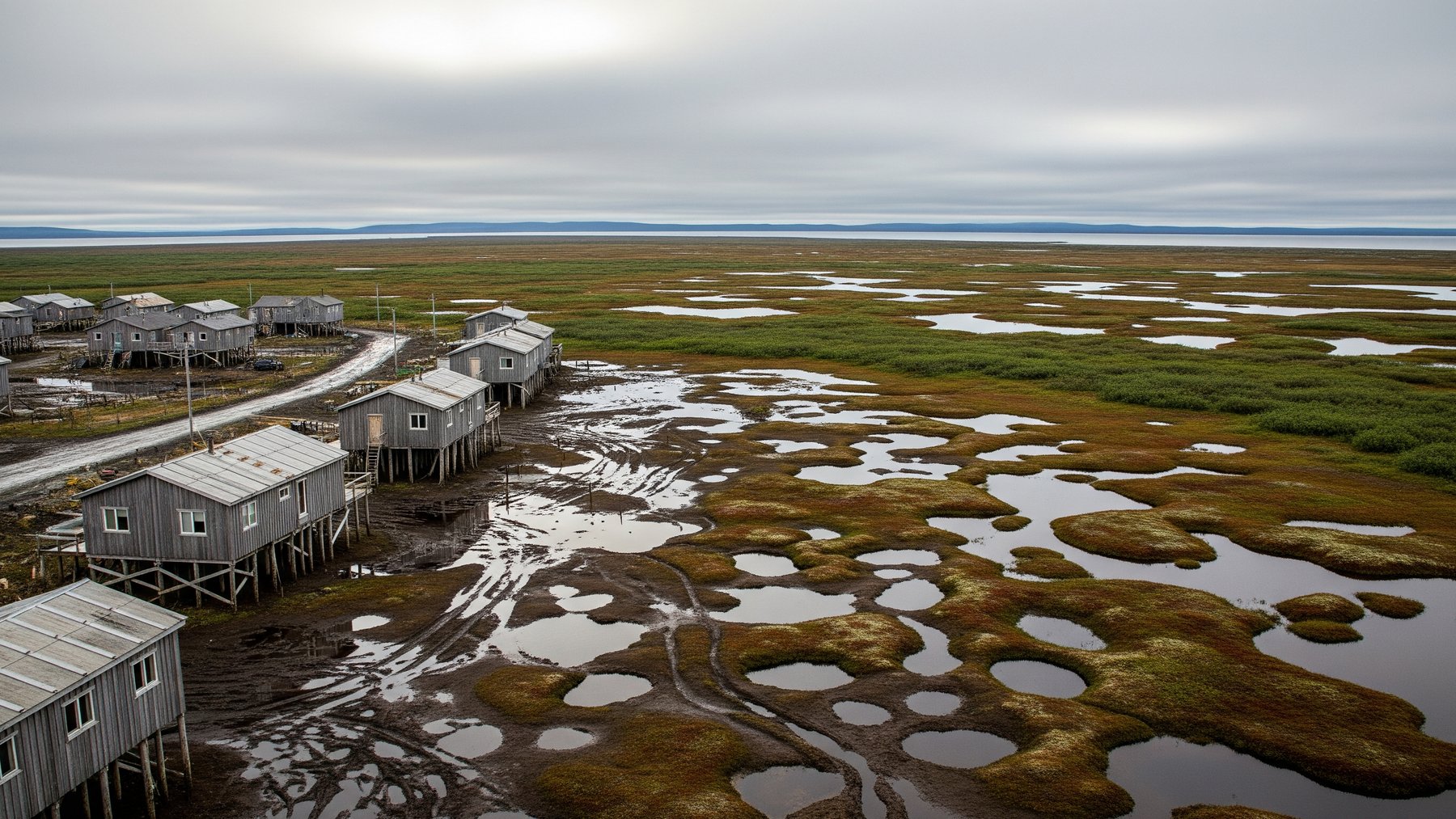
In the northern Alaska village of Point Lay, the houses are doing something nobody expected. They are not toppling in storms or washing away in floods.
They are simply sinking into the earth, slowly, silently, one tilted piling at a time.
And what researchers found when they dug into the ground beneath them may be one of the most unsettling climate stories hiding in plain sight.
A village built on frozen ground that is not frozen anymore
A team of scientists working with local residents has documented a thaw they call catastrophic. The ground is dropping, and the damage is everywhere.
Foundations are buckling. Water and sewer lines are failing. Power poles lean at odd angles, and fire hydrants stand unmoored in the soft mud.
In some places the soil has collapsed so far that several feet of support pilings now hang in the open air.
Houses that were once single story buildings suddenly sit as high as two stories above the sunken ground around them.
It is a slow motion emergency most Americans have never heard of. So what exactly is failing under their feet?
The ground that held everything together
Permafrost is exactly what it sounds like. It is ground that stays frozen all year round.
For thousands of years it has been the invisible foundation under Alaska, Canada, and Siberia, solid enough to build on and reliable enough to trust.
It covers about 24 percent of the Northern Hemisphere and holds roughly half of all the organic carbon on Earth.
Think of it as a natural deep freeze, one that has quietly stored the remains of ancient plants, animals, and soil for millennia.
As long as it stays cold, that carbon stays locked away. The trouble is, it is not staying cold.
When the freezer starts to fail
Experiments by University of Leeds researchers found that thawing makes permafrost between 25 and 100 times more permeable, letting trapped gases escape.
It works much like meat left out of a freezer. After a few days, the organic matter begins to rot.
Rising soil temperatures wake up microorganisms that had been frozen for ages. Once switched on, they feast on the old plant and animal matter and release carbon and methane.
Methane is the part that keeps scientists up at night. It traps heat 28 times more effectively than carbon dioxide over a century.
When the permafrost softens, it does not just collapse buildings. It breathes out gases that nudge the whole planet warmer. And the size of what is stored down there is staggering.
The hidden carbon bomb under Alaska’s feet
This is the real story beneath the sinking houses. As of 2020, estimates suggest permafrost holds as much as 2.5 times more carbon than the entire global atmosphere.
When it thaws, it releases that carbon dioxide and methane, and the process feeds itself. More thaw means more emissions, which drives more warming and more thaw.
A sweeping 2026 study found that thawing Arctic permafrost is reshaping rivers and releasing ancient carbon locked away for thousands of years, with runoff rising and the thaw season stretching deeper into fall.
Worse still, so much uncertainty remains that current climate models do not fully include the effect. They may be seriously underestimating how fast the planet is heating.
The cost on the ground is already mounting. One study estimates permafrost thaw will hit Alaska roads and buildings for 37 to 51 billion dollars by mid century.
That figure climbs as more infrastructure is counted and the ground keeps softening. Much like Louisiana’s coastline slipping into the Gulf, whole Alaskan communities now watch the land give way beneath them.
A feedback loop the world cannot afford to ignore
The thaw has already triggered a public health crisis across Alaska, cutting off clean water, sanitation, and basic medical infrastructure.
But the ripple reaches far past Alaska. Without aggressive action, researchers predict permafrost could release 550 gigatons of carbon dioxide by 2100.
That would exceed the entire cumulative emissions of the United States within the same period, possibly pushing the climate past a point of no return.
The behavior of this frozen ground is, in the words of one NASA polar scientist, “like a wild card.”
There are still cautious reasons for hope. New research on Arctic soil microbes suggests the dreaded methane bomb may not be inevitable.
The science on climate feedback systems is still evolving, and every fraction of a degree avoided now buys the permafrost more time to stay frozen.
The ground beneath Alaska is sending a message. The question is whether the world hears it before the freezer door swings fully open.
Read the whole thing?
Get the week's signal, not the noise
Our sharpest reporting on energy, climate and nature — free, once a week.