
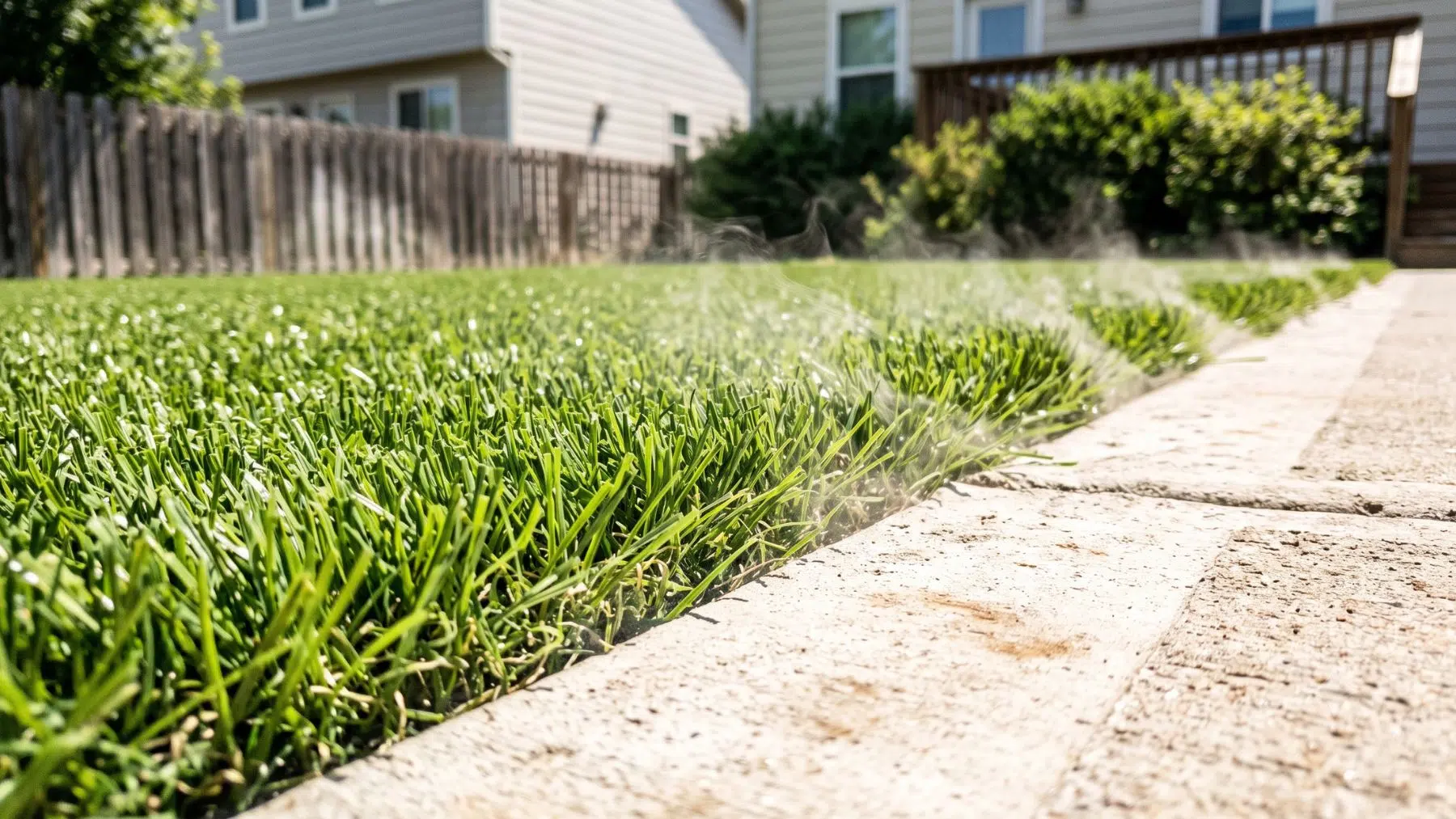
From across the yard it looks like the coolest lawn on the block, green and perfect in the July heat.
No brown patches, no bare spots, just an even carpet of bright plastic blades.
Nothing about it hints at what the sun has been doing all afternoon.
Then you kneel down and press a hand flat against it.
The surface is hot enough to hurt, far warmer than the air around it.
That green carpet is one of the hottest things in the garden.
A lawn built to never need water
Artificial grass sells itself on a simple promise, green all year with almost no work.
No mowing, no watering, no mud, and it stays the same through a drought.
In hot dry cities where water is scarce, that pitch is hard to resist.
Water restrictions in dry states have pushed sales higher almost every year.
Millions of yards, schoolyards, and sports fields have traded living grass for plastic.
For a busy family it can feel like the practical, easy choice.
The plastic lawn keeps its color through the worst of summer.
But the same sun that would scorch real grass does something else here.
It turns the whole surface into a shallow solar oven.
And that stored heat is where the trouble begins.
Why plastic bakes while grass stays cool
Real grass is full of water, and it sweats much the way we do.
As that water evaporates from the blades, it carries heat away and cools the surface.
A living lawn on a hot day rarely climbs far above the air temperature.
You can feel that difference walking barefoot from a real yard onto a plastic one.
Artificial grass has no water in it at all.
Its plastic blades and rubber infill simply soak up sunlight and store it.
With nothing to evaporate, the heat has nowhere to go but up into the surface.
The rubber crumb packed between the blades only adds to the effect.
Dark, dense surfaces absorb far more sunlight than pale open ones do.
So the fake lawn cannot cool itself the way a real one does.
It behaves less like a meadow and more like a dark rooftop.
The numbers are worse than the sidewalk
Researchers have been measuring this gap for years.
In one field study, synthetic turf ran about 37 degrees hotter than nearby asphalt.
Against natural grass the gap was even wider, close to 86 degrees.
On a 98 degree afternoon, the plastic surface climbed toward 175 degrees and beyond.
Other tests on hot days recorded readings near 200 degrees.
Shoes have been known to soften and cleats to pick up melted plastic.
For comparison, natural grass usually stays between 75 and 95 degrees.
The sidewalk you would hop across barefoot is actually the cooler surface.
And the danger does not stop at an uncomfortable hand on the ground.
You cannot hose it cool
The obvious fix is to spray the turf with water, and it does work for a moment.
In one test a field dropped from 174 degrees to 85 the instant it was watered.
Five minutes later it had already rebounded to 120 degrees.
Within twenty minutes it was back near 164 degrees, as if nothing had changed.
The water runs off or sinks away fast, taking its brief relief with it.
That is the part that surprises people most, the heat simply returns.
A local test found the same stubborn gap on a summer field.
At about 140 degrees, bare skin can burn in under five seconds.
Worse, the surface radiates that heat back out and warms the air just above it.
A wide plastic field can turn its own corner of a yard into a heat pocket.
Where the heat matters most
The problem is sharpest in exactly the places that love artificial grass.
Hot dry regions like Arizona push these surfaces to their most extreme.
There the air alone can sit above 100 degrees for weeks at a time.
The plastic that saves water in a drought also bakes hardest under a desert sun.
Schools and clubs now hose their fields before games and avoid the midday sun.
Shade cloth, trees, and lighter colored blades can take the edge off.
None of this shows up in the smooth green photos of a sales catalog.
Extreme surfaces show up all over a warming world, from horned lizards on scorching ground to a coastal sensor that once read past 100 degrees.
Artificial grass is not evil, it is a real tradeoff between water and heat.
The greenest looking lawn on the street can still be the one that burns. That is the catch no brochure mentions.
Read the whole thing?
Get the week's signal, not the noise
Our sharpest reporting on energy, climate and nature — free, once a week.


