

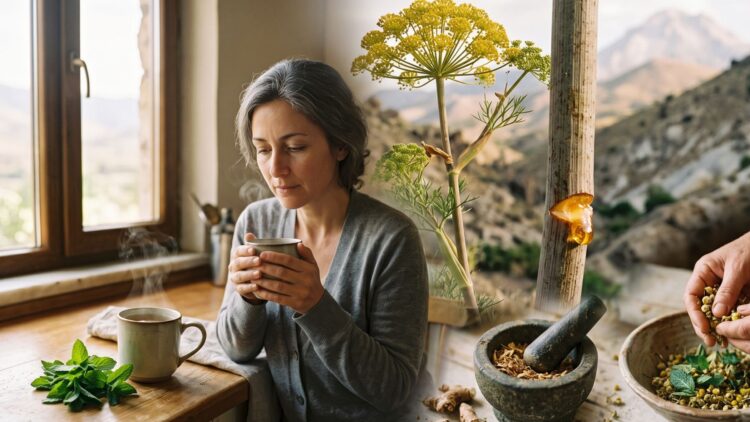
Most of us have done it without thinking.
A sore throat and we reach for ginger tea.
A headache and we crush fresh mint between our fingers.
Doctors sometimes call it folk instinct, and skeptics call it wishful thinking.
But a discovery on a volcanic mountain in Turkey is reshaping that judgment, and it starts with a question that goes back 2,000 years.
The instinct that never went away
Long before pharmacies existed, every human culture on Earth kept a working knowledge of medicinal plants.
That knowledge was not superstition.
It was the product of thousands of years of careful, cumulative observation, passed from healer to healer, season to season.
Some researchers argue this trust is partly baked in.
Our ancestors who correctly identified healing plants survived, and those who ignored them often did not.
The result is a bias toward plant remedies that runs deeper than culture.
When someone today brews a medicinal tea, they are drawing on one of the oldest and most heavily tested datasets in human history.
What the psychology of plant trust actually tells us
Research into why people choose herbal medicine reveals something more interesting than simple distrust of doctors.
Studies suggest that people who turn to plant remedies tend to value personal agency in their own health.
They want to understand what goes into their body, and they prefer treatments that feel connected to the natural world.
That is not avoidance, it is a form of autonomy that psychologists link to higher engagement with long term health behaviors.
There is a sensory dimension too.
The smell of a freshly brewed herb, the bitterness of a tincture, the texture of a root, all activate neural reward circuits tied to expectation and care.
The ritual of plant medicine is part of its effect on the nervous system, and that is not a placebo weakness.
It is how healing has always worked on a human brain.
The ancient pharmacopoeia science keeps rediscovering
For decades, researchers have been systematically testing traditional plant medicines in the lab.
The results keep surprising them.
Compound after compound pulled from plants used by ancient healers turns out to carry measurable antibacterial, anti inflammatory or anticancer activity.
Willow bark became aspirin.
Foxglove became digoxin.
Artemisia became one of our most powerful antimalarial drugs.
The pattern keeps repeating, ancient observation points, and modern chemistry follows.
Some of those observations survived only in fragments, or in the memory of communities whose names never made it into history books.
Which raised a harder question, had any of the most celebrated ancient remedies slipped from the record entirely?
A golden herb on a mountain nobody expected
The most famous of all was thought to be gone forever.
The ancient Greeks called it silphion, and the Romans could not get enough of it.
During the reign of Julius Caesar, more than a thousand pounds of it were stockpiled in Rome’s treasuries, beside the gold.
Pliny the Elder wrote that its juice sold at the same rate as silver.
It was a seasoning, a perfume, a medicine and a contraceptive, and it grew on the coast of what is now Libya.
Pliny also recorded its ending, that the last stalk anyone could find was given to the Emperor Nero, in the first century.
Then Mahmut Miski, a professor at Istanbul University, spent decades studying a plant on Mount Hasan in Anatolia, nearly a thousand miles from where silphion grew.
In a 2021 study in the journal Plants, he laid out the case that Ferula drudeana shares silphion’s thick branching roots, its celery like leaves, and the shape stamped on ancient coins.
It carries anticancer and anti inflammatory compounds, its sap draws swarms of pollinators, and it grows in exactly the spots where Greek communities once settled, as though somebody planted it.
What a mountain survivor changes about herbal trust
The silphion story is not proof that every herbal remedy works.
Science is careful about that distinction, and so should we be.
Miski’s identification is still debated, no original sample survives for genetic comparison, and other Ferula species remain candidates, so the case is compelling rather than closed, as several outside botanists have pointed out.
Plant medicine also belongs alongside professional care, not instead of it, and many herbs interact with prescription drugs in ways worth asking a doctor about.
What the find does confirm is something more fundamental.
The instinct to trust plants is not gullibility.
It is the accumulated record of a species paying close attention to its world for millennia, a record that modern researchers keep finding was more precise than anyone credited.
The compounds ancient healers prized did not vanish when the cultures describing them faded.
They were waiting on a mountain, in volcanic soil, for someone with the right tools and enough patience to look closely.
Every time a lost remedy resurfaces, the long human record of plant knowledge gets harder to dismiss.