Deep in the sawgrass marshes of South Florida, where the light goes green and the water has no bottom you can see, something moves that most people never will.
It is not the panther or the alligator that has wildlife managers losing sleep.
It is a snake from Southeast Asia, coiled in the roots, that can swallow a deer whole and vanish without trace.
But a team of researchers just found a way to follow it straight to its hiding place, and their secret weapon is the last animal anyone would have picked for the job.
A snake that rewrote an entire food web
Burmese pythons, originally from Southeast Asia, have been expanding their range across Florida since they were first recorded in the wild in 1979.
They are not just big.
Burmese pythons can grow to nearly 20 feet long, and unlike humans, they are the species specifically evolved to thrive in subtropical wetlands.
In the roughly 40 years since they became established, medium-sized mammals have declined by over 90 percent.
Raccoons have dropped by around 99 percent, opossums by around 98 percent, and bobcats by around 88 percent.
Marsh rabbits, cottontail rabbits, and foxes are now considered locally extinct from most areas of successful python invasion.
With prey vanishing, the already endangered Florida panther struggles to find food, and the ripple from one invasive predator runs all the way to the top of the ecosystem.
The problem with hunting a ghost
Finding a Burmese python in the Everglades is nearly impossible by conventional means.
Traditional detection rates have fallen below one percent, while environmental DNA analysis has pushed that figure far higher in sawgrass marsh and tree islands far from roads and canals.
Even eDNA tells you the snake was there, not where it is now.
Experts have tried hunting the snakes using robotic decoys and GPS-implanted scout snakes, yet the pythons have continued to decimate native animal populations.
The snakes had beaten every trap and every tracker.
Until researchers noticed something strange on their GPS screens in 2022 and refused to ignore it.
The signal that came from inside the snake
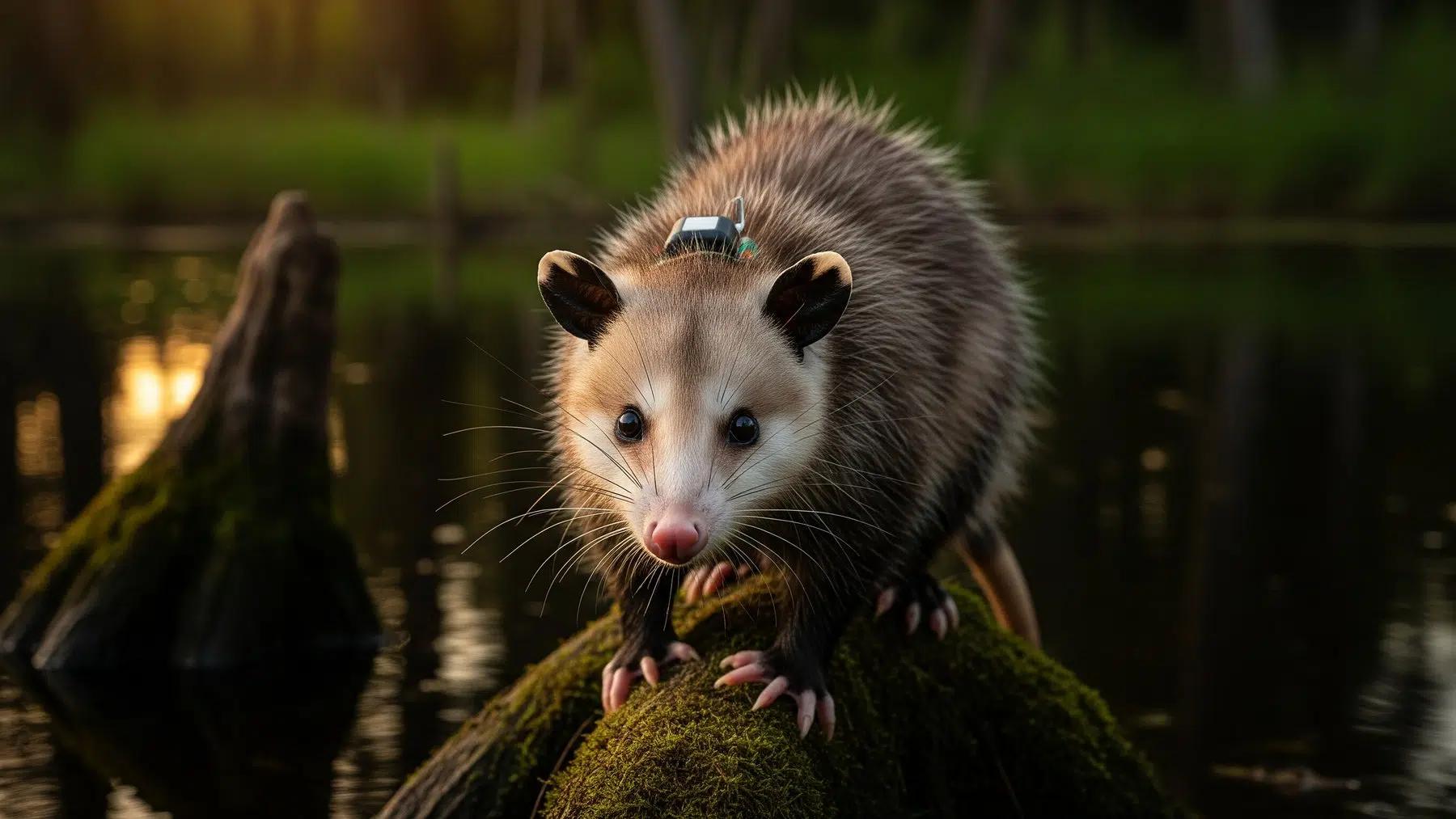
The idea took root when biologist Michael Cove was studying the movements of raccoons and opossums in the refuge alongside refuge manager Jeremy Dixon.
They kept getting mortality signals from GPS-collared mammals, and when they went to recover the collars, they found them inside the bellies of large pythons.
That accidental discovery became a plan.
The tracking system uses VHF and GPS technology to monitor opossums, with the program, now expanded by Cove and biologist A.J. Sanjar, currently running 32 collared animals and aiming to reach at least 40 by the end of summer.
If a collared animal stays stationary for more than four hours, the device alerts researchers that it has likely been predated.
Because pythons digest slowly, the collar keeps transmitting from inside the snake, allowing teams to locate and euthanize the reptile.
Collar costs dropped from $1,500 to $190, and the team has already removed at least 18 Burmese pythons, all over 8 feet long, with the largest around 13 feet.
The hidden biology that makes the opossum perfect for this
Here is the part of the story that stops scientists cold.
The opossum was not simply chosen because it is plentiful and easy to catch.
This small marsupial, North America’s only native marsupial, carries something in its blood that no python has ever had to contend with: a built-in shield against snake venom.
Opossums produce a protein called Lethal Toxin-Neutralizing Factor, which neutralizes the venom of major snake families including rattlesnakes, cottonmouths, and coral snakes.
The protein’s active components in the opossum’s bloodstream bind to the toxic elements and inactivate them before they can reach their target sites.
Evolution handed the opossum a molecular armor that millions of years of snakebite pressure forged, piece by piece, into something scientists are now trying to copy as a universal antivenom for humans.
The same animal being swallowed in a Florida swamp may one day help save snakebite victims around the world, with researchers working to engineer bacteria that produce its protective peptide at low cost.
What the swamp is slowly teaching us
Using opossums has become one of the most successful python removal techniques at Crocodile Lake National Wildlife Refuge in Key Largo, with 18 large snakes captured through this method so far.
Many of those snakes, often females, would have laid between 20 and 50 eggs during the spring had they not been intercepted, based on the typical clutch size documented for Burmese pythons in Everglades National Park.
Each collar recovered from a python stomach represents dozens of future predators that will never hatch.
The opossum’s story is also a reminder of how deeply animals reshape their landscapes, the way elephants and giant anteaters reroute their entire lives in response to pressure they never chose.
The collar program is still a targeted, small-scale tool at one refuge, and by itself it cannot reverse decades of python expansion across the broader Everglades.
But in the dark water of Crocodile Lake, a three-pound marsupial fitted with a $190 collar is doing something no robot decoy or DNA swab managed to do.
It is leading researchers, from the inside of a predator’s stomach, to the very heart of the problem.
Read the whole thing?
Get the week's signal, not the noise
Our sharpest reporting on energy, climate and nature — free, once a week.