

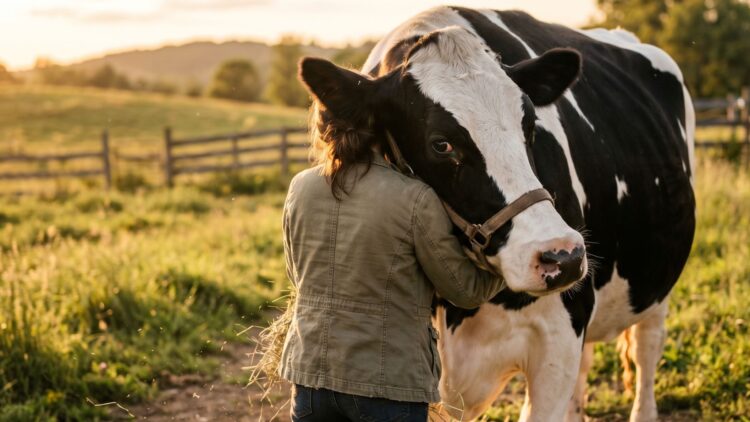
Picture a small farm in upstate New York on a clear morning, two young Holstein steers grazing in a sunlit field while a researcher watches every move they make.
The volunteers who arrive expect to do something ordinary, a gentle, almost sleepy way to spend a morning.
What the cows do next is anything but.
A Dutch tradition that crossed an ocean
The practice has a name in Dutch, koeknuffelen, which translates directly to cow cuddling or cow hugging.
It grew out of a Netherlands custom of leaving the city for the countryside to spend time with farm animals and reset.
The idea traces back to the rural town of Reuver, built on the notion that the simple presence of a farm animal carries real healing power.
Unlike the better known therapies built around dogs or horses, cow cuddling offers something different, an invitation to slow down and connect with nature in an unusually intimate way.
Farmers in Reuver noticed decades ago that visitors who spent even an hour in a barn left visibly calmer, shoulders dropped, breathing slower. That is the kind of plain observation that eventually pulls scientists in.
What a thousand pound therapist feels like
A cow’s warmer body, slower heartbeat and sheer size make hugging one a surprisingly soothing experience.
Backrubs, leaning against a warm flank, even being licked all become part of the encounter.
When a person touches or lies beside the animal, the body releases oxytocin, the hormone tied to feelings of happiness and lower stress.
Gentle touch lowers blood pressure and calms the nervous system, and it works whether you are the one holding or the one being held.
Often called the cuddle hormone, oxytocin helps people feel connected and calm while lowering levels of the stress hormone cortisol.
There is something almost architectural about it too. A full grown steer weighs roughly half a ton, and when it presses its warm side against your back, the pressure alone reaches the same calming pathways that weighted blankets are built to find.
The sanctuary where science paid close attention
Researchers ran their study at Surrey Hills Sanctuary in New York State, bringing in 11 volunteers aged 13 to 79 to spend time with two young Holstein steers named Magnus and Callum.
Six of the volunteers were women and girls, five were men and boys, a very small group by any measure.
Each person spent at least 45 minutes with one of the steers, whose temperaments differed, Magnus leaning into contact while Callum took more patience before he settled.
Afterward, participants filled out a survey and talked through which moments had felt mutual and which had felt one sided.
The team measured it all with a standard scale built to capture both how much a person engages an animal and how much the animal seems to engage back.
The data that came back surprised the people who had designed the experiment.
The steers had a clear favourite, and it surprised everyone
The steers showed a strong preference for time with women over men, and the women in turn reported stronger attachment to the animals.
Women and girls described far more moments of being licked, of the steers taking food from their hands, of the animals responding when they tried a little training.
Across this small group the pattern was consistent enough to stand out, much the way an overlooked animal in New York can reveal something no one was looking for.
The researchers are careful here. They cannot yet say whether the steers actively sought out women, or whether women were simply more likely to reach out first.
They are also clear that this was a pilot study, too small to prove anything on its own. Even so, the finding opens a real question, whether some therapies may land differently by gender, not just by method.
What it means for the cows, and for the rest of us
One result mattered as much as the gender finding. The team concluded the sessions were not only good for the people but enriching for the cattle, who stayed close and stayed engaged the whole time.
Animal assisted therapy is meant to work alongside approaches like cognitive behavioral therapy, complementing professional care rather than replacing it.
Very little research has looked at farm animals this way, even though cows can bond with people in ways shaped by their size and calm, the same surprise found when animals adapt to a human world.
Magnus and Callum nudged their way into the scientific record that morning in upstate New York.
It turns out that a thousand pound animal leaning its warm weight against you, and seeming to choose you, may be one of the stranger and more genuine kinds of comfort that modern psychology has ever measured.