The panel comes up the belt face up, cells still catching the light.
Somebody bolted it down a long time ago and never thought about it again.
The frame comes off, then the junction box, and then the slow part.
What most of the world does with this panel is bury it whole.
Roughly three quarters of its weight is glass.
Not window glass either. Low iron, optically precise, and still perfectly good.
Why the most valuable layer was always the one thrown away
The sheet on top of a panel has to let light through without losing energy to reflection, which makes it a specialized product rather than a container.
For most of the industry’s history it has been treated as the container anyway.
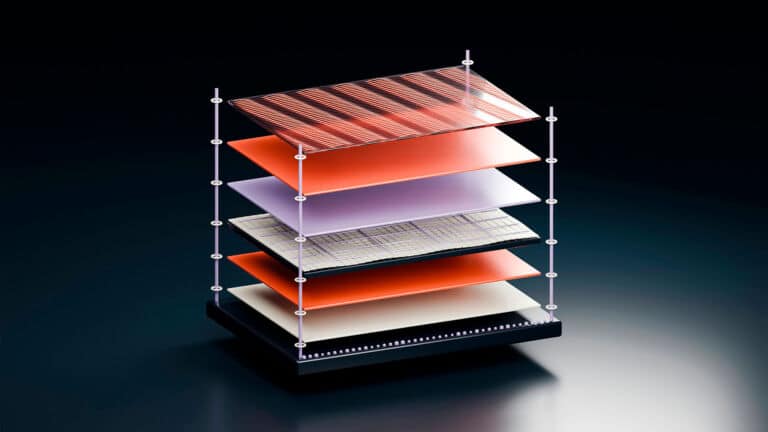
The reason sits underneath it. A plastic film called EVA bonds the glass to the silicon cells so completely that separating the two without wrecking either has defeated recyclers for years.
Crushing the whole assembly is trivial. What comes out is a low value aggregate with the silver, the silicon and the precision glass all mixed together.
That mixture is worth less than the cost of collecting it, which is the entire reason landfilling won for two decades.
So the technical problem was never breaking a panel. It was taking one apart.
What a 255,000 square foot building is for
The plant sits in Cedartown, in northwest Georgia, and it began operating in January.
It is processing thousands of panels a week and is aiming for a million a year by the end of 2026.
At full capacity the building is rated for 5 gigawatts of panels a year, about 10 million modules, which the operator puts at a quarter to a third of everything the country is expected to retire by 2030.
The recovery claim is 96 percent of the value in the silver, copper, aluminum, glass and other materials, with nothing landfilled.
Next to it sits a site for a glass factory that would turn recovered material back into cover glass for new panels.
The idea is a loop measured in yards. Glass out of a dead panel crosses a fence line and returns as the front of a live one.
What the recycled glass had to prove first
A loop is only worth building if the second hand material actually works, and that question got tested off site.
Researchers at Arizona State University built small proof of concept modules using glass that was half recovered from end of life panels, and a matching set using virgin material.
Then they ran standard power conversion efficiency tests on both sets.
The modules built with recycled glass performed the same, with no statistically significant difference on the measures that matter.
The silver is a separate story. It is a thin printed grid on each cell, almost nothing by weight, and a large share of the recoverable value.
Across the operator’s sites, 480,406 panels went through last year, on capacity that grew 228 percent in twelve months.
What has not been solved
The EVA film is still the stubborn layer, and clean separation at industrial speed remains the open engineering problem in this whole business.
It is a large part of why recycling a panel still costs more per unit than sending it to a landfill in the states that allow that.
The glass factory is also not built. Ground is due to be broken in the middle of this year, with first production in 2028, and the operator says customers have committed to more than 80 percent of its planned capacity.
Until that plant runs, the loop is a plan with a permit rather than a working circle.
The West Texas site that came first is the honest picture of the current state of it, taking apart 480,000 panels a year while running about half its own power off a 500 kilowatt array assembled from reused ones.
The operator’s own numbers are the source for most of this, which is worth saying out loud.
Where the customers actually come from
A plant like this does not live on good intentions. It lives on states that make disposal somebody’s legal problem.
There is no national rule, and the patchwork is wide. North Carolina requires owners of solar projects of 2 megawatts and up to register, file decommissioning plans and post financial assurance.
State thresholds run from 500 kilowatts in Illinois for projects on leased farmland to 25 megawatts in New York including co located storage, and 70 megawatts in Nevada for ground mounted arrays.
Below those thresholds a panel is whatever the owner decides, and the federal test that separates ordinary waste from hazardous waste can put two identical panels on opposite sides of the line.
Every state that writes a threshold hands this building a customer list, and every state that does not leaves the cheapest option intact.
Which is the part of the story that has nothing to do with the machines inside, and everything to do with whether they run full.
Read the whole thing?
Get the week's signal, not the noise
Our sharpest reporting on energy, climate and nature — free, once a week.