
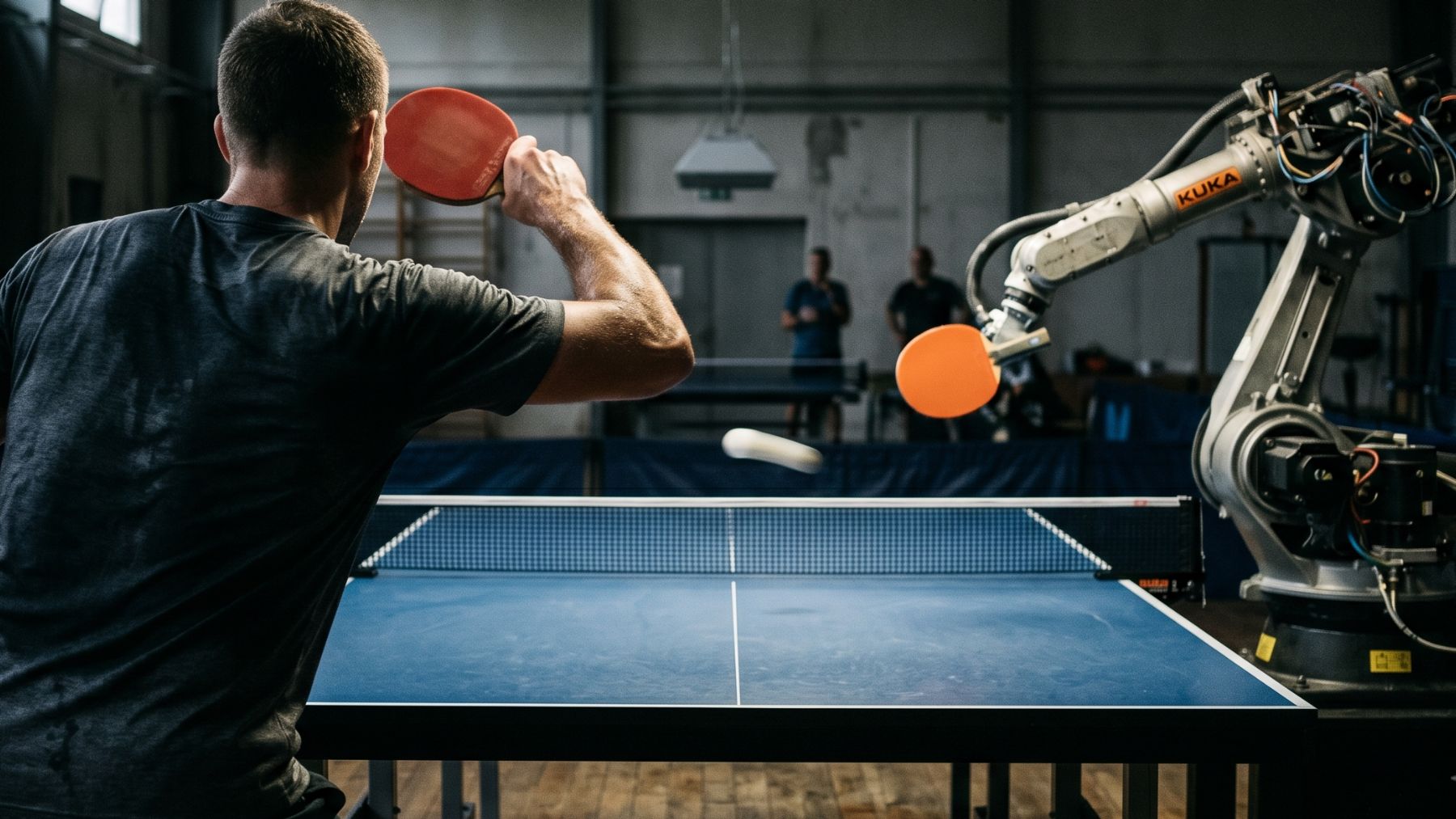
The gym in Tokyo felt ordinary enough. A regulation table, a licensed umpire, two players stretching at opposite ends.
But one of those players had no heartbeat and no nerves. It waited at its end of the table, having never once felt the pressure of a real match or the eyes of a crowd.
Then the first rally began, and within seconds the human across the net knew something was wrong. The machine was not only fast. It was impossible to read.
No one in the room had ever quite seen the like.
A sport built to defeat machines
Table tennis is, in many ways, the cruelest possible test for a robot. The ball blurs even to a trained eye, and every shot demands a decision in a few milliseconds.
Since the first robot table tennis contest back in 1983, engineers have chased this sport as a holy grail for physical machines. For decades the robots rallied well enough, then came apart against anyone truly skilled.
The problem was never raw speed. It was the harder thing, reading a living opponent and adapting to a ball that never behaves the same way twice.
That wall held for more than forty years. Then a small team in Zurich found a way through it, and the result unnerved the very players brought in to test it.
The arm that moves like nothing human
The machine does not look like a person at all. It is a single robotic arm, anchored at one end of the table, built with the bare minimum of joints it needs to compete.
Yet the players who faced it kept reaching for the same word, strange. The arm moves with a smooth, deliberate motion that looks nothing like a human swing.
It tracks the ball faster than the human eye can follow, and returns each shot with a placement that feels almost taunting. There is no wasted movement, no flicker of doubt, no nerves to exploit.
A ring of cameras feeds its eyes, and it answers each shot before most people would have finished blinking.
And that was the first clue that this machine had not been trained the way every athlete before it had.
The players who could not read it
Professional player Mayuka Taira, who lost to the machine in late 2025, described the eerie feeling of standing across the table from it.
Its real strengths, she said, are that it is very hard to predict, and it shows no emotion. You cannot read its face. You cannot sense the moment it hesitates.
In human table tennis, half the game is psychological, the tiny tells that betray what an opponent fears. Against this arm, there were simply none to find.
It never flinched, never tired, and never gave away the shot it disliked, because it did not telegraph one. Where, the players kept asking, had a style this alien even come from?
It had never watched a single human
Here is the part that stops people mid sentence. The robot, called Ace, had never once studied a human match.
It learned entirely by playing against itself, alone, through millions of rallies inside a simulated world. There were no highlight reels to copy and no human style to absorb.
Picture that for a moment. A player that rehearsed nothing but its own imagination, then arrived at a real table already sharper than people who have trained since childhood.
That is exactly why its game feels alien, because it was never shaped by the way people play. In a study published in the journal Nature in April 2026, Ace became the first robot to reach expert level in a popular physical sport.
Against skilled players, Ace won three of five matches, and later defeated three new professionals at least once each. It had built, from nothing, instincts that no human coach would ever have thought to teach.
What a ping pong robot really tells us
Sony is honest that Ace is a research platform, not a product, and that a controlled lab table is a long way from the messy real world.
But the deeper lesson is already spreading into other fields. Machines that learn through self play instead of copying us can find strategies no person would ever invent, which is both the wonder and the faint unease of the whole thing.
It echoes something older, in nature itself. Researchers building drone wings that adjust in mid air, and bird wings that recover from a stall on their own, are chasing the same idea from the opposite direction.
Nature has always found paths that engineers never imagined. What one small arm did on a Tokyo table is a sign that machines are starting to do the same, and the road from there to a hospital ward or a disaster site suddenly feels genuinely short.
Read the whole thing?
Get the week's signal, not the noise
Our sharpest reporting on energy, climate and nature — free, once a week.


