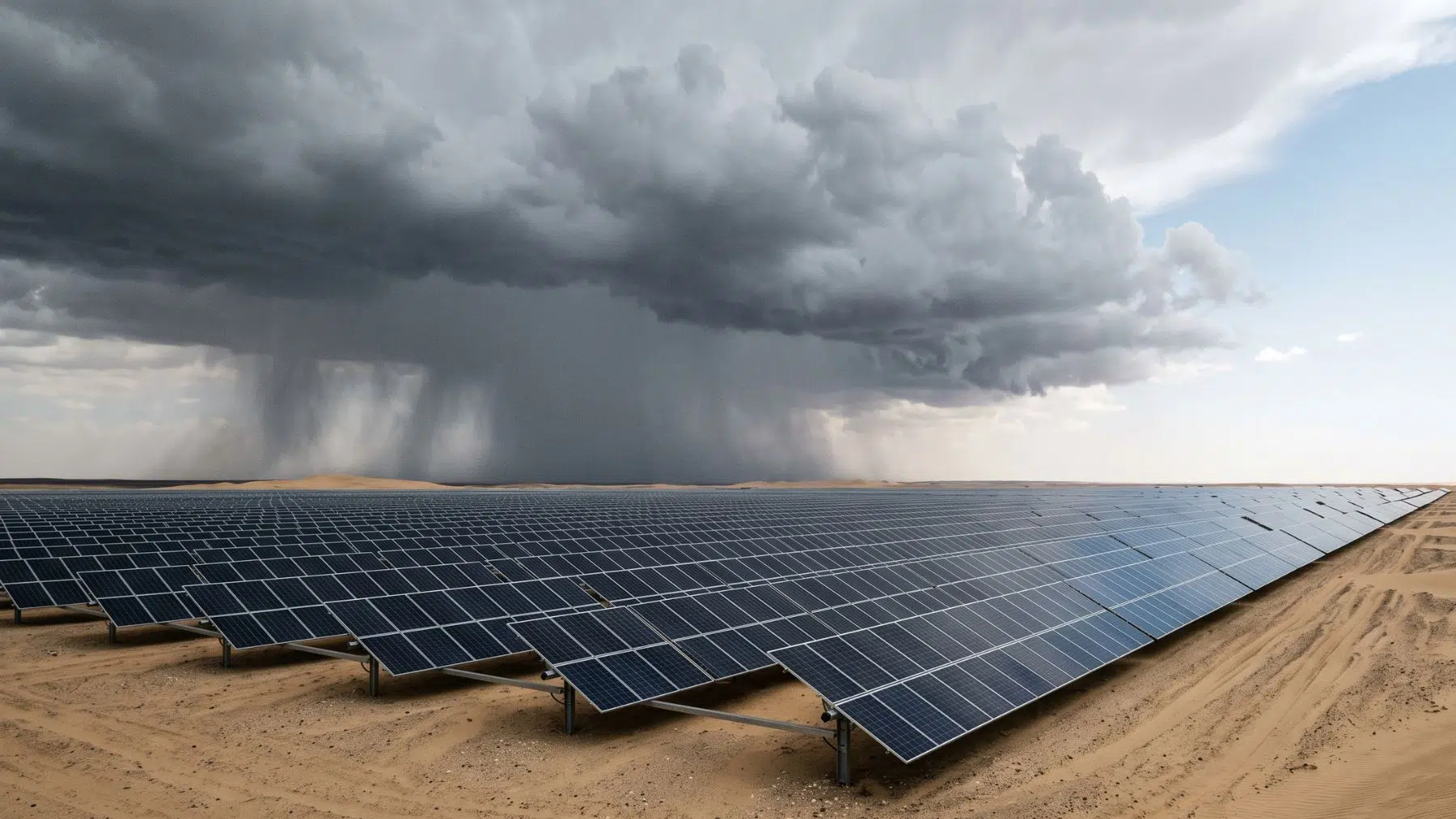
Rain almost never reaches the deep Sahara.
Some corners of it go years between storms, and the sand simply waits.
It is the emptiest large place on the planet, and also the sunniest.
Climate scientists asked what would happen if you paved that emptiness with dark solar panels.
The models answered with something nobody ordered, rain clouds.
What the researchers actually did
This is not a thing anyone has watched happen, and that matters.
In 2018, Yan Li, Eugenia Kalnay and colleagues published a study in the journal Science using a climate model with living, growing vegetation built into it.
They filled more than 9 million square kilometers of the Sahara with imaginary wind and solar farms.
The solar half alone would have generated about 79 terawatts of power.
Global energy demand in 2017 was 18 terawatts.
Nobody is proposing this, it is a thought experiment with real physics inside it.
So the simulated farm produces roughly four times everything humanity uses, which tells you the scale we are talking about.
Then they let the model run, and the desert started raining.
Why dark panels pull water out of dry air
Here is where most retellings get the physics backwards.
Solar panels do not cool the desert down, they heat it up.
Sand is pale and bounces sunlight back to space, while a panel is dark and swallows it.
That change in reflectivity, what scientists call albedo, means the ground beneath a solar farm absorbs more energy than the bare desert ever did.
Hot surfaces send air upward, and rising air cools, and cooling air lets go of whatever moisture it carries.
The panel does not add a single drop of water to the sky.
It only changes where the air decides to rise.
That is a cloud, built out of nothing but a darker floor.
In the model, rainfall over the Sahara and the neighboring Sahel more than doubled.
Wind turbines add a second push, by roughening the surface and dragging moist air inland.
The loop that turns rain into more rain
The interesting part is what happens next.
Rain lands on sand that has not seen water in years, and things begin to grow.
Seeds that waited decades find their moment.
Plants are darker than sand, so the ground gets darker still.
A darker ground absorbs even more heat, sends up even more air, and makes even more rain.
Scientists call that a positive feedback loop, and in the wind farm simulations it accounted for roughly 80 percent of the total rainfall increase.
Once it starts, it feeds itself.
We know it is possible because it already happened.
Around 6,000 years ago the Sahara was green and wet, full of lakes, grassland, hippos and people.
The same machinery that greened it then is the machinery the panels would restart.
The rain has to come from somewhere
Now the part that rarely makes the headline.
In 2021, Zhengyao Lu and colleagues ran the experiment again in a full Earth system model, covering 20 and 50 percent of the Sahara.
The Sahara greened, exactly as before.
Then the rest of the world moved.
But the enormous new heat source reorganized wind and ocean circulation across the whole planet.
The tropical rain band, which delivers more than 30 percent of the world’s precipitation, shifted north.
Roughly the same amount of extra rain the Sahara gained was lost from the Amazon, which fell into drought and forest degradation.
Their model also found global warming, Arctic sea ice loss, and more tropical cyclones striking North American and East Asian coasts.
The desert does not manufacture water, it takes it from a rainforest on another continent.
What this means for the panels we actually build
None of this describes any solar farm on Earth today.
The largest single site plant in the world covers around 20 square kilometers, and the Sahara scenario is hundreds of thousands of times bigger.
Real desert arrays, like China’s Tengger park or Morocco’s Noor Ouarzazate complex, are far too small to bend a rain band.
Your roof is not making weather, and neither is the array outside your town.
They do produce measurable local effects, and researchers keep finding that desert wildlife moves into the cool shade beneath them.
The Lu team is careful to say their model still leaves things out, including the Saharan dust that blows across the Atlantic and fertilizes the Amazon.
So the honest version is not that panels are secretly making it rain.
It is that at planetary scale, even a solar panel stops being a quiet object and becomes a piece of weather.
Build enough of them in one place and the sky notices.
Which is exactly why where we put them may matter as much as how many we build.
Read the whole thing?
Get the week's signal, not the noise
Our sharpest reporting on energy, climate and nature — free, once a week.