Picture a country the size of Alaska, and imagine more than four fifths of it undergoing surface melting in the space of a week.
That is what happened over Greenland last July, and the satellites watching from orbit did not miss a single moment.
What they measured across that vast area is not just a story about melting ice.
It is a story about a hidden clock buried inside the ice itself, and what it is now telling scientists about the future.
The summer the melt broke records
Every year, Greenland’s melt season follows a familiar rhythm.
Snow softens along the coasts in May, water trickles toward the edges, and by September the cold returns.
During the summer of 2025, a remarkably large area of the ice sheet was melting at once in July, with a prolonged period of high temperatures and coastal melting that pushed the cumulative melt-day extent above the 1981 to 2010 average.
But one week in July shattered even that picture.
In mid-July, melting occurred over a record area: for three days in a row, it was present over more than 80% of the ice sheet.
It peaked at 81.2%, the highest value in a dataset stretching back to 1981.
That is not a warm summer. That is something else entirely.
What the satellites see that no plane ever could
The only way to watch something this big is from space.
Scientists delivered the first combined measurements of the Greenland Ice Sheet’s changing thickness using data from ESA’s CryoSat-2 and NASA’s ICESat-2, which together carry altimeters using two different technologies: radar for one, laser for the other.
Each technology has a blind spot, which is exactly why both are needed.
Radar signals can pass through clouds but also penetrate the ice surface and must be adjusted.
Laser signals reflect from the actual surface but cannot record when clouds are present.
Together, they form a complete eye in the sky, cross-checking each other over every square mile of ice.
Between 2010 and 2023, the ice sheet thinned by 1.2 meters on average, but in the ablation zone where summer melt outpaces winter snowfall, average thinning reached 6.4 meters.
The dirty secret inside the gray
The gray color itself is part of the problem, and it feeds on itself in a way that feels almost cruel.
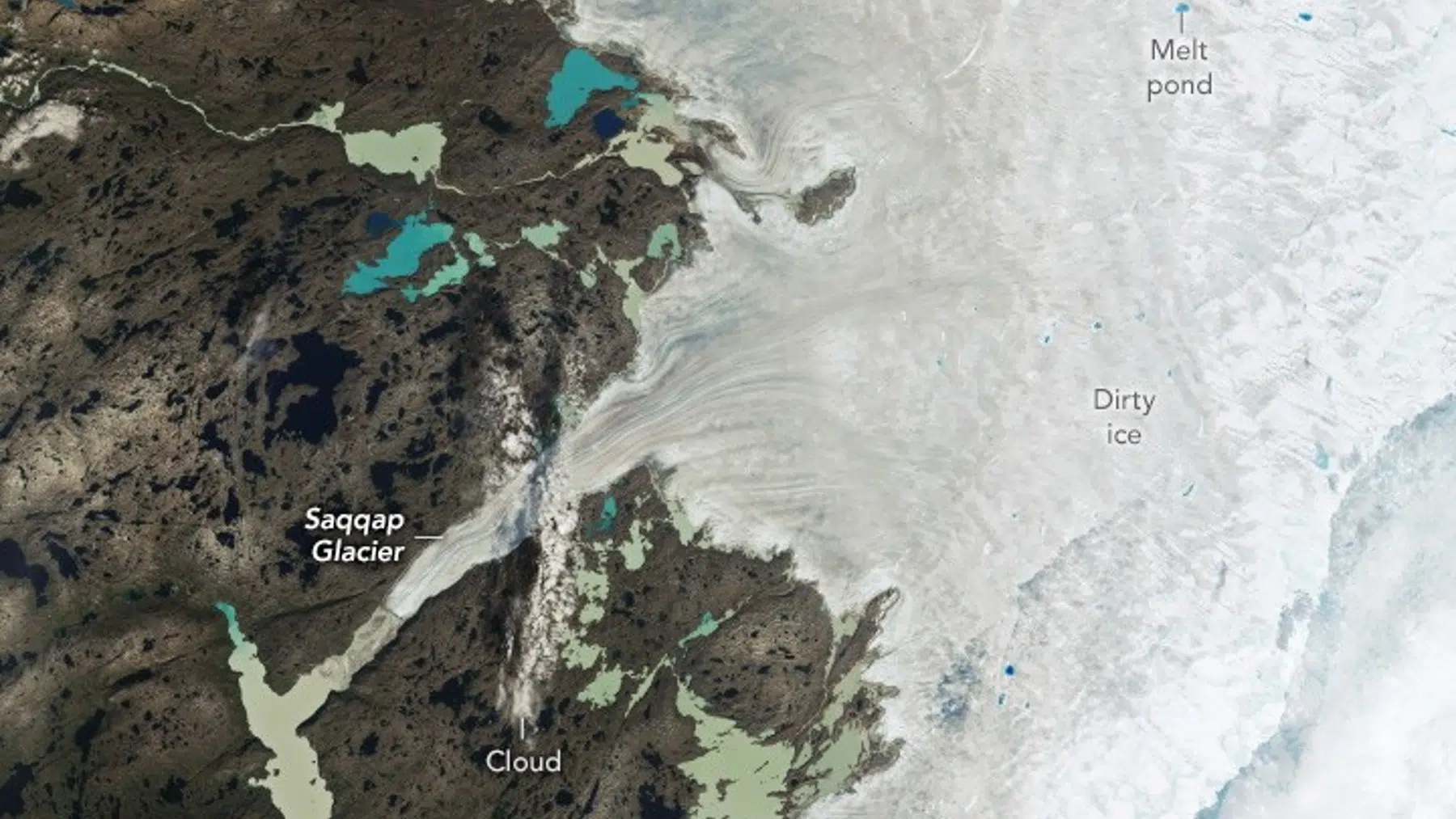
In satellite images, a vast expanse of dirty ice becomes visible, its darker appearance caused by particles like black carbon and dust left behind as the snow melts and impurities concentrate on the surface.
This darkening reduces the ice’s albedo, its ability to reflect sunlight, causing it to absorb more solar energy and melt even faster.
Think of it as the ice developing a fever that keeps getting worse the longer it runs.
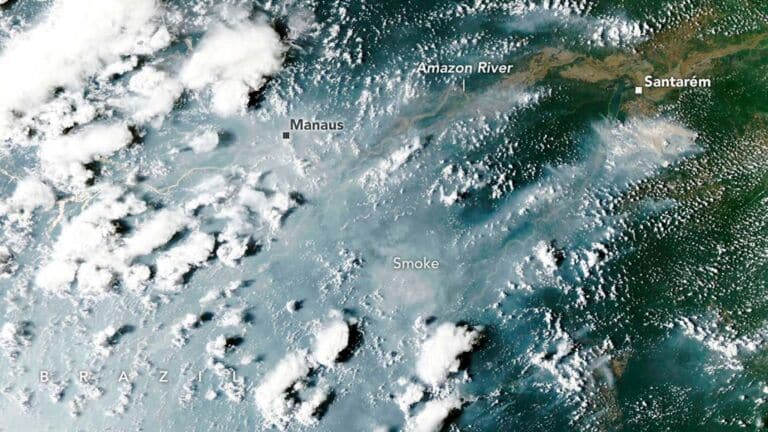
Soot, wildfire ash and surface dust increase solar energy absorption, meaning every wildfire season on Earth sends a ripple all the way to Greenland.
Researchers found that extreme melting events are now happening more often and covering larger areas.
The surface area affected has expanded by about 2.8 million square kilometers per decade since 1990.
The Greenland ice sheet’s hidden record, and what losing hundreds of billions of tonnes a year means
Here is what makes Greenland unlike anywhere else on Earth.
The Greenland ice sheet is not just frozen water.
It is a layered archive of every summer and winter going back hundreds of thousands of years, with ancient air bubbles trapped inside each band of ice like chapters in a book.
When it melts, those chapters disappear forever.
Greenland has been losing ice every year since the late 1990s, shedding on average around 266 billion tonnes per year in recent decades according to GRACE satellite gravity data, contributing roughly 0.7 millimeters to global sea level rise annually.
Between 2002 and 2025, that sustained loss has added measurably to coastlines around the world.
A 2025 modelling study published in The Cryosphere identified a surface mass balance threshold of around 230 gigatons per year, a 60% decrease from pre-industrial levels, as the point beyond which the ice sheet could enter an irreversible long-term decline. That finding comes from a single model and carries large uncertainty; the study’s authors note that previous work on the magnitude of such a threshold remains controversial.
Scientists note this is a very long-term process measured in thousands of years, not decades, but the direction of travel matters now.
Why the satellites also carry a kind of hope
The same space missions watching Greenland dissolve are also the tools that make solutions possible.
Combining the two satellite systems produces a more reliable estimate of ice loss than either could achieve alone, and means that if one mission fails, the other can maintain the polar ice record without a gap.
That continuity matters enormously for coastal communities tracking sea level projections, and for scientists studying how flooding patterns will shift decade by decade.
The mass balance of the Greenland Ice Sheet for 2025 was -129 gigatons, showing less loss than the 2003 to 2024 annual average of -219 gigatons.
Above-average snowfall helped push the numbers toward a somewhat better year.
That is not cause for complacency, but it is a reminder that the system still responds to conditions, and that what happens in the atmosphere still matters.
The ice is a clock, the satellites are its face, and for the first time in history, every person on Earth can read it.
Read the whole thing?
Get the week's signal, not the noise
Our sharpest reporting on energy, climate and nature — free, once a week.