

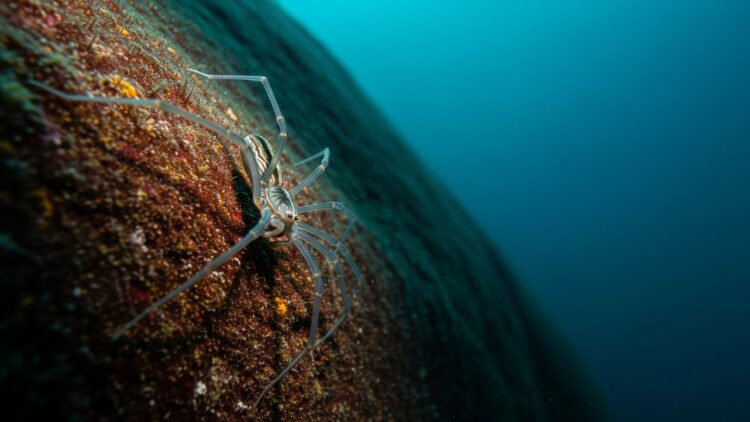
Picture the bottom of a warm Jurassic sea, roughly where southern France sits today, 160 million years before anyone built a road or planted a vineyard.
Something impossibly spindly picks its way across the mud on legs so long they barely belong to the body they carry.
That body is almost no body at all, just a tiny stub of a trunk with a needle-like mouth at one end.
Scientists just confirmed that this creature, pressed into French rock for over a hundred and sixty million years, is the near twin of an animal you could find crawling through a tide pool right now.
A site in France that keeps its secrets well
The fossils came from La Voulte-sur-Rhône, a stretch of riverbank in southern France with a remarkable habit of preserving soft-bodied animals that almost never make it into the fossil record.
“Sea spider fossils are very rare, but we know a few of them from different periods,” one researcher noted, adding that the La Voulte fauna “dates back to the Jurassic, some 160 million years ago.”
The rock held the specimens locked inside, invisible to the naked eye.
The research team travelled to Paris and set out to investigate with cutting-edge approaches, because accessing what was hidden in the rock fossils was impossible any other way.
They used X-ray scanning to peer through solid stone and a photographic technique that moves a light source around the surface to pull out features no conventional image would show.
The creature that evolution seemed to leave alone
What the scans revealed was an animal that felt both deeply familiar and slightly off.
“It is fascinating how these pycnogonids look both very familiar, and very exotic,” the lead scientist said.
“Familiar, because you can definitely recognize some of the families that still exist today, and exotic because of small differences like the size of the legs, the length of the body.”
That combination, recognizable yet slightly wrong, is exactly what makes the find so striking.
Most ancient fossils of this creature’s lineage look genuinely alien, so different from modern forms that tracing the family tree becomes a guessing game.
The rare specimens show that today’s diversity of sea spiders had already started to form by the Jurassic period.
A body plan so strange it barely needs improving
To understand why this matters, you have to grasp just how weird sea spiders are in the first place.
Sea spiders are marine arthropods with extremely long legs relative to body size, a reduced abdomen, and a piercing proboscis used to feed on soft-bodied invertebrates such as hydroids, bryozoans and anemones.
Their trunk is so small that the body ran out of room for ordinary organs.
So unusual is their morphology that many of their internal organ systems have been displaced into the legs.
The gut branches into each limb, and so do the reproductive organs.
Sea spiders lack gills entirely and presumably take up oxygen directly through the cuticle, with only a simple heart to drive circulation.
Older scientists, baffled by this near-absent body, nicknamed them “nobody crabs.”
What 160 million years of staying the same actually tells us
This is where the fossils from La Voulte-sur-Rhône become genuinely important to science.
Two of the specimens were matched to families that are still alive in the ocean today.
Researchers used X-ray microtomography to reconstruct 3D models of the fossilized specimens.
They also applied Reflectance Transformation Imaging to enhance surface features, then compared the results with living species.
That means the sea spider found a body plan so effective that the ocean never forced it to change fundamentally, even as continents moved, seas rose, and mass extinctions swept through the world around it.
It is one of the clearest demonstrations in the fossil record of what biologists call evolutionary stability, a design that works so well it keeps winning every round.
The diversity we see crawling through tide pools today began taking shape during the Jurassic, and these fossils are the proof.
The living animal hiding in plain sight
Sea spiders are not rare today.
Around 1,300 species are found around the globe, from shallow intertidal zones to depths of 7,000 meters.
Some deep-ocean forms grow to the width of a dinner plate, a phenomenon called polar gigantism that still puzzles researchers.
Most coastal species are small enough to hide between barnacles, which is why almost nobody ever spots them.
The La Voulte fossils now give scientists a firm anchor point in time.
They function as a kind of evolutionary timestamp that helps calibrate how quickly the whole group diverged, reshaping what we know about the arthropod family tree.
These findings will also help calibrate the molecular clock, improving our understanding of how life on Earth branches and spreads across deep time.
The next time you wade through a rocky tide pool and feel something brush your ankle on eight improbable legs, you are meeting a design that survived the age of dinosaurs without a single significant rewrite.
That is not a small thing to find pressed inside an ordinary piece of French riverbed stone.