

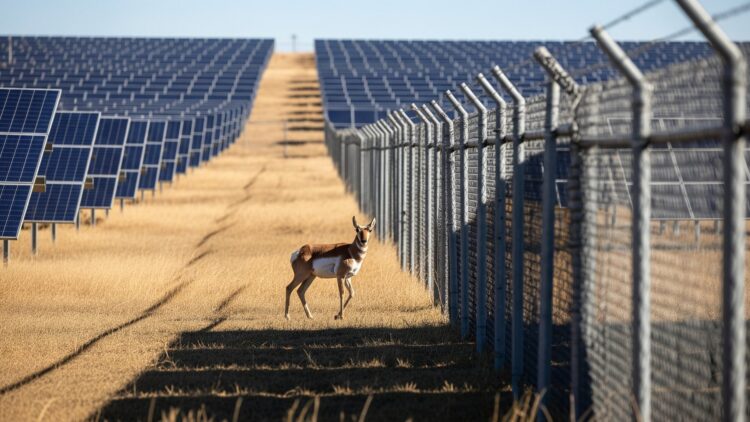
The sun rises fast over the high desert of New Mexico, and when it does, the pronghorn move.
They follow ancient routes across the shortgrass plain, the same corridors their ancestors wore into the landscape over thousands of years.
But something new appeared on one of those routes in 2024, and the animals have been sending back data ever since, whether they know it or not.
The story they are telling is more complicated than anyone building the clean energy future expected.
The fastest animal in the Western Hemisphere just met a fence it cannot jump
The pronghorn is not a deer and not quite an antelope.
It is the fastest land animal in the Americas, capable of sustaining speeds that no other creature on this continent can match over distance.
It evolved those legs on wide open plains, and its one fatal weakness has always been the same: it cannot jump.
Unlike a white-tailed deer, which clears a fence with ease, a pronghorn tends to drop to its knees and attempt to slide under.
That quirk of biology did not matter much on the open range.
Then the solar farms arrived, and the chain-link walls came with them.
An 1,100-acre project and a helicopter searching for white specks on the plain
In the spring of 2024, a black helicopter made low passes over a sunbaked valley near Farmington, New Mexico.
Inside, a team from the Wildlands Network was hunting for pronghorn, spotting them from above as small white shapes against the dry ground.
Their target was the San Juan Solar and Storage Project, an 1,100-acre facility rising from the same grassland the pronghorn had used for generations.
The site sat just a few miles from the shuttered coal plant it was built to replace, which meant the land was already familiar to researchers as industrial territory turning green.
The team fitted GPS collars on 75 female pronghorn, collecting one location every single hour around the clock.
By early 2025 the dataset held over 700,000 points, one of the most detailed records of large mammal movement near a solar installation ever assembled.
What the collars started picking up, and why the engineers had not planned for it
The San Juan facility was built thoughtfully, broken into individually fenced arrays with gaps and passages between them to accommodate roads and dry washes.
In theory, an animal could thread through.
In practice, the passages vary wildly in width, length and position relative to hills, cliffs and roads.
A pronghorn reading the landscape sees something different from what a solar siting map shows.
A peer-reviewed study in the journal Ecological Solutions and Evidence found that pronghorn use declined measurably near an 80-megawatt solar facility in Wyoming, with the loss extending well beyond the physical footprint of the fence itself.
The fence required by the National Electric Code around every solar facility is six feet of chain-link, the same specification used around power plants and refineries.
For a pronghorn, that wall is essentially permanent.
America’s solar boom is enormous, and the pronghorn question is hiding inside it
The scale of what is coming makes this urgent.
One landmark study estimated that roofing the world’s 3.2 million kilometers of highways with solar panels could generate enough electricity to cover more than 60 percent of global consumption, and researchers found it could prevent 150,000 deaths a year from vehicle exhaust alone.
Even a fraction of that vision applied to America’s open West means millions of fenced acres dropping across the same migration corridors pronghorn have used since before Europeans arrived.
Prior research found that 86 percent of migrating pronghorn in one Wyoming study area moved through land that a solar facility later consumed.
The Wildlands Network’s collaring work near San Juan is among the first efforts in the country to watch pronghorn behavior change in real time, before and after construction, on the same animals in the same place.
It echoes findings from wind country too: a North Sea wind farm study showed that large infrastructure, once understood by wildlife, can eventually be shared rather than simply surrendered.
Researchers have already documented pronghorn navigating inter-array passages, though which widths and designs they actually prefer remains open.
The fence is the problem, and engineers already know how to fix it
The encouraging part is that the fix is not complicated.
Raising the bottom of the fence apron high enough for a pronghorn to slide under could restore movement across otherwise blocked corridors.
That modification costs far less than the panels themselves.
Early evidence from sites designed with wildlife passage in mind shows that pronghorn do use carefully sized gaps, especially when the openings line up with routes the animals already prefer.
The Wildlands Network is continuing to collect GPS data through 2025 and beyond, building the evidence base that solar developers need before a project breaks ground rather than after.
The research is not anti-solar, and the San Juan project itself replaced a coal-burning plant that had operated for decades in the same valley.
The pronghorn was here long before that plant, and with the right fence design, it can share the plain with the solar farm too.
That outcome depends on whether engineers study the GPS data before they pour the concrete, and right now, the collars are still transmitting.