It has the same horse-shaped head, the same curling tail, the same enclosed brood pouch. At first glance — and at second — it looks exactly like a seahorse. But this thumb-sized fish is not one.
For decades, it sat misfiled in a museum’s invertebrate collection, catalogued by accident alongside shelled creatures it had nothing to do with. It belongs to a genus known from just seven preserved specimens, gathered by chance over 65 years off southern Australia’s deep reefs. Not one has ever been seen alive.
Caught by accident, filed in the wrong drawer
Every specimen of these fish arrived the same way: uninvited. Trawl nets and dredges working the seafloor between 50 and 125 meters down scooped them up as bycatch, incidental to whatever the crew was actually after. The single specimen of A. aegis surfaced in 2006 near the Gambier Islands during a brachiopod survey — a hunt for small shelled invertebrates. Because the expedition was after invertebrates, the fish landed in the invertebrate collection of the South Australian Museum, where it sat unrecognized for years.
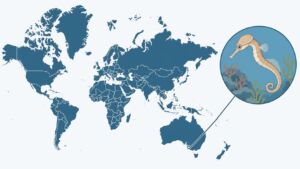
Seven specimens total. Spread across more than 2,500 kilometers of Australian coastline, gathered over roughly 65 years of accidental catches. Nothing has turned up in nearly two decades, which means every preserved animal in a museum drawer is effectively irreplaceable. There are no backup specimens waiting to be examined. No living population anyone has ever watched.
Bones and genes overturn a century of appearances
Because dissection was out of the question, researchers turned to micro-CT scanning — the same X-ray technology used in hospitals, tuned fine enough to resolve tiny bones. The scans let them build three-dimensional skeletal models of each fish and compare them, bone by bone, with true seahorses from the genus Hippocampus.
The internal architecture told a different story than the surface. Seahorses have a rigid cage of fused bony plates supporting the belly and a bony head crown called a coronet. Australyichthys has neither — in their place is a distinct arrangement of belly-supporting bones that appears in no seahorse. Every earlier classification had relied solely on external appearance. The skeleton didn’t support it, according to Science Daily.
DNA confirmed what the bones had already suggested. Only one specimen — A. aegis, stored in ethanol rather than formalin — yielded usable genetic material, since ethanol preserves DNA and formalin does not. Sequencing placed the fish firmly outside the seahorses, on the branch occupied by their closest relatives. Genes and skeleton agreed: these animals needed a genus of their own. Researchers named it Australyichthys, from the Latin for southern and the Greek for fish.
Evolution’s repeat performance: building the same fish twice
When unrelated lineages independently arrive at the same body plan, biologists call it convergent evolution. It usually reflects a shared way of life rather than shared ancestry — similar ecological pressures pushing different starting points toward the same solution.
The full seahorse blueprint — bent head, gripping tail, enclosed brood pouch — has now been assembled at least twice within a single fish family, Syngnathidae, which also includes pipefishes, pipehorses, and seadragons. That family already contained some of the ocean’s most unusual body plans. The sea muppets add another layer to that strangeness.
Each of the three species carries a name that reflects its appearance. A. aegis is the helmethead sea muppet, named for its dome-like crest (the aegis was a protective shield in Greek mythology). A. minotaur is the bullneck sea muppet, and A. paradoxus the paradoxical sea muppet — fitting, for a fish that looks like something it isn’t. Understanding how evolution keeps arriving at the seahorse shape could illuminate the developmental and ecological pressures driving it.
A hidden world beneath the Great Southern Reef
The sea muppets live along the Great Southern Reef, the connected system of kelp forests and rocky reefs encircling southern Australia. It’s one of the most species-rich marine ecosystems on Earth and also one of the least explored. Many of the species found there exist nowhere else, and its deeper zones remain almost entirely unsurveyed.
That context makes the discovery both remarkable and unsurprising. An entire vertebrate genus managed to hide there — misidentified, misfiled, overlooked — until modern imaging technology settled the question. If a distinct genus can go unrecognized for 65 years, the deeper reef almost certainly holds more.
Calling these animals “lost species” isn’t a declaration of extinction. It’s a call to look deliberately rather than wait for the next accidental net haul. Targeted surveys of the Great Southern Reef’s deeper zones could finally produce a living specimen — one that’s never been observed, filmed, or studied in its actual habitat. The sea muppets are most likely still down there. Finding them would only require going to look.
Read the whole thing?
Get the week's signal, not the noise
Our sharpest reporting on energy, climate and nature — free, once a week.