
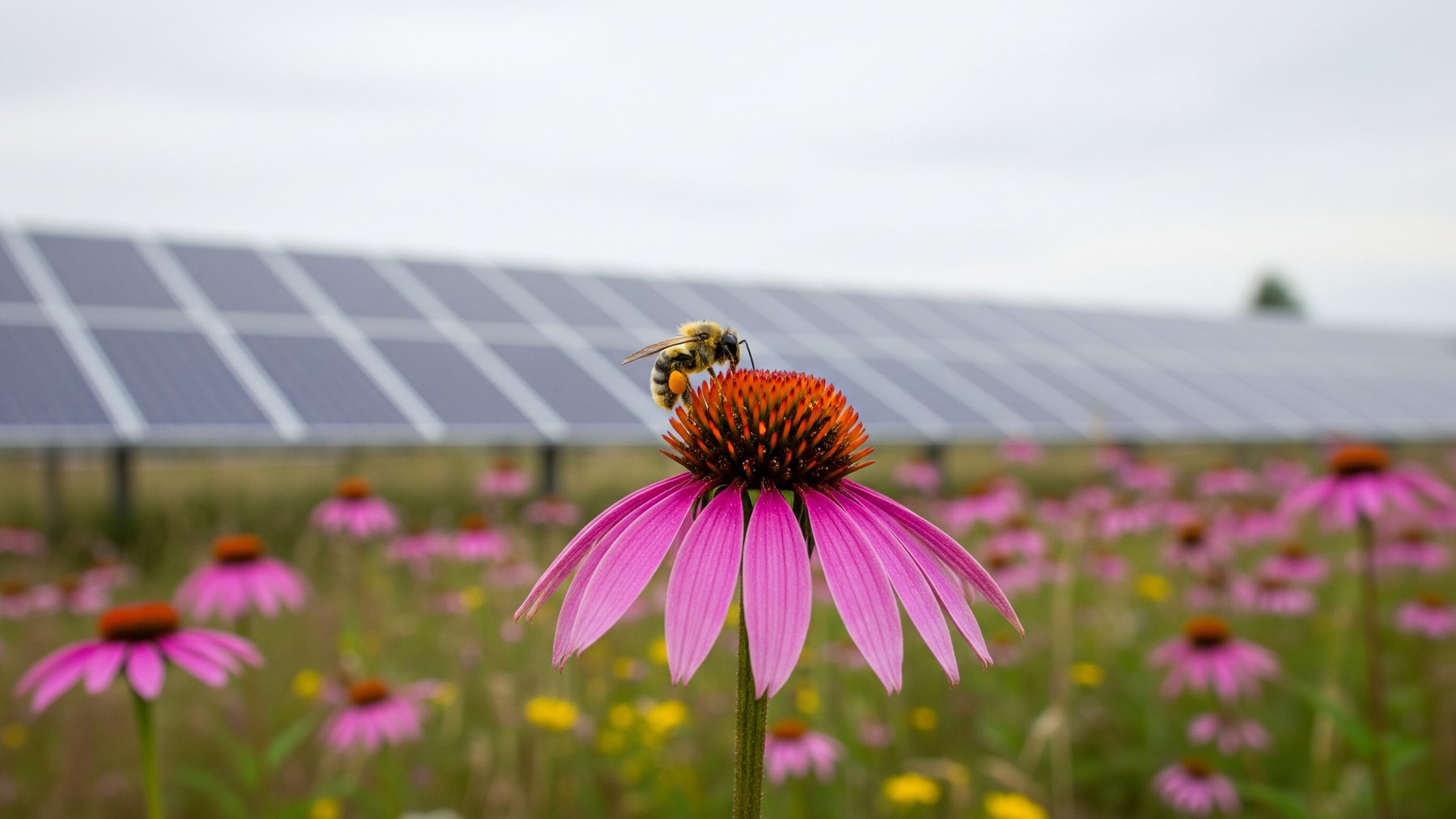
Picture two big solar farms sitting in the middle of southern Minnesota farm country, panels tilted toward the sky, humming with electricity.
The ground between the rows is bare and forgettable, the kind of dirt that normally just sits there doing nothing for anyone.
That was the starting point before seeding began in early 2018.
What came next, over five years of counting, turned out to be one of the more surprising reversals in renewable energy’s short history.
The land that everybody forgot about
Most solar farms are built on what used to be intensively farmed land, plowed season after season, drenched in herbicide, and stripped of the wild corners that once gave insects somewhere to live.
When the panels go up, the plowing stops, but the ground is usually left as gravel or closely cropped turf.
It looks tidy.
It does nothing for anything with wings.
The two farms in Minnesota, built on retired row-crop land operated by Enel Green Power North America, started exactly that way.
But the teams managing the sites made one small, almost gardener-like decision before the first full season of operation began.
Native grasses, wildflowers, and a lot of patience
Much of the land beneath the panels was first treated to clear the weeds, then seeded with native grasses and flowering plants.
It was not a grand conservation gesture.
It was a modest bet that the ground could do more than one job at the same time.
The two sites were planted with flowering plants and native grasses during the early part of 2018, and beginning in August of that year researchers from Argonne National Laboratory and the National Renewable Energy Laboratory came back four times every summer to count whatever was living there, logging 358 separate surveys across the two sites through August 2022.
The early results were modest, because prairie takes time to find its feet.
The flowers were sparse at first, the insects scarce.
It would have been easy to conclude the whole idea was a fine thought that nature had declined to confirm.
But the researchers kept coming back.
What the counters kept finding, year after year
Each summer the numbers shifted.
Flowering plant species grew more varied.
Insect diversity crept upward.
The team found increases over time for all habitat and biodiversity metrics: floral rank, flowering plant species richness, insect group diversity, native bee abundance, and total insect abundance.
The panels never stopped making electricity.
The ground beneath them was becoming something else entirely, threading new life through every row.
The most numerous insect groups observed were beetles, flies and moths.
Something far more specific was happening alongside all of that.
The creature no one had put on the engineering plan
The stars of the five-year count were native bees.
Total insect abundance tripled, while native bees showed a 20-fold increase in numbers.
Twenty times more native bees on ground that had been nearly lifeless farmland just years earlier.
The effect did not stay inside the fence.
In an added benefit, the researchers found that pollinators from the solar sites also visited soybean flowers in adjacent crop fields, providing additional pollination services.
In other words, the bees crossed the fence and began pollinating the neighboring farmer’s crop, delivering a bonus nobody had budgeted for.
The five-year field study, led by Argonne landscape ecologist Leroy J. Walston and published in Environmental Research Letters, found rapid increases in both habitat quality and insect diversity at the two Minnesota sites, with the spillover into neighboring soybean fields among its most striking findings. Independent coverage confirms the soybean-visitation result. The full Argonne write-up is available at Argonne National Laboratory.
A second job the panels never advertised
The researchers are careful to say this result does not apply automatically to every solar site in America.
The findings came from test plots planted with additional species and managed differently than the rest of the solar sites.
Active management is the real difference between a meadow and a gravel lot.
But the economics point in the same direction as the ecology.
Solar pollinator habitats require less mowing than closely cropped lawns, which reduces long-term maintenance costs and makes the habitat option easier to justify.
And the scale of what is coming makes the choice matter enormously.
As explored in work on wildlife at solar farms, each new site is a fresh decision about what lives underneath.
Two farms in Minnesota have already shown what a patch of wildflowers and a few years of patience can do for a creature the size of your thumbnail, and for the farmer on the other side of the fence who never asked for the help but got it anyway.
Read the whole thing?
Get the week's signal, not the noise
Our sharpest reporting on energy, climate and nature — free, once a week.


