

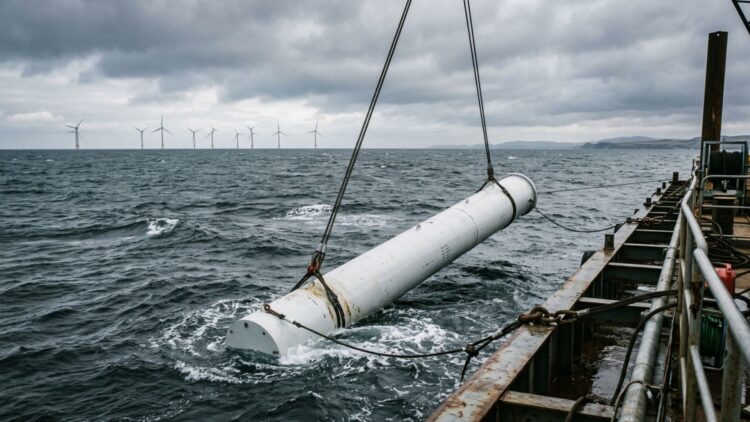
Off the north coast of Scotland, where the wind turbines never seem to stop turning, something strange happened a few years ago. A crew on a barge slowly lowered a long white cylinder, sealed tight as a submarine, down into the freezing grey water.
It was full of machines that were still switched on. Then they let it sink to the seabed and left it there.
To anyone watching from shore, it made no sense. Why would anyone drown a tube full of running electronics on purpose, then walk away for two years?
The wildest water they could find
The spot was no accident. The seas around the Orkney Islands are some of the roughest anywhere, with currents that race past at nine miles an hour and storm waves taller than a house.
Most engineers would steer well clear of water like that. This team went looking for it.
What pulled them north was the power. The local grid runs on 100 percent renewable energy, fed by the wind, the tides, and the waves, exactly the kind of clean electricity the experiment needed. If the idea could survive here, it could survive almost anywhere. The brutal sea was never the obstacle. It was the whole test.
Sealed, filled with nitrogen, and left in the dark
Before it went under, the cylinder was emptied of ordinary air and filled with dry nitrogen instead. No oxygen to rust the metal, no damp to corrode the wiring, and no people to knock anything loose inside.
Then it was sunk 117 feet to the seafloor and simply abandoned.
For two full years, nothing human touched it. Down in the cold and the dark, the machines inside hummed along on their own, watched only from a distance. The whole point was to learn what happens when you walk away and never open the lid.
On land, a datacenter is a pampered place, full of technicians swapping parts and cooling systems roaring day and night. This was the exact opposite, a sealed machine left in silence and trusted to survive entirely alone.
Two years passed, and the sea moved in
While the machines ran, the ocean went to work on the outside. A soft coat of algae and barnacles crept across the white steel.
In the sheltered nooks of its base, sea anemones swelled to the size of melons, and a sea urchin tucked itself in for the ride. Later, when the tube broke the surface again, a seabird landed on top as if it had always belonged there.
The cylinder had stopped being a machine in the water and become something closer to a small reef. But the real surprise was not on the outside. It was sealed deep within.
What they pulled back up rewired how we think about the cloud
When the crew finally raised it in 2020 and cracked it open, the verdict was startling. The cylinder was a Microsoft datacenter, 864 computer servers sunk to the bottom of the sea in a test called Project Natick.
Those servers had failed eight times less often than identical machines running in an ordinary datacenter on land, the World Economic Forum reported.
The still, cool, nitrogen filled calm had protected them better than any building could. No one had laid a finger on the hardware in two years, and that turned out to be the secret. With no oxygen to corrode the parts and no human hands to disturb them, the machinery simply lasted. The cold sea did the cooling for free, with no freshwater used at all, much the way offshore wind structures quietly turn into reefs instead of dead steel.
Why the future of AI might sit beside a wind farm
That result matters far more today than it did back then. The AI boom has turned datacenters into some of the hungriest machines on the planet, swallowing electricity and draining precious freshwater just to stay cool.
A datacenter resting offshore sidesteps both. The sea cools it for nothing, and since more than half the world lives near a coast, it sits close enough to serve those cities fast.
Better still, it could be plugged straight into an offshore wind farm, drawing clean power from the same water that keeps it cold. It is the same surprising overlap that lets a wind farm pull sea life toward it rather than drive it away. Two clean ideas, the turbine above and the servers below, sharing one cold patch of sea.
The honest part is that this is still early. Salt, crushing pressure, and the trouble of reaching a sealed tube on the seabed are all real, and no one is sinking the whole internet tomorrow.
But the machine the ocean tried to reclaim left a quiet hint behind. The cleanest place for some of our computers may not be on dry land at all, and the wind turning overhead may one day both power and cool the AI running below it at the very same time.