
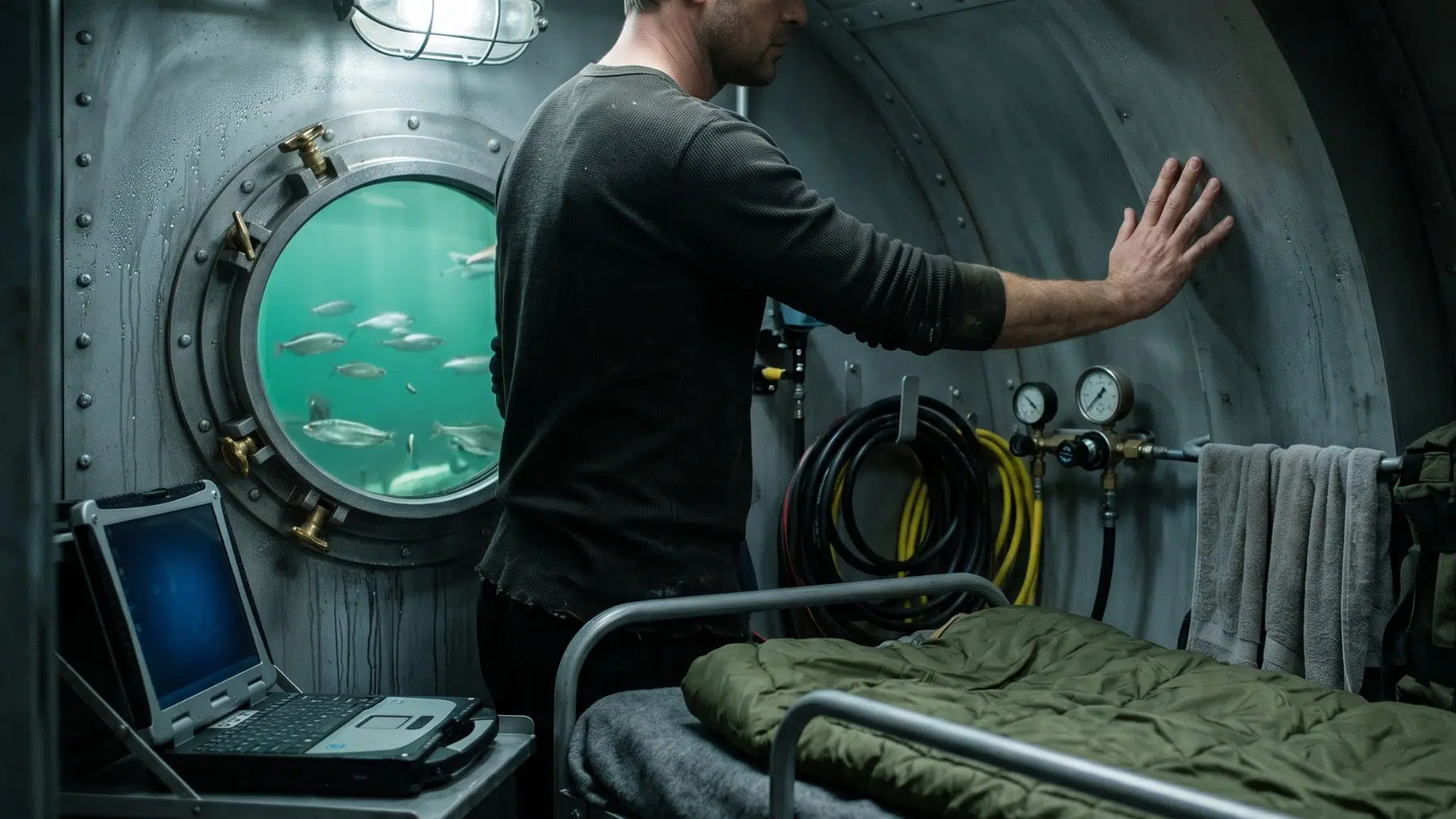
Twenty two feet under a Key Largo lagoon, a man wakes in a steel room the size of a hotel bathroom.
There is no hatch he can simply open and swim up through.
He has been down here for weeks, then months, breathing pressurized air.
His meals arrive in sealed containers, and his students meet him by video.
By the time he floats up, his own body will have changed shape.
So what does a hundred days underwater actually do to a person?
The body that came up shorter
The strangest result was waiting inside his own spine. After a hundred days at pressure, the man measured half an inch shorter than when he sealed himself in, a drop he could read straight off the tape. The constant squeeze had pressed the soft discs between his vertebrae flatter, the way a stack of sponges settles under a heavy load.
The sea had made him measurably smaller.
He did not stay that way. Once the pressure eased at the surface, his spine slowly drew itself back out, and the lost height returned within days. The change was real but temporary, more a dent than lasting damage.
That shrinking body became the headline, yet it was almost a footnote. He had gone under to test how a person holds up when the sea presses in around the clock, and his own height was merely the first thing anyone could measure.
A room the size of a hotel bathroom
Home for those hundred days was a cramped steel pod on the floor of a Florida lagoon. The whole living space ran to about a hundred square feet, less than many parking spaces, with a bunk, a tiny desk and a round porthole onto the murky water outside.
Cut off from the surface, he kept a strict routine. He worked out with resistance bands, ate protein packed meals sent down from above, and slept in the damp, still air of the capsule. Every day he also taught a university course by video, reaching more than 5,500 students in over a dozen countries who never guessed their instructor sat on the seabed.
The old record stood at seventy three days.
When he passed that mark and simply kept going, he pushed into unknown territory, for the record books and for his own physiology alike. Nobody had solid data on what came next.
Why the deep squeezes a spine
The shrinking trick starts with simple physics. Water is heavy, and every foot of depth stacks more of it overhead, so an underwater habitat sits under far higher pressure than a room on land. That extra load presses on everything inside, the person included.
The spine is unusually easy to squash. Between each pair of vertebrae sits a spongy disc that works like a cushion, and under steady pressure those cushions lose a little water and compress. Astronauts see the reverse in orbit, where the missing gravity lets the spine stretch and they briefly grow taller.
So the sea did the opposite of spaceflight.
Where zero gravity stretches a spine longer, constant pressure at depth packed his frame down, a plain reminder that the human body keeps adjusting to whatever forces happen to surround it.
The part that is not proven yet
Alongside the height loss came a string of far bolder claims. Early checks after the dive hinted at better sleep, lower cholesterol and reduced inflammation, and some reports even floated talk of reversed aging. Those numbers came from a single person over a short window, so they prove almost nothing on their own.
It is worth being blunt about the science here. None of the health findings have cleared peer review, and a study with one subject and no control group cannot separate the pressure from the diet, the exercise or plain chance. Researchers who track hidden variables, the same rigor behind an offshore wind forecast, would want many more people before believing any of it.
The man himself framed the trip as a starting point, not a verdict. As his university reported, he said the human body had never been underwater that long, and that the months down there had changed him in ways he was still working to understand.
What 100 days underwater is really for
Behind the stunt sits a serious question about living in the sea. If people are ever going to staff research stations or work sites on the ocean floor, someone has to learn what months at pressure do to the human body, from the spine to the sleep cycle. This long, messy dive was one first data point.
It also doubled as a very public classroom. Thousands of students followed a teacher who had turned his own body into the experiment, watching science unfold in real time rather than reading it later, a bit like a fox that settles in around some solar panels and makes strange ground its own.
The record itself is almost the least interesting part. Officials at the record body logged the longest stay, yet the man kept insisting the point was the human data, not the plaque on the wall.
For now, the clearest thing he brought back up was his own slightly shorter frame, already stretching back toward normal.
Read the whole thing?
Get the week's signal, not the noise
Our sharpest reporting on energy, climate and nature — free, once a week.


