

Mechanical engineers have developed a miniaturized wave energy harvester that utilizes an internal pendulum system.
It makes use of the mechanical energy in waves and converts it into electrical energy without the need for any resonance tuning.
Conventional wave energy harvesting systems have to be tuned to the frequency of the incoming waves for efficient energy harvesting.
The use of a freely swinging internal mass along with a specialized gear system and generator facilitates mechanical energy harvesting at varying wave frequencies.
Power generation was stabilized in the lab through a 28-inch system experiment.
Creating an internal pendulum wave energy harvester
Conventional wave energy systems have used complicated resonant tuning systems to achieve maximum energy generation from the ocean waves and currents.
The resonance system breaks down as soon as wave frequencies deviate from the set single frequency.
This was resolved by connecting an internal pendulum to a rotating shaft.
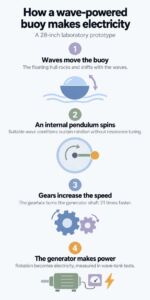
Wave action causes the internal pendulum to oscillate in a to-and-fro manner within the enclosed body.
The to-and-fro oscillation of the pendulum, in turn, works on the gear mechanism, which amplifies the speed of rotation and connects it to the electric generator.
This mechanical connection allows the production of kinetic energy.
Transmission of speed through small mechanical gears
The free oscillating pendulums in the floating buoys cause slow rotations that are unsuitable for generator action.
The engineers connected the pendulum axle of the main pendulum to the right-hand and left-hand gears in several stages.
Interlocking gears enhance slow revolutions into the faster revolutions needed to run small alternators.
Friction between the interlocking gears causes a small amount of loss of mechanical energy; however, optimized design of the gear teeth facilitates more efficient torque transmission.
The faster rotation turns the internal alternator and permanent magnet mechanism to generate electricity.
The efficiency of the mechanical energy is directly dependent on the decrease of friction within the system of the gear housing.
Increasing magnetic flux using Halbach arrays
There will be a weakening of the strength of the magnetic field due to the downscaling of the generator from an ordinary electrical generator.
Innovations incorporated an innovative Halbach magnet configuration in the body of the generator.
The Halbach magnets are capable of positioning the flux lines of the magnets in one side of the stator elements.
The clustering of the flux lines causes a 60 percent increase in flux density.
Increased flux density means an increased current flow in the copper coils with each rotation of the generator shaft.
Formation of the magnetic field is important in achieving high power density in small generators.
Testing laboratory-scale energy harvesters in a wave tank facility
Marine renewable energy concepts require accurate physical testing in a wave-making tank before deployment into natural water systems.
The harvesting buoy was positioned inside an indoor wave tank. Paddles were used to make waves that set the pendulum oscillating.
Energy output was tested in relation to different wave heights and wave cycles through various testing phases.
Electric efficiency of the wave harvester was found to be 17 percent in wave tank tests, just as had been expected through computer simulation, according to Nonlinear Dynamics.
The power generation process was unrelated to fluid mechanics for non-resonant pendulum wave energy harvesters during wave tank testing.
Scaling problems and obstacles in open water
While laboratory experiments can measure the mechanical effectiveness of small buoy experiments, the marine environment is much more complex.
The impacts of marine corrosion, biofouling, and rough weather will degrade the seals and the gear system in the long term.
A laboratory experiment will never be able to fully replicate the stormy conditions at sea for hull testing.
It is clear that laboratory tests test the mechanical effectiveness of the design, but not its durability.
To do so, it will be necessary to use more durable machines capable of withstanding harsh environments in open sea.
Hydrodynamic tests will continue to prove the effectiveness of pendulum energy harvesters to power ocean sensors off the coast.
Read the whole thing?
Get the week's signal, not the noise
Our sharpest reporting on energy, climate and nature — free, once a week.


