
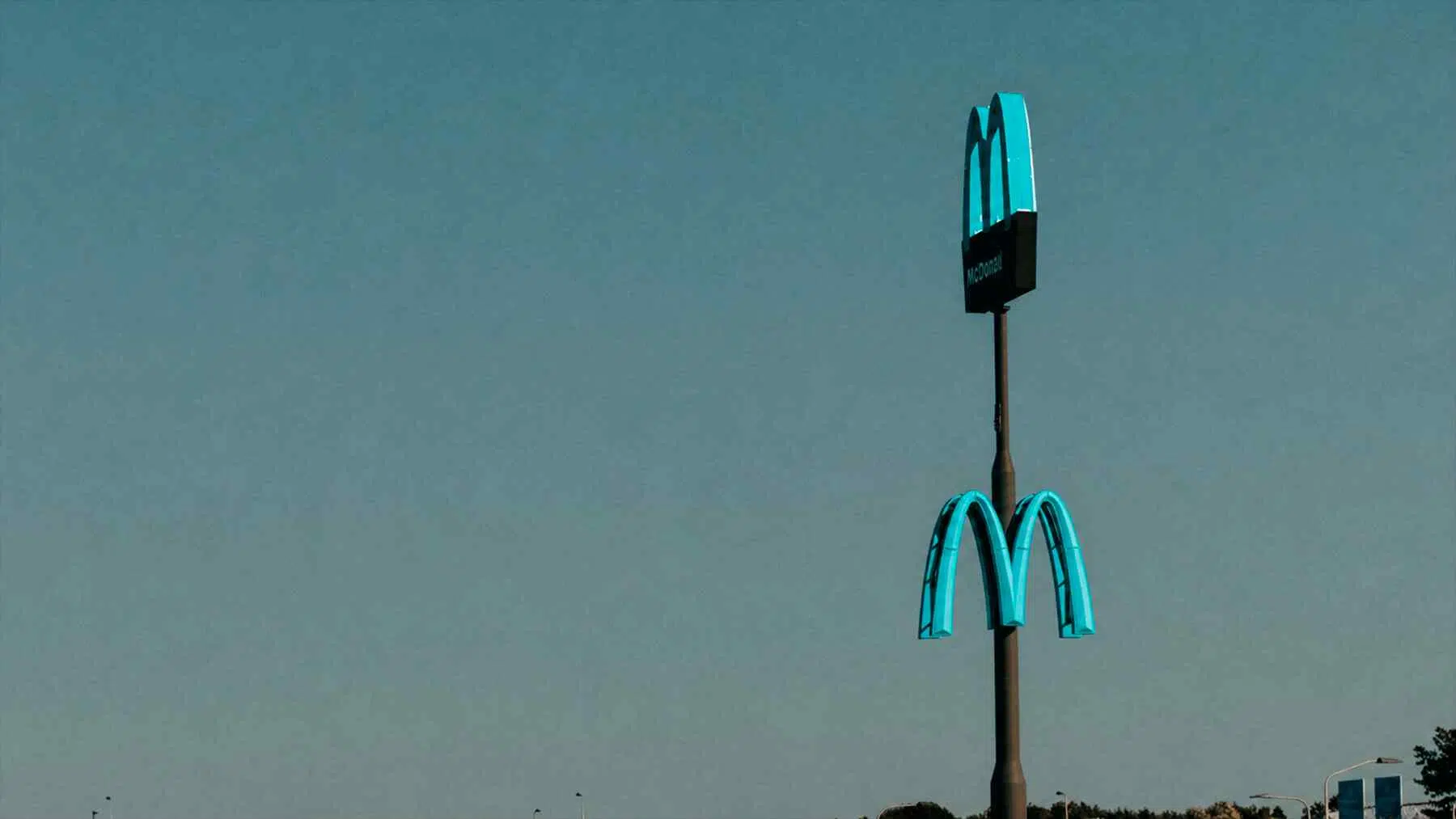
At first, it looks like a mistake.
You see the familiar shape from a distance—the arches, the building, the layout. Everything tells you it’s a McDonald’s.
But something feels off.
The color is wrong.
Instead of the iconic golden arches, they’re blue.
Bright, unmistakably blue.
And for years, people have asked the same question.
Why would one of the most recognizable brands in the world change something so fundamental?
How one location broke a global rule
McDonald’s is known for consistency.
From New York to Tokyo, the branding rarely changes. The golden arches are more than a logo—they’re a symbol recognized almost instantly, anywhere in the world.
So when drivers along a highway in Arizona spot a version that doesn’t follow that rule, it stands out immediately.
Tourists stop. Photos get taken.
And the assumption is usually the same.
It must be temporary.
A promotion. A redesign. Maybe even a mistake.
But it’s none of those.
Because this change was never about branding.
It was about location.
A town that refused to look like everywhere else
The story goes back to the early 1990s.
At the time, plans were underway to build a McDonald’s in Sedona, Arizona—a town known for its striking red rock landscapes and carefully preserved natural beauty.
Unlike most places, Sedona had strict regulations about how buildings could look.
Nothing was allowed to disrupt the visual harmony of the area.
Height. Materials. Colors.
Everything had to blend into the environment.
When the proposal for the McDonald’s came forward, officials saw a problem.
The golden arches.
Bright. Reflective. And impossible to ignore.
In a place defined by earthy tones and red sandstone, they would stand out immediately.
And that wasn’t acceptable.
The decision that changed the logo
Local authorities made their position clear.
If the restaurant was going to be built, it had to follow the town’s aesthetic guidelines.
That included changing the color of the arches.
Instead of gold, they wanted something softer. Something that wouldn’t clash with the surrounding landscape.
Something that would blend in.
Surprisingly, McDonald’s agreed.
The company replaced the iconic gold with a turquoise-blue tone and even adjusted the height of the sign to reduce its visual impact.
The goal was simple.
To make it less noticeable.
Where the blue McDonald’s actually is
The result can still be seen today. And it’s iconic.
At 2380 West US Highway 89A, in Sedona, Arizona, stands the only McDonald’s in the world with blue arches.
What was meant to make the restaurant blend in has had the opposite effect.
It became a landmark.
A curiosity. Immediately noticeable from a distance.
A place people go out of their way to visit—not for the food, but for the sign.
Because the difference is just enough to feel unusual.
Familiar, but not quite.
And it’s jarring.
Why this “minor” change still matters decades later
This isn’t just a story about a logo.
It’s about control. And deflection.
Sedona showed that even the largest global brands can be shaped by local rules.
That a town can decide how it wants to look—and enforce it.
And in doing so, it created something unique.
A version of a global symbol that exists nowhere else.
A small change that made it stand out even more
The irony is hard to miss.
The goal was to reduce attention.
To make the building disappear into its surroundings.
Instead, it became more visible than ever.
Because when something breaks a pattern people expect, it draws attention instantly.
And in this case, all it took was changing one color.
From gold… to blue.
Read the whole thing?
Get the week's signal, not the noise
Our sharpest reporting on energy, climate and nature — free, once a week.


