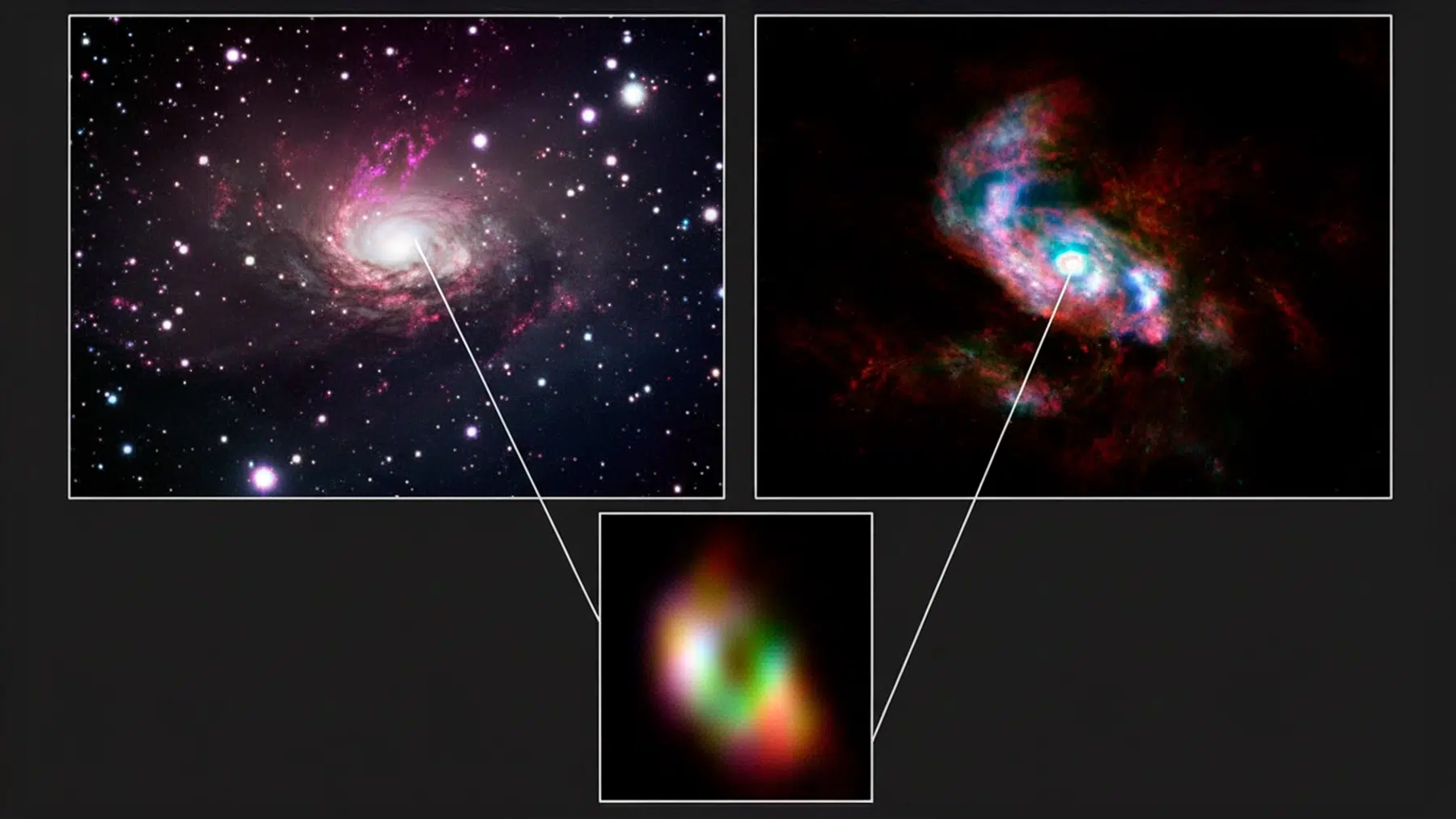
Some 13 million light-years away at the center of the Circinus Galaxy, an interesting find has been located. A supermassive black hole has been revealed, and it is swallowing up matter at an alarming rate. The visuals this has provided are spectacular.
A monster that swallows entire suns
Cold molecular gas is being fed into this black hole by cosmic tentacles. Anything that orbited around this black hole is being pulled in rapidly at speeds of up to 150,000 km/h. This includes enormous gas clouds and even suns; nothing seems to be safe from this black hole.
This discovery further proved how adept we have become at observing the distant universe while also bringing to the light the fact that we still know so very little about it all. It was always believed that black holes eat up matter slowly and over a long time. Not this one.
A galaxy is being consumed by a black hole, and not slowly
The Circinus Galaxy is a splendid sight, a vista of color and sparkling stars that is almost made brighter against the dark backdrop of the southern sky. But inside it, a flurry of chaos ensues as the tentacles we mentioned wrangle matter and feed the black hole. Gas is transported inside the black hole, and even solar masses 7.5 times larger than our own sun are not immune to this pull.
The black hole is growing because of all it is sucking inwards and rapidly. Everything around it, from stars to interstellar dust, is being affected by this dominance. It does take in gas, but scientists note that only 12% of this ends up inside the black hole. Most of it is spewed back out into space.
The black hole has a tight grip on this galactic environment
This discovery is significant because of what it means when it comes to our thinking around black holes, a phenomenon we are still learning more about every year, it would seem. The Circinus has shown us that supermassive black holes need not grow slowly and over many years; their growth can be rapid and rampant. Early models of black holes may have to be reexamined, as these could have also benefited from boosts in growth by gaseous tentacles much like this one.
This could provide us with another missing piece in the puzzle that is creation. The gas this black hole spews out could also give rise to new stars or even other black holes that will also consume and eject matter. Circinus is reshaping the space it occupies
What this black hole means for the future of cosmology
Astronomers are constantly peering into the void, discovering new occurrences and oddities, all in the hopes of better understanding the universe and our place in it. The plan is to look even deeper to learn even more. This black hole has shocked and surprised astronomers with what it is doing and how it is going about doing this.
It begs the questions, what other galactic monsters might be out there, and how those might differ from this one. How many suns might those swallow — 7.5 solar masses per feeding event is by no means a small number, especially if you consider that these are at times larger than our own sun, which is a massive entity. Even in a galaxy as beautiful as the Circinus, a monstrous entity could lurk, ready to devour insatiably.
Theories will be looked at again by scientists and astronomers alike, with certain perceptions either being thrown out completely or slightly walked back. All this will add to the study of our universe and the furthering of our knowledge of it.
Read the whole thing?
Get the week's signal, not the noise
Our sharpest reporting on energy, climate and nature — free, once a week.