

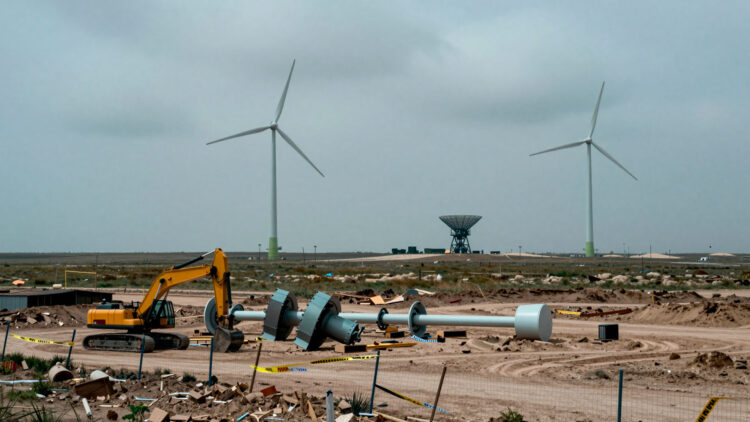
155 wind projects across Texas, Colorado, Washington, and other states are frozen — the Pentagon says turbines could interfere with military radars and complicate missile detection.
For nearly a year, hundreds of wind energy projects across the United States have been unable to break ground — not because of a new law or a court order, but because a federal permitting process has quietly stopped moving.
At least 155 projects across 24 states, representing 44 gigawatts of potential capacity, are effectively frozen. The Pentagon says the pause is necessary to address emerging drone threats near military radar systems. Wind developers say it’s costing them billions. Whether this is a legitimate national security response — or something else entirely — is the question hanging over the entire industry.
A permitting process that quietly ground to a halt
Building a wind project takes more than land and financing. You need Pentagon sign-off. Without it, no lender provides capital and no insurer covers the risk. That single chokepoint has become the mechanism for what amounts to a construction ban across much of the country.
For nearly a year, the Defense Department has held applications in limbo — no new approvals issued, no timeline announced for resuming the process. Unlike most federal policy shifts, this one arrived with no public notice, no comment period, and no formal explanation beyond internal legal filings.
The Pentagon’s position: this is a delay, not a rule change, and therefore requires none of the transparency that formal rulemaking would demand. “This case at core is one of agency inaction, i.e., delay, so there is no agency action for which to seek notice-and-comment rulemaking,” the department wrote in court filings. Critics find that framing convenient. A pause lasting a year, affecting 155 projects across 24 states, with no end date in sight, functions like a policy — whatever you call it.
How wind turbines and radar became a long-running tension
The conflict between wind farms and military radar isn’t new. Turbine blades create “blade flash” on radar screens — a signature that’s hard to distinguish from an aircraft. Steel tower bases also reflect electromagnetic waves, adding noise to radar images. For a military that depends on radar for threat detection and navigation, that interference is a genuine concern.
For more than a decade, the Pentagon managed this through a structured permitting program. Developers submitted proposals, addressed military objections, and sometimes paid to upgrade nearby radar systems — upgrades designed to filter out turbine signatures so operators could see through the clutter.
The new problem, according to the Pentagon, is small drones. One flying at low altitude through a wind farm could theoretically evade detection, and radar upgrades built to tune out turbines may actually make that worse. Detecting a slow-moving, low-profile drone requires finer resolution than existing upgrades were built to provide. That’s a technically coherent concern. Whether it justifies halting all new approvals for nearly a year is a separate question.
The financial and legal fallout for wind developers
The industry’s estimate of the damage so far: $2 billion in additional costs — carrying costs on stalled projects, broken agreements, and the compounding effects of missed deadlines.
One deadline looms particularly large. Under the One Big Beautiful Bill Act — the 2025 law that phased out several clean energy incentives — developers needed to begin construction by July 4 to qualify for federal tax credits already built into their financial models. Some projects may have already missed that window.
In May, a coalition of renewable energy companies filed suit against the Department of Defense, describing the pause as the most damaging tactic yet in an “unprecedented campaign” against the wind industry. “An unknown number of projects may never be able to move forward,” the lawsuit stated. The 44 gigawatts of onshore capacity affected is four times the generation capacity of the offshore projects canceled through federal buyouts.
Offshore wind’s parallel battle — and what it signals
The onshore freeze didn’t emerge in isolation. Over the past year, the Trump administration separately froze leases for five offshore wind projects, also citing radar interference. Federal judges reviewed the classified justification — and rejected the stop-work orders anyway.
After losing in court, the administration paid developers a combined $2.6 billion to cancel more than 11 gigawatts of offshore capacity. The government effectively paid to make those projects disappear. No onshore cancellations have been reported yet, but the potential reach is larger. Land-based wind represents the bulk of U.S. wind development, spanning private property across 24 states. When the same national security rationale is deployed against both offshore and onshore wind — and courts have already found it insufficient in one context — industry observers are drawing their own conclusions.
Insiders call for transparency — and question the motives
Dave Belote helped build the original Pentagon wind review process during the Obama administration. He describes the current freeze as unrecognizable. “Totally politically motivated,” he said flatly.
When Belote’s team created the permitting program, it followed standard federal procedure: public notices, comment periods, documented reasoning. None of that accompanied the current pause. “I’ve got clients all over the country who are just wondering what the heck is going on,” he said. His argument isn’t that drone threats are imaginary — it’s that a genuine security review should be visible, with public studies and documented progress.
Fifty-five Democratic representatives sent a letter to the Defense Department in May requesting even a confidential briefing. As of publication, no response has come. Pentagon lawyers, meanwhile, have been direct: “Whether national security interests must take a back seat when they inconvenience the development interests of the energy industry — the answer should doubtlessly be ‘no.'”
What comes next
The lawsuit filed by wind developers is working through the courts. Its outcome could force the Pentagon to either justify the freeze formally or resume approvals. Judges who reviewed classified material in the offshore cases weren’t persuaded — which may or may not predict how courts treat the onshore dispute.
Every month the freeze continues adds costs, missed deadlines, and projects edging toward the point of no return. Watch for whether the Pentagon responds to Congress, whether cancellations begin surfacing, and whether courts move quickly enough to matter. The wind industry has survived policy uncertainty before — but a freeze of this scope, with no stated end date and no clear legal resolution, is a different kind of test.
Disclaimer: Our coverage of events affecting companies or institutions is purely informative and descriptive. Under no circumstances does it seek to promote an opinion or create a trend, nor can it be taken as investment advice or a recommendation of any kind.